
Mechanical seals are essential components in centrifugal pumps and other rotating equipment. They help control fluid leakage where a rotating shaft passes through a stationary pump housing.
However, mechanical seals can fail prematurely when operating conditions, installation practices, or material specifications do not match the application's requirements.
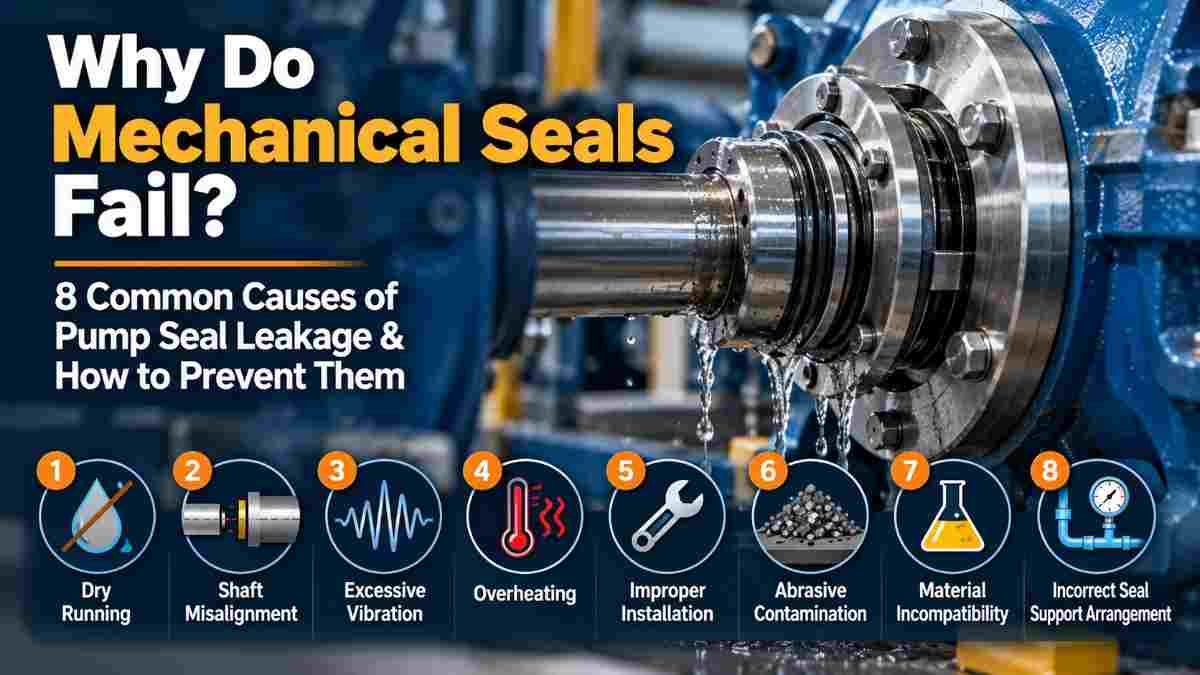
A leaking mechanical seal is not always caused by a defective seal. In many cases, the underlying problem involves dry running, shaft misalignment, excessive vibration, incorrect installation, inadequate cooling, contaminated process fluids, or incompatible materials.
The most common mechanical seal failure causes include dry running, misalignment, vibration, overheating, improper installation, abrasive contamination, material incompatibility, and incorrect seal support arrangements.
Replacing a failed seal without identifying the underlying cause can lead to repeated leakage, unplanned pump shutdowns, and unnecessary maintenance expenses.
This guide explains eight common causes of pump mechanical seal failure, how to identify their symptoms, and what maintenance teams can do to prevent recurring problems.
What Is a Mechanical Seal and How Does It Prevent Pump Leakage?
A mechanical seal is a sealing assembly installed between a rotating shaft and a stationary equipment housing.
Most conventional liquid-lubricated mechanical seals contain a rotating seal face, stationary seal face, secondary sealing elements, and a mechanism that maintains the required closing force.
The two seal faces operate with a very thin fluid film between their surfaces. This film helps lubricate and cool the faces while controlling leakage.
Mechanical seals are widely used in:
- Centrifugal pumps
- Chemical transfer pumps
- Water treatment equipment
- Oil and gas processing systems
- Pharmaceutical manufacturing
- Food processing equipment
- Industrial mixers and agitators
- Petrochemical plants
Different equipment and process conditions require different seal arrangements. Arohan Seals explains the available configurations in its guide to types of mechanical seals.
Understanding the seal design is the first step toward identifying why leakage occurs.
What Are the Most Common Causes of Mechanical Seal Failure?
Mechanical seal failure can result from a single problem or a combination of operating and installation conditions.
| Failure Cause | Common Symptoms | Preventive Action |
|---|---|---|
| Dry running | Overheated or cracked seal faces | Maintain adequate liquid supply and priming |
| Shaft misalignment | Uneven face wear and recurring leakage | Check shaft alignment and runout |
| Excessive vibration | Intermittent leakage and premature wear | Correct hydraulic and mechanical vibration sources |
| Overheating | Discoloration, hardening, thermal damage | Verify cooling, lubrication, and operating conditions |
| Improper installation | Leakage shortly after replacement | Follow correct installation and setting procedures |
| Abrasive contamination | Scored faces and accelerated wear | Control solids and use appropriate seal arrangements |
| Material incompatibility | Swollen elastomers, corrosion, chemical damage | Verify face and secondary seal materials |
| Incorrect seal support | Poor cooling, unstable pressure, leakage | Maintain the specified flush or barrier system |
These symptoms provide initial troubleshooting clues, but the final diagnosis should be based on inspection findings and equipment operating records.
1. Why Does Dry Running Cause Mechanical Seal Failure?
Dry running occurs when a liquid-lubricated mechanical seal operates without sufficient liquid at its sealing faces.
The thin liquid film normally helps reduce friction and carry heat away from the seal interface.
When adequate lubrication is lost, contact and frictional heating can rapidly damage the seal faces.
What Causes Dry Running in Industrial Pumps?
Common causes include:
- Starting a pump before priming it
- Low liquid level in the supply tank
- Blocked suction lines
- Air trapped inside the pump
- Loss of suction pressure
- Vapor formation near the seal
- Incorrect operating procedures
Some process changes can also cause the liquid film to become unstable even when the pump contains fluid.
How Can You Identify Dry-Running Damage?
Typical inspection findings may include:
- Cracked carbon seal faces
- Heat checking on hard mating faces
- Discoloration around seal components
- Hardened or damaged elastomers
- Rapid leakage following startup
These symptoms are not exclusive to dry running, so they should be reviewed together with operating conditions.
How Do You Prevent Mechanical Seals from Running Dry?
Maintain proper pump priming and ensure sufficient liquid is available before startup.
Depending on the equipment, operators may use appropriate low-level protection, suction-pressure monitoring, or automatic shutdown interlocks.
Confirm that the selected mechanical seal is suitable for the actual process conditions.
Do not assume that a standard liquid-lubricated seal can safely operate dry simply because its faces contain hard materials.
2. How Does Shaft Misalignment Damage a Mechanical Seal?
Shaft misalignment can increase vibration and mechanical loading in pump assemblies.
Mechanical seals are designed to accommodate limited shaft movement within their specified operating limits.
Excessive shaft movement, runout, or related equipment misalignment can disrupt the sealing interface and accelerate wear.
What Are the Signs of Mechanical Seal Misalignment?
Possible indicators include:
- Uneven wear patterns on sealing faces
- Repeated leakage after seal replacement
- Excessive shaft or housing vibration
- Abnormal bearing temperatures
- Damage concentrated on one side of a component
Misalignment should be distinguished from shaft runout, seal-chamber eccentricity, and shaft deflection because each can require a different corrective action.
How Can You Correct Shaft Alignment Problems?
Maintenance teams should inspect pump and motor alignment, bearing condition, shaft runout, and other equipment-specific tolerances.
Use suitable precision alignment tools and follow the pump manufacturer's specifications.
Correcting the root mechanical problem is more effective than repeatedly installing new seals into an unstable rotating assembly.
3. Why Does Excessive Pump Vibration Cause Seal Leakage?
Excessive vibration can disturb the seal faces, increase dynamic loading, and accelerate wear of mechanical seal components.
Vibration may originate from the pump, motor, bearings, coupling, foundation, or hydraulic operating conditions.
What Causes Excessive Vibration in Centrifugal Pumps?
Common sources include:
- Worn or damaged bearings
- Impeller imbalance
- Shaft misalignment
- Cavitation
- Loose foundations or mounting bolts
- Operation far from the pump's preferred operating range
- Mechanical looseness
- Pipe strain
How Can Pump Vibration Be Reduced?
Inspect the rotating assembly and identify whether the vibration originates from a mechanical, hydraulic, or structural issue.
Possible corrective actions include bearing replacement, alignment correction, impeller inspection, foundation repair, or adjustments to operating conditions.
Vibration measurements should be assessed against equipment-specific requirements.
Installing a stronger seal without correcting excessive vibration may not resolve repeated leakage.
4. How Does Overheating Affect Mechanical Seal Performance?
Mechanical seal faces generate heat due to friction and fluid-film shearing during operation.
This heat must be controlled through appropriate lubrication, circulation, cooling, or seal-support arrangements.
When the operating temperature exceeds the limits of the seal components, the assembly may suffer premature damage.
What Causes Mechanical Seal Overheating?
Possible causes include:
- Insufficient lubrication
- Loss of seal flush flow
- Operating outside specified pressure limits
- Excessive closing force
- High process fluid temperature
- Vaporization at the seal faces
- Incorrect material selection
- Blocked cooling passages
What Are the Symptoms of an Overheated Mechanical Seal?
Inspection findings may include discoloration, hardening of secondary seals, face cracking, abnormal deposits, and accelerated wear.
However, visual appearance alone may not identify the exact source of overheating.
How Can You Prevent Seal Overheating?
Verify process temperature, seal-chamber conditions, flush arrangements, and the operating limits specified by the seal manufacturer.
Confirm that the seal faces and elastomers are compatible with the process temperature and fluid.
For demanding applications, a balanced mechanical seal or an engineered support arrangement may be appropriate.
Arohan Seals offers multi-spring mechanical seals in different configurations for industrial applications, subject to the required operating specifications.
5. Can Incorrect Installation Cause a Mechanical Seal to Leak?
Yes. Improper installation is a common cause of leakage, particularly when a seal begins leaking immediately or shortly after replacement.
Mechanical seal components require correct positioning, compression, alignment, and handling.
What Are Common Mechanical Seal Installation Mistakes?
- Incorrect installation length or compression
- Damaging an O-ring during assembly
- Contaminating the seal faces
- Installing components in the wrong orientation
- Uneven tightening of gland bolts
- Incorrect shaft sleeve positioning
- Failing to follow the manufacturer's installation drawing
- Incorrect handling of cartridge seal setting devices
Some mistakes can cause immediate leakage, while others gradually reduce operating life.
How Can Installation Errors Be Prevented?
Follow the manufacturer's installation instructions, inspect all mating surfaces, and confirm the correct seal dimensions before assembly.
Use compatible assembly lubricants only where permitted, and protect secondary seals from sharp edges.
Installation and commissioning should be performed by trained personnel.
Can Cartridge Mechanical Seals Reduce Installation Errors?
Cartridge seals are supplied as preassembled units with the principal sealing components arranged within one assembly.
Their preset configuration can reduce certain installation measurements and assembly errors compared with component-style seals.
However, cartridge seals still require correct mounting, shaft or sleeve preparation, connection of support systems, and removal or release of setting devices according to the manufacturer's procedure.
For applications where easier replacement is important, buyers can explore Arohan Seals' cartridge mechanical seal range.
6. How Do Abrasive Particles Cause Mechanical Seal Failure?
Abrasive particles can enter the seal interface and damage the rotating and stationary faces.
Process fluids containing sand, sludge, mineral particles, crystallized deposits, or other solids may accelerate wear.
Particles can also accumulate around springs or other moving components, restricting their ability to operate correctly.
Which Industries Commonly Experience Abrasive Seal Wear?
Abrasive seal wear can occur in:
- Wastewater treatment
- Mining and mineral processing
- Slurry handling
- Pulp and paper processing
- Chemical processing
- Industrial solids-handling systems
What Does Abrasive Seal Damage Look Like?
Possible inspection findings include:
- Grooves or scratches on seal faces
- Uneven wear tracks
- Particles trapped within seal components
- Clogged spring cavities
- Accelerated wear of secondary components
How Can You Prevent Abrasive Mechanical Seal Failure?
Select seal faces and secondary components suited to the process fluid, particle characteristics, operating speed, and pressure.
Depending on the application, suitable arrangements may include engineered flush systems, solids-handling seal designs, or appropriate hard-face combinations.
It is also important to evaluate the risk of spring clogging in viscous or solids-containing service.
Arohan Seals discusses these considerations in its article on single-spring balanced seals for viscous and clogging industrial fluids.
7. Why Does Incorrect Seal Material Selection Cause Failure?
Mechanical seals contain several materials that must remain compatible with the process fluid and operating conditions.
These may include:
- Carbon graphite
- Silicon carbide
- Tungsten carbide
- Ceramic materials
- Stainless steel components
- Elastomeric O-rings
- PTFE-based components
A material suitable for clean water may not perform adequately when exposed to an aggressive solvent, corrosive chemical, abrasive slurry, or elevated temperature.
What Happens When an O-Ring Is Chemically Incompatible?
An incompatible elastomer may swell, soften, harden, crack, or lose its sealing properties.
This can create a leakage path that bypasses the main mechanical seal faces.
Common secondary seal materials include NBR, EPDM, FKM, and PTFE, but none is suitable for every fluid.
How Do You Choose the Right Mechanical Seal Face Material?
Face selection should consider:
- Process fluid chemistry
- Abrasive particle content
- Operating temperature
- Pressure
- Shaft speed
- Lubrication characteristics
- Thermal shock
- Chemical compatibility of the complete material grade
Silicon carbide may offer excellent hardness and chemical resistance, while tungsten carbide can be useful for selected high-load and abrasive applications.
However, tungsten carbide performance depends partly on binder composition, and silicon carbide can have limitations related to brittleness or particular chemicals.
Always verify the exact face pairing and material specifications with the seal manufacturer.
8. How Can Incorrect Seal Flush or Barrier Fluid Arrangements Cause Leakage?
Mechanical seals used in demanding industrial applications may require supporting systems to control temperature, lubrication, fluid cleanliness, or containment.
These systems may include flush lines, cooling arrangements, quench connections, and buffer or barrier fluid systems.
Incorrect pressure, flow, temperature, fluid compatibility, or piping configuration can contribute to premature seal failure.
What Happens When Seal Flush Flow Is Insufficient?
Insufficient flush flow can result in inadequate heat removal or allow process deposits and solids to accumulate around the seal faces.
This may lead to higher operating temperatures, accelerated wear, or unstable sealing conditions.
Can Excessive Flush Pressure Cause Leakage?
Improper differential pressure can affect seal operation, particularly in systems with specialized sealing arrangements.
However, the exact effect depends on the seal configuration and support plan.
Excessive or insufficient pressure must be evaluated against the manufacturer's specified operating range.
Why Are Barrier and Buffer Fluids Important for Double Seals?
Some double mechanical seal arrangements use a buffer or barrier fluid between the sealing interfaces.
These fluids may provide lubrication, cooling, or additional containment depending on the seal arrangement.
The required pressure relationship depends on the particular design and seal-support plan.
Incorrect fluid levels or pressure conditions can affect sealing performance and may create contamination or leakage risks.
Maintenance teams should follow the applicable seal-support system instructions rather than using one generic pressure setting for every installation.
How Can You Identify Mechanical Seal Failure Symptoms?
Mechanical seal damage may produce recognizable symptoms, but similar symptoms can result from different root causes.
| Observed Symptom | Possible Cause | Recommended Check |
|---|---|---|
| Leakage immediately after installation | Installation error or damaged secondary seal | Verify setting dimensions, faces, and O-rings |
| Leakage after dry startup | Loss of face lubrication | Review priming and seal face condition |
| Recurring leakage with high vibration | Shaft movement, bearings, or hydraulic problems | Inspect vibration and rotating assembly |
| Scratched seal faces | Contamination or abrasive wear | Check process fluid cleanliness |
| Swollen elastomers | Chemical incompatibility | Review elastomer material compatibility |
| Cracked or heat-damaged faces | Overheating or unstable lubrication | Inspect fluid film, cooling, and operation |
| Leakage after process changes | Pressure, temperature, or chemical changes | Compare current conditions with seal specifications |
Use inspection evidence and operating records together before deciding on the corrective action.
How Do You Troubleshoot a Leaking Mechanical Seal Step by Step?
When a mechanical seal starts leaking, the most effective approach is to investigate the complete pump system rather than assume the seal itself is defective.
Step 1: How Do You Make the Pump Safe for Inspection?
Follow the facility's approved shutdown, isolation, lockout/tagout, depressurization, draining, and decontamination procedures.
Do not loosen a seal gland or dismantle pressurized equipment.
Hazardous or hot process fluids require additional precautions defined by the plant's safety procedures.
Step 2: What Operating Conditions Should You Record?
Record the relevant operating conditions before disassembly where it is safe to obtain them.
- Pump speed
- Discharge and suction pressures
- Process temperature
- Process fluid composition
- Seal chamber pressure
- Vibration readings
- Flush or barrier fluid conditions
- Time of failure
- Recent maintenance or process changes
This information may reveal whether the failure followed dry startup, overheating, increased solids content, or other changes.
Step 3: How Should You Inspect the Failed Seal?
After safe isolation and disassembly, inspect the rotating and stationary faces, O-rings, springs, shaft sleeve, and gland components.
Look for evidence of:
- Uneven wear
- Face cracking
- Corrosion
- Heat damage
- Particle contamination
- Spring binding
- Secondary seal damage
Photograph and document important findings before cleaning or replacing damaged components.
Step 4: How Do You Confirm the Root Cause?
Compare the inspection findings with pump operating records and the seal's specified limits.
For example, repeated face cracking after pump startup may justify investigating inadequate lubrication or thermal shock.
Repeated uneven wear together with elevated vibration may indicate a broader mechanical or hydraulic problem.
Where the cause is uncertain, involve the equipment or seal manufacturer in the investigation.
Step 5: Should You Replace the Seal Immediately?
A damaged seal may need replacement, but replacing it before correcting the cause can result in another failure.
Resolve issues such as misalignment, contamination, abnormal temperature, or improper flush conditions before recommissioning the pump.
How Can You Prevent Repeated Mechanical Seal Failures?
Preventing repeated failures requires a combination of appropriate seal selection, correct installation, stable operating conditions, and preventive maintenance.
Recommended practices include:
- Confirm that the seal suits the process fluid.
- Maintain proper priming and lubrication.
- Monitor pump vibration and bearing condition.
- Verify shaft alignment and runout.
- Inspect seal flush and cooling systems.
- Use compatible face and elastomer materials.
- Follow approved installation procedures.
- Maintain accurate equipment operating records.
- Investigate recurring failures instead of repeatedly replacing components.
For selected applications, changing the seal configuration may improve reliability, but such changes should be based on engineering requirements rather than assumptions.
When Should You Replace a Mechanical Seal Instead of Repairing It?
A mechanical seal may require replacement when components are too damaged or worn to meet the manufacturer's acceptance criteria.
Replacement may be necessary when:
- Seal faces are cracked or severely scored
- Secondary seals are chemically damaged
- Metal components are excessively corroded
- Critical dimensions are outside tolerance
- Suitable replacement parts are unavailable
- Repair is not economically justified
Some industrial mechanical seals can be reconditioned by qualified specialists, depending on their design and condition.
However, repairs should not be performed without appropriate technical inspection and dimensional verification.
Which Mechanical Seal Is Best for Preventing Pump Leakage?
There is no single mechanical seal suitable for all industrial pumps.
Selection should be based on the actual operating conditions.
| Application Requirement | Seal Option Worth Evaluating |
|---|---|
| General-purpose liquid pumps | Suitable single-spring mechanical seal |
| Higher pressure or demanding operating conditions | Appropriately rated balanced seal |
| Reduced installation complexity | Cartridge mechanical seal |
| Viscous or solids-containing process fluid | Application-specific solids-handling seal |
| Hazardous process fluid requiring additional containment | Suitable dual-seal arrangement with support system |
| Specialized rotating equipment | Custom-engineered seal configuration |
Arohan Seals provides single-spring mechanical seals, multi-spring designs, and cartridge configurations for different industrial requirements.
Before selecting a replacement, confirm the shaft diameter, seal chamber dimensions, process fluid, pressure, temperature, rotational speed, and operating conditions.
What Information Should You Provide When Ordering a Replacement Mechanical Seal?
Accurate specifications help manufacturers recommend a compatible replacement sealing solution.
Important information includes:
- Pump manufacturer and model
- Existing mechanical seal model, if known
- Shaft diameter
- Seal chamber dimensions
- Process fluid
- Operating and maximum pressure
- Operating temperature
- Shaft speed
- Available flush or barrier arrangements
- Preferred face materials, if specified
- Existing failure symptoms
- Quantity and application requirements
Providing photographs of the existing seal and an equipment drawing may also help the supplier evaluate dimensions and configuration.
Frequently Asked Questions About Mechanical Seal Failure
What Is the Most Common Cause of Mechanical Seal Failure?
Common causes include dry running, overheating, incorrect installation, vibration, misalignment, contamination, and unsuitable materials. The dominant failure mechanism varies by equipment and service conditions.
Why Does My Pump Mechanical Seal Keep Leaking?
Repeated leakage often indicates that an underlying operating or installation problem remains unresolved. Inspect the pump's alignment, vibration, seal chamber conditions, fluid properties, and seal-support system.
Can a Mechanical Seal Fail Without Visible Damage?
Yes. Leakage may occur through damaged secondary sealing elements, incorrect installation, pressure conditions, or other problems that are not immediately obvious from a visual inspection.
Can Dry Running Destroy a Mechanical Seal?
Yes. In a conventional liquid-lubricated seal, inadequate fluid at the faces can cause rapid frictional heating and damage. Always follow the seal manufacturer's operating requirements.
Does Shaft Misalignment Cause Mechanical Seal Leakage?
Misalignment and related shaft movement can contribute to vibration, uneven loading, accelerated wear, and leakage. The complete rotating assembly should be assessed.
How Long Should an Industrial Mechanical Seal Last?
There is no universal mechanical seal lifespan. Service life depends on seal design, fluid properties, equipment condition, pressure, temperature, installation, and maintenance practices.
Can Mechanical Seals Be Repaired?
Some designs can be repaired or reconditioned by qualified specialists. Severely damaged or unsuitable components may require replacement.
Are Cartridge Mechanical Seals Better Than Conventional Seals?
Cartridge seals can simplify installation and reduce certain assembly errors, but they are not automatically superior for every application. Performance depends on correct selection, installation, and operating conditions.
Does a Mechanical Seal Provide Zero Leakage?
Conventional mechanical seals generally operate with a microscopic fluid film, so absolute zero leakage should not be assumed. Acceptable leakage depends on the seal design, fluid, application, and relevant requirements.
What Is the Best Way to Prevent Mechanical Seal Failure?
Use a correctly specified seal, maintain adequate lubrication and cooling, control vibration and contamination, follow installation instructions, and investigate failure causes before replacing components.
How Can the Right Mechanical Seal Reduce Pump Failure and Downtime?
Mechanical seal failure is often a symptom of a wider equipment or operating problem.
Dry running, misalignment, excessive vibration, overheating, poor installation, abrasive contamination, material incompatibility, and inadequate seal support can all contribute to premature leakage.
Identifying the actual cause helps maintenance teams take corrective action and reduce the likelihood of repeated failures.
Arohan Seals manufactures mechanical sealing solutions for pumps, agitators, mixers, and other industrial rotating equipment, including single-spring, multi-spring, and cartridge mechanical seals.
For replacement selection or an application-specific enquiry, explore Arohan Seals' cartridge mechanical seals and other product categories to identify a suitable sealing arrangement based on your equipment specifications.