
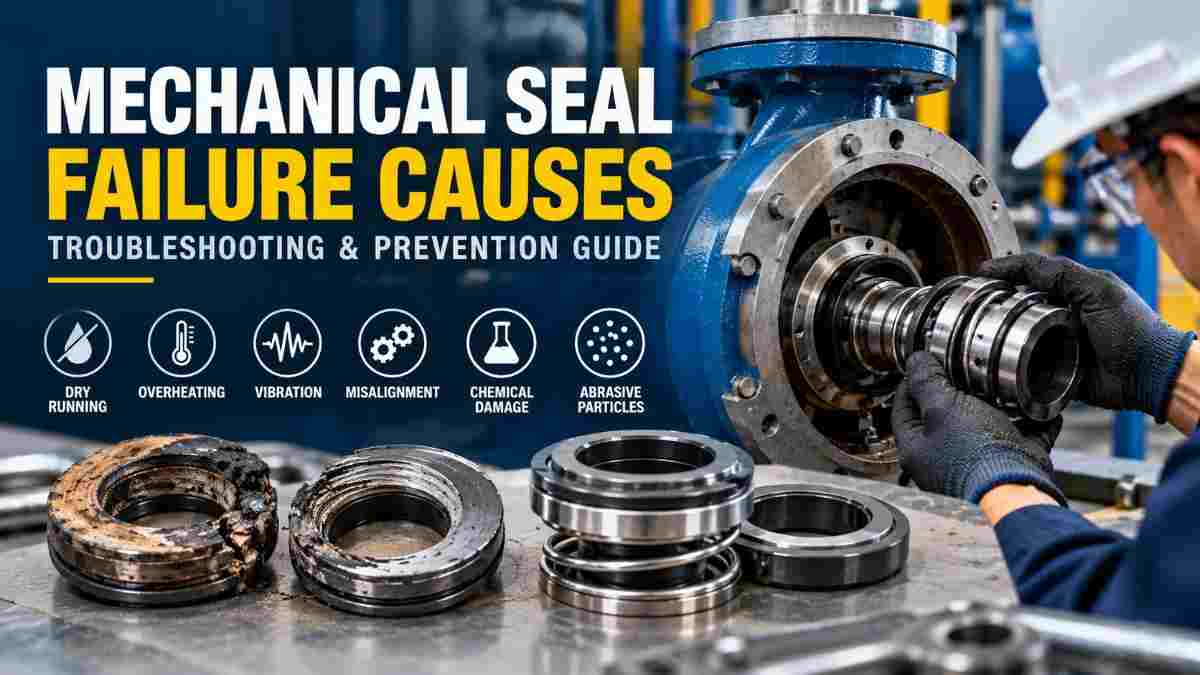
Are you dealing with repeated mechanical seal leakage, unexpected pump shutdowns, or frequent seal replacements? Mechanical seal failure is a common maintenance challenge in industrial pumping systems, particularly when equipment operates under demanding pressure, temperature, or fluid conditions.
The most common mechanical seal failure causes include dry running, insufficient lubrication, overheating, shaft misalignment, excessive vibration, improper installation, abrasive contamination, and incompatible seal materials. These conditions can damage the sealing faces, secondary seals, springs, and other components, leading to leakage or premature failure.
Mechanical seal problems can affect operational reliability, increase maintenance costs, and cause unplanned downtime in chemical processing, wastewater treatment, pharmaceutical manufacturing, oil and gas, and other industries.
Arohan Seals manufactures and supplies industrial mechanical seals, including single-spring, multi-spring, bellows, cartridge, and agitator seal configurations.
This guide explains the main causes of mechanical seal failure, how to identify common symptoms, what maintenance teams should inspect, and how to reduce the risk of repeated seal problems.
What Are the Most Common Causes of Mechanical Seal Failure?
The most common causes of mechanical seal failure are inadequate lubrication, dry running, excessive temperature, shaft or bearing problems, contamination, incorrect material selection, and installation errors. These problems can damage the seal faces or prevent the seal from operating under its intended conditions.
Common failure causes include:
-
Dry running: Insufficient liquid film between the sealing faces.
-
Overheating: Excessive friction or inadequate heat removal.
-
Misalignment: Incorrect alignment of the rotating shaft or sealing components.
-
Excessive vibration: Movement caused by equipment or operating problems.
-
Chemical incompatibility: Process fluids attacking seal faces, elastomers, or metallic components.
-
Abrasive particles: Solids wearing or damaging sealing surfaces.
-
Incorrect installation: Improper assembly, incorrect setting length, or component damage.
-
Pressure fluctuations: Operating conditions outside the seal's intended limits.
-
Cavitation: Vapor bubble formation and collapse contributing to vibration and unstable pump operation.
-
Normal wear: Progressive deterioration after extended service.
The same leakage symptom may have multiple possible causes. Identifying the actual failure mechanism is essential before selecting a replacement seal.
How Does Dry Running Cause Mechanical Seal Failure?
Dry running causes mechanical seal failure when the lubricating fluid film between the seal faces becomes insufficient or disappears, allowing excessive friction and heat to damage the sealing surfaces.
Mechanical seals typically rely on a very thin fluid film to lubricate and cool the contacting faces during operation.
When this film is lost, frictional heat can increase rapidly.
Potential causes include:
-
Starting a pump without adequate priming.
-
Air trapped inside the seal chamber.
-
Insufficient fluid supply.
-
Interrupted flushing or circulation.
-
Localized vaporization of the process fluid.
-
Incorrect seal installation.
-
Operating conditions unsuitable for the selected seal.
What Are the Warning Signs of Dry Running?
Common warning signs of dry running include abnormal seal temperature, unusual noise, increased leakage, discoloration, and visible seal-face damage.
Inspection may reveal:
-
Heat-affected seal faces.
-
Cracks or thermal damage.
-
Damaged elastomers.
-
Excessive face wear.
-
Carbon deposits.
-
Changes in sealing performance.
These symptoms are not exclusive to dry running and should be evaluated alongside operating records.
How Can You Prevent Mechanical Seal Dry Running?
Prevent dry running by following approved pump startup procedures, maintaining adequate liquid supply, removing trapped air, and verifying that the specified seal support system operates correctly.
Recommended practices include:
-
Prime the pump according to the manufacturer's instructions.
-
Vent trapped air where required.
-
Confirm adequate suction conditions.
-
Verify seal chamber liquid supply.
-
Check flushing arrangements.
-
Avoid operation outside approved process limits.
-
Inspect relevant monitoring instruments.
-
Follow the seal manufacturer's startup procedure.
Some mechanical seal designs are intended for specialized dry-running service, but conventional lubricated seals should not be assumed to tolerate it.
Why Does Overheating Damage Mechanical Seals?
Overheating damages mechanical seals because excessive temperature can distort sealing faces, degrade elastomers, affect secondary sealing components, and accelerate wear.
Seal overheating may result from friction, poor lubrication, high process temperature, insufficient cooling, or unstable operating conditions.
Potential indicators include:
-
Increased seal chamber temperature.
-
Discolored components.
-
Hardened elastomers.
-
Thermal cracking.
-
Unusual leakage.
-
Deposits on sealing surfaces.
How Can You Reduce Mechanical Seal Overheating?
Reduce overheating by maintaining the required lubrication, cooling, flushing, and operating conditions for the selected mechanical seal.
Maintenance teams should:
-
Verify seal support system operation.
-
Monitor process temperature.
-
Check flushing and cooling circuits.
-
Inspect for blocked lines.
-
Confirm suitable seal face materials.
-
Check pump operating conditions.
-
Investigate abnormal friction or vibration.
The correct solution depends on the actual cause of overheating.
How Does Shaft Misalignment Affect Mechanical Seal Performance?
Shaft misalignment can affect mechanical seal performance by creating uneven loading, increased vibration, and unfavorable movement at the sealing interface.
Mechanical seals are designed to operate within specified shaft movement and alignment limits.
When equipment exceeds these limits, seal components may experience accelerated wear or unstable operation.
Potential causes include:
-
Incorrect pump and motor alignment.
-
Distorted equipment foundations.
-
Worn bearings.
-
Shaft deflection.
-
Incorrect assembly.
-
Excessive shaft runout.
-
Thermal growth not accounted for during alignment.
What Are the Symptoms of Mechanical Seal Misalignment?
Possible symptoms include uneven face wear, repeated leakage, increased vibration, bearing problems, and premature seal damage.
Inspect:
-
Shaft alignment records.
-
Bearing condition.
-
Shaft runout.
-
Coupling condition.
-
Equipment mounting.
-
Seal chamber alignment.
A trained maintenance professional should assess the complete rotating equipment assembly.
How Can You Prevent Misalignment-Related Seal Failure?
Prevent misalignment-related seal failure by maintaining pump and motor alignment, checking shaft movement, inspecting bearings, and following the equipment manufacturer's installation tolerances.
Avoid adjusting the mechanical seal as a substitute for correcting an underlying equipment alignment problem.
Why Does Excessive Vibration Cause Mechanical Seal Leakage?
Excessive vibration can cause mechanical seal leakage by disturbing stable face contact, increasing dynamic loads, and accelerating wear of seal components.
Possible vibration sources include:
-
Worn bearings.
-
Rotor imbalance.
-
Misalignment.
-
Cavitation.
-
Pipe strain.
-
Loose mounting components.
-
Operation away from the pump's suitable operating range.
When vibration exceeds acceptable limits, the seal may experience unstable movement and additional mechanical stress.
How Can You Reduce Vibration-Related Seal Failure?
Reduce vibration-related seal failure by identifying and correcting the underlying pump or piping problem rather than replacing the seal alone.
Maintenance checks may include:
-
Measuring equipment vibration.
-
Checking bearing condition.
-
Verifying coupling alignment.
-
Reviewing pump operating conditions.
-
Inspecting mounting bolts.
-
Investigating cavitation.
-
Evaluating pipe strain.
Any corrective action should follow the pump manufacturer's maintenance procedures and applicable safety requirements.
How Does Cavitation Contribute to Mechanical Seal Failure?
Cavitation can contribute to mechanical seal failure by creating unstable hydraulic conditions, vibration, and pressure fluctuations that affect pump operation and sealing performance.
Cavitation occurs when vapor bubbles form in a liquid and subsequently collapse as pressure changes.
Potential contributing conditions include:
-
Inadequate suction pressure.
-
Excessive suction-line restrictions.
-
Elevated liquid temperature.
-
Incorrect pump operating conditions.
-
Air or vapor-related process problems.
Common symptoms may include unusual noise, vibration, reduced pump performance, and recurring sealing problems.
How Can You Prevent Cavitation-Related Seal Problems?
Prevent cavitation-related problems by ensuring the pump operates within its intended hydraulic conditions and has adequate available net positive suction head.
Maintenance and engineering teams should evaluate:
-
Suction system design.
-
Available NPSH.
-
Pump operating point.
-
Liquid temperature.
-
Suction piping restrictions.
-
Fluid vapor pressure.
-
Air ingress.
-
Pump performance records.
Correcting cavitation often requires reviewing the pumping system rather than changing the seal alone.
How Does Chemical Incompatibility Cause Mechanical Seal Failure?
Chemical incompatibility causes mechanical seal failure when process fluids react adversely with sealing materials, causing swelling, corrosion, softening, hardening, cracking, or other deterioration.
A mechanical seal contains several materials that must be compatible with the operating environment.
These may include:
-
Primary seal faces.
-
Secondary elastomer seals.
-
Metallic springs.
-
Sleeves.
-
Retainers.
-
Gaskets.
Material performance depends on fluid chemistry, temperature, concentration, pressure, and exposure conditions.
How Do Incompatible Elastomers Affect Mechanical Seals?
Incompatible elastomers can swell, lose flexibility, harden, crack, or deteriorate when exposed to unsuitable fluids or temperatures.
Common secondary seal materials include:
-
FKM.
-
EPDM.
-
NBR.
-
PTFE-based components.
These materials have different chemical and temperature limitations.
No single elastomer is suitable for every industrial fluid.
How Can You Prevent Chemical Damage to Mechanical Seals?
Prevent chemical-related failure by selecting seal face materials, elastomers, and metallic components that are compatible with the actual process fluid and operating conditions.
Before selecting materials, confirm:
-
Fluid composition.
-
Chemical concentration.
-
Operating temperature.
-
Design pressure.
-
Contaminants.
-
Cleaning chemicals.
-
Expected operating cycles.
Material compatibility should be verified using reliable technical data and manufacturer recommendations.
How Do Abrasive Particles Damage Mechanical Seal Faces?
Abrasive particles can damage mechanical seal faces by entering the sealing interface and causing scratching, accelerated wear, or disruption of the lubricating film.
Abrasive media may include:
-
Sand.
-
Slurry particles.
-
Crystallized chemicals.
-
Process solids.
-
Corrosion products.
-
Other suspended contaminants.
The severity of damage depends on particle characteristics, seal design, material selection, and operating conditions.
Which Seal Face Materials Are Used for Abrasive Applications?
Silicon carbide and tungsten carbide are commonly considered for certain abrasive sealing applications because they offer high hardness and wear resistance.
However, material selection must also consider chemical compatibility, lubrication, thermal behavior, and the complete seal design.
Hard-face material combinations are not automatically suitable for every slurry or process fluid.
Arohan Seals offers Silicon Carbide Seal Faces for industrial sealing applications.
How Can You Reduce Abrasive Seal Face Wear?
Reduce abrasive wear by selecting suitable seal face materials, controlling contamination where practical, and using an appropriate seal arrangement or support system.
Potential measures include:
-
Reviewing the fluid's solids content.
-
Selecting compatible face materials.
-
Checking flushing requirements.
-
Using appropriate seal support arrangements.
-
Avoiding unsuitable operating conditions.
-
Monitoring seal wear and leakage.
The correct approach depends on the equipment and process.
Can Incorrect Installation Cause Premature Mechanical Seal Failure?
Yes. Incorrect installation can cause premature mechanical seal failure by damaging components, creating improper face loading, affecting alignment, or preventing the seal from operating as designed.
Common installation problems include:
-
Incorrect seal setting length.
-
Damaged O-rings.
-
Contaminated seal faces.
-
Improper shaft sleeve preparation.
-
Incorrect assembly sequence.
-
Misaligned seal components.
-
Incorrect fastener tightening.
-
Failure to follow startup instructions.
How Can You Prevent Mechanical Seal Installation Errors?
Prevent installation errors by following the manufacturer's instructions, inspecting components before assembly, using appropriate tools, and verifying the completed installation before startup.
Recommended practices include:
-
Confirm the correct replacement seal.
-
Inspect the shaft and seal chamber.
-
Check for damage or contamination.
-
Verify dimensional compatibility.
-
Follow the approved installation sequence.
-
Use specified fastener tightening procedures.
-
Confirm seal support connections.
-
Complete required startup checks.
Mechanical seal installation should be performed by trained personnel.
Can Cartridge Mechanical Seals Help Reduce Installation Errors?
Yes. Cartridge mechanical seals can reduce certain installation errors because their principal components are supplied as a preassembled unit with factory-established positioning. However, they still require correct equipment preparation, mounting, connection, and commissioning.
Potential advantages include:
-
Preassembled seal components.
-
Reduced need for certain field measurements.
-
Simplified handling of the seal assembly.
-
Consistent component positioning.
-
Suitability for selected maintenance applications.
A cartridge seal cannot correct pump misalignment, inadequate lubrication, incorrect materials, or unsuitable operating conditions.
Explore Cartridge Mechanical Seals from Arohan Seals for available configurations.
What Are the Most Common Signs of a Failing Mechanical Seal?
Common signs of mechanical seal failure include abnormal leakage, increased temperature, unusual noise, vibration, damaged components, and recurring sealing problems.
Important warning signs include:
-
Leakage above the expected level for the seal arrangement.
-
Sudden changes in leakage.
-
Unusual seal chamber temperature.
-
Abnormal pump noise.
-
Increased vibration.
-
Visible deposits.
-
Damaged seal faces.
-
Deteriorated elastomers.
-
Reduced equipment reliability.
Some seal arrangements permit controlled leakage as part of normal operation, so not every visible trace of fluid automatically indicates failure.
Leakage involving hazardous, flammable, or otherwise dangerous fluids requires particular care.
Operating personnel should follow approved shutdown and safety procedures.
How Can You Troubleshoot a Leaking Mechanical Seal?
Troubleshooting a leaking mechanical seal involves identifying the leakage location, reviewing operating conditions, checking installation history, and examining the seal and associated equipment for damage.
A structured investigation should include:
-
Identify the leakage location.
-
Review the equipment's operating conditions.
-
Check recent maintenance history.
-
Review seal support system performance.
-
Investigate temperature and vibration changes.
-
Verify pressure and fluid conditions.
-
Inspect shaft alignment and bearing condition.
-
Examine removed seal components where appropriate.
-
Determine the likely failure mechanism.
-
Correct the underlying problem before replacement.
What Should You Check When a Newly Installed Mechanical Seal Leaks?
When a newly installed seal leaks, first investigate installation correctness, dimensional compatibility, damaged components, operating conditions, and startup procedures.
A new seal can fail prematurely if the original problem remains unresolved.
Check whether:
-
The correct seal model was installed.
-
Setting dimensions were followed.
-
The pump was properly prepared.
-
Required flushing was established.
-
Materials match the process fluid.
-
Components were damaged during installation.
Do not repeatedly operate leaking equipment in an attempt to make an unsafe seal condition resolve itself.
What Should You Check When an Older Mechanical Seal Starts Leaking?
When an older mechanical seal begins leaking, inspect for normal wear, changing operating conditions, vibration, material deterioration, and equipment problems.
Compare current conditions with historical records to identify changes that may explain the failure.
What Should You Inspect on a Failed Mechanical Seal?
A failed mechanical seal should be examined for face wear, cracks, deposits, corrosion, elastomer damage, spring condition, and evidence of incorrect installation or operating conditions.
Important inspection areas include:
-
Rotating seal face.
-
Stationary seal face.
-
O-rings and secondary seals.
-
Springs.
-
Retaining components.
-
Shaft sleeve.
-
Gland.
-
Seal chamber.
-
Drive elements.
-
Support system connections.
Preserve damaged components and operating records when a root-cause investigation is necessary.
Evidence may be lost if the components are cleaned or discarded before inspection.
How Can You Prevent Repeated Mechanical Seal Failures?
Repeated mechanical seal failures can be reduced by identifying root causes, correcting equipment problems, selecting compatible materials, and following appropriate operating and maintenance procedures.
A practical prevention plan includes:
-
Reviewing the previous failure.
-
Checking equipment alignment.
-
Monitoring vibration.
-
Verifying fluid compatibility.
-
Maintaining adequate lubrication.
-
Inspecting flushing and cooling systems.
-
Checking bearings and shaft condition.
-
Following installation instructions.
-
Training maintenance personnel.
-
Recording seal performance and failure history.
Repeatedly replacing a damaged seal with the same design may not resolve the problem.
A different seal arrangement or material may be appropriate when supported by an engineering review.
When Should You Replace a Mechanical Seal Instead of Repairing It?
A mechanical seal should be replaced when its components are damaged beyond approved repair limits, its performance cannot be restored safely, or the existing design is unsuitable for the application.
Replacement may be necessary when inspection identifies:
-
Cracked seal faces.
-
Severe wear.
-
Damaged elastomers.
-
Deformed components.
-
Excessive corrosion.
-
Incompatible materials.
-
Recurring leakage caused by an unsuitable design.
Some seals can be refurbished by qualified service providers using approved procedures and replacement components.
The decision should consider the seal design, manufacturer guidance, inspection findings, and process criticality.
How Do You Choose the Right Replacement Mechanical Seal?
Choose a replacement mechanical seal by confirming the equipment dimensions, operating pressure, temperature, shaft speed, process fluid, material compatibility, and existing seal arrangement.
Provide the supplier with:
-
Pump manufacturer and model.
-
Shaft or sleeve diameter.
-
Seal chamber dimensions.
-
Process fluid.
-
Operating pressure.
-
Operating temperature.
-
Rotational speed.
-
Solids content.
-
Existing seal type.
-
Required seal face materials.
-
Secondary sealing materials.
-
Flushing or barrier system details.
-
Available technical drawings.
Accurate specifications help avoid selecting a replacement that fits dimensionally but is unsuitable for the process.
Why Should Industrial Buyers Consider Arohan Seals for Mechanical Seal Replacements?
Arohan Seals manufactures and supplies different mechanical seal configurations and seal face materials for industrial rotating equipment. Its product range can support buyers evaluating replacement options for pumps, mixers, and agitators.
Established in 2018 and based in Mumbai, India, the company offers products for different industrial applications.
Its listed seal categories include:
-
Single-spring mechanical seals.
-
Multi-spring mechanical seals.
-
Bellows mechanical seals.
-
Cartridge mechanical seals.
-
Agitator mechanical seals.
-
Silicon carbide seal faces.
-
Other rotary and stationary seal components.
Buyers can explore Cartridge Mechanical Seals and Silicon Carbide Seal Faces.
The most suitable product must be confirmed against the actual process conditions and equipment dimensions.
What Information Should You Include in a Mechanical Seal Replacement Enquiry?
A mechanical seal replacement enquiry should include the equipment model, seal dimensions, process fluid, pressure, temperature, rotational speed, materials, failure symptoms, and required quantity.
Use this checklist:
-
Equipment: Pump or mixer make and model.
-
Seal type: Existing seal configuration.
-
Dimensions: Shaft size and seal chamber details.
-
Fluid: Process medium and concentration.
-
Temperature: Normal and maximum operating conditions.
-
Pressure: Relevant seal chamber pressure conditions.
-
Speed: Rotational speed.
-
Materials: Existing face and elastomer specifications.
-
Failure history: Leakage, overheating, or other problems.
-
Support system: Flush, quench, or barrier arrangements.
-
Quantity: Required number of seals.
-
Destination: Delivery location.
-
Documentation: Drawings, photographs, and relevant specifications.
Submit these details through the enquiry form on the Arohan Seals website.
What Are the Most Frequently Asked Questions About Mechanical Seal Failure?
Common mechanical seal failure questions concern dry running, leakage, overheating, vibration, seal face damage, replacement, and expected service life.
What Is the Most Common Cause of Mechanical Seal Failure?
Dry running and inadequate lubrication are frequently reported causes of mechanical seal damage. Other significant causes include incorrect installation, vibration, material incompatibility, and unfavorable operating conditions.
Can a Mechanical Seal Fail Without Visible Leakage?
Yes. A seal may develop internal wear, thermal damage, or other deterioration before visible leakage becomes noticeable. Appropriate condition monitoring can help identify abnormal operation.
Can Dry Running Damage a Mechanical Seal?
Yes. Dry running can cause rapid heat buildup and damage to seal faces and elastomers when the seal requires a lubricating fluid film.
Does Pump Vibration Cause Mechanical Seal Leakage?
Yes. Excessive vibration can contribute to unstable seal operation, accelerated wear, and leakage. The underlying vibration source should be identified and corrected.
Can Incorrect Seal Face Materials Cause Premature Failure?
Yes. Materials that are incompatible with the process fluid, temperature, or wear conditions may deteriorate prematurely.
Can Cartridge Mechanical Seals Prevent Every Installation Error?
No. Cartridge seals can reduce certain assembly and setting errors, but correct mounting, operation, and maintenance remain essential.
Should You Replace a Mechanical Seal Every Time It Leaks?
Not automatically. The cause and severity of leakage should be evaluated. Depending on the findings, repair, adjustment, or replacement may be appropriate under approved maintenance procedures.
How Long Does a Mechanical Seal Normally Last?
Mechanical seal service life varies according to equipment condition, seal design, materials, fluid properties, operating conditions, and maintenance. A universal service-life guarantee is not appropriate.
Can Cavitation Cause Mechanical Seal Failure?
Yes. Cavitation can create vibration and unstable hydraulic conditions that contribute to seal damage and premature failure.
Can a Different Mechanical Seal Design Reduce Repeated Failures?
Potentially. A different seal configuration, face material, elastomer, or support arrangement may improve suitability when chosen through an appropriate engineering assessment.
How Can You Request a Mechanical Seal Replacement or Technical Recommendation From Arohan Seals?
You can request a mechanical seal replacement or technical recommendation from Arohan Seals by sharing your equipment details, operating conditions, existing seal specifications, and failure symptoms.
For a useful technical enquiry, explain whether the seal is experiencing leakage, overheating, excessive wear, vibration-related damage, or repeated premature failure.
Include available drawings, photographs, and product information to support the supplier's evaluation.
Choosing the correct replacement seal begins with understanding why the previous seal failed. Correcting the underlying operating or equipment problem is often as important as selecting the replacement itself.
Looking for a mechanical seal manufacturer in India?
Explore Cartridge Mechanical Seals, review Silicon Carbide Seal Face Options, or contact Arohan Seals to discuss your industrial sealing requirements.
Technical Note: Mechanical seal troubleshooting should be performed by trained personnel using approved plant safety procedures. Before inspection or removal, equipment must be appropriately isolated, depressurized, cooled, drained, and secured against unintended startup. Seal selection and corrective actions must follow manufacturer instructions and applicable engineering requirements.