
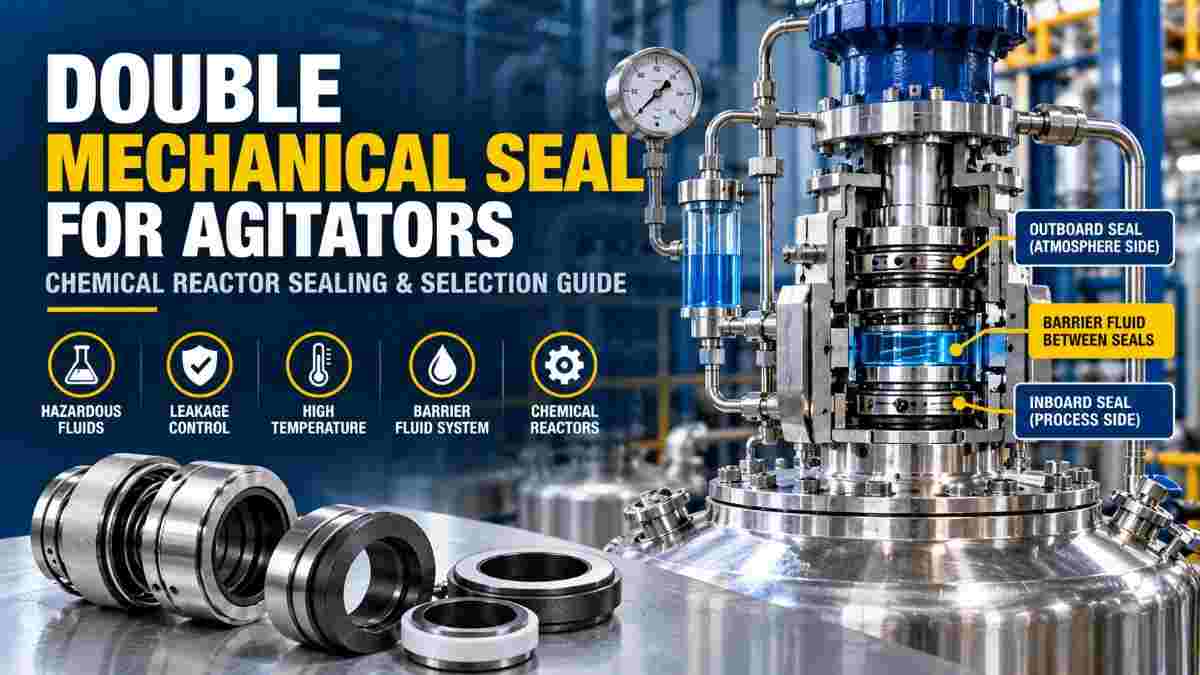
Are you selecting a mechanical seal for a chemical reactor, industrial agitator, or mixing vessel that handles hazardous chemicals, corrosive liquids, or sensitive process materials? Choosing the right sealing arrangement is essential for controlling leakage, maintaining process conditions, and protecting equipment.
A double mechanical seal for an agitator is generally considered when a single seal cannot provide the required level of process containment, fluid separation, or operating reliability. Double seals use two sealing interfaces with a controlled fluid or gas system between them to manage leakage and support seal operation.
These sealing arrangements are often evaluated for chemical reactors, pharmaceutical processing equipment, petrochemical mixing vessels, and other industrial applications with demanding sealing requirements.
However, not every agitator requires a double mechanical seal. The selection depends on process fluid properties, operating pressure, temperature, shaft movement, contamination limits, and the consequences of leakage.
Arohan Seals manufactures and supplies agitator mechanical seals, including single, double, dry-running, and reactor-specific configurations for industrial applications.
This guide explains when a double mechanical seal may be appropriate, how barrier systems work, how to choose suitable materials, and which specifications buyers should provide before ordering.
What Is a Double Mechanical Seal for an Agitator?
A double mechanical seal for an agitator is a sealing assembly that uses two sets of sealing interfaces around a rotating shaft, with a controlled space between them. Depending on the arrangement, this space may contain a pressurized barrier fluid or an unpressurized buffer fluid.
An agitator mechanical seal helps control fluid or vapor movement where the rotating shaft enters a stationary mixing vessel or reactor.
A double arrangement typically contains:
-
An inboard seal facing the process fluid.
-
An outboard seal facing the external environment.
-
A controlled space between the seals.
-
Suitable seal face materials.
-
Secondary sealing elements.
-
Metallic support components.
-
Connections for the required seal support system.
The double arrangement can provide additional process containment compared with a conventional single seal, but its performance depends on the design and support conditions.
Explore Agitator Mechanical Seals from Arohan Seals for available configurations.
When Should You Use a Double Mechanical Seal Instead of a Single Seal?
A double mechanical seal should be considered when the process requires additional leakage control, separation from the atmosphere, specialized lubrication, or protection against process fluid contamination of the sealing faces.
Situations that may justify a double arrangement include:
-
Hazardous or toxic process fluids.
-
Volatile chemical products.
-
Fluids that crystallize near the sealing faces.
-
Abrasive or contaminated process media.
-
Processes with strict leakage limits.
-
Applications requiring separation of the product from the atmosphere.
-
Specialized vacuum or pressure conditions.
-
Equipment requiring a dedicated seal support system.
A single mechanical seal may still be suitable for many nonhazardous applications where operating conditions and leakage requirements permit its use.
The choice must be supported by the process safety assessment and technical specification.
How Does a Double Agitator Mechanical Seal Work?
A double agitator mechanical seal uses two sealing interfaces to control movement of process fluid and support fluid around the rotating shaft. The pressure relationship between the process and the fluid between the seals determines the arrangement's operating behavior.
In a pressurized double seal, the barrier fluid is generally maintained above the relevant process pressure.
This establishes a pressure differential that tends to drive compatible barrier fluid toward the process side rather than allowing process fluid to pass outward through the inner sealing interface.
In an unpressurized dual seal, the buffer fluid operates at a lower pressure than the process.
This arrangement provides a secondary sealing interface and may allow controlled collection or monitoring of process leakage.
Both designs require appropriate engineering and monitoring.
What Is the Difference Between a Single and Double Agitator Mechanical Seal?
A single agitator mechanical seal uses one primary sealing interface, while a double arrangement uses two sealing interfaces with an intermediate support-fluid space.
Important distinctions include:
Single mechanical seals:
-
Use one primary sealing interface.
-
May be suitable for compatible nonhazardous process fluids.
-
Generally have a less complex support arrangement.
-
Require correct face lubrication and operating conditions.
-
Must meet the specified leakage and safety requirements.
Double mechanical seals:
-
Use two sealing interfaces.
-
May provide additional process containment.
-
Require an appropriate buffer or barrier system.
-
Can be selected for certain hazardous or contamination-sensitive applications.
-
Require monitoring and maintenance of the support system.
-
Typically involve additional components and installation considerations.
A double mechanical seal is not automatically better for every application.
Its advantages must justify the additional engineering, operating, and maintenance requirements.
What Is the Difference Between a Pressurized and Unpressurized Double Mechanical Seal?
A pressurized double mechanical seal operates with barrier fluid above the process-side seal pressure, while an unpressurized dual seal operates with buffer fluid below the relevant process pressure. This distinction affects leakage direction and process containment.
How Does a Pressurized Double Mechanical Seal Work?
A pressurized double mechanical seal uses a compatible barrier fluid maintained at a pressure greater than the process pressure acting on the inboard seal.
The controlled pressure differential helps separate the process fluid from the external environment.
Potential applications include:
-
Selected hazardous chemical services.
-
Certain abrasive or crystallizing fluids.
-
Processes requiring strong product containment.
-
Applications where suitable barrier fluid can be tolerated in the product.
-
Industrial systems with demanding leakage-control requirements.
The barrier fluid must be compatible with the process and seal materials.
How Does an Unpressurized Dual Mechanical Seal Work?
An unpressurized dual mechanical seal uses a buffer fluid maintained below the process pressure to support the outboard seal and allow controlled handling or detection of leakage.
This arrangement may be appropriate when the operating conditions and emissions requirements permit it.
Because the buffer fluid is not maintained above process pressure, process fluid may migrate into the buffer system.
An unpressurized arrangement should not be assumed to offer the same containment behavior as a pressurized barrier system.
Why Is Barrier Fluid Important in a Double Mechanical Seal?
Barrier fluid is important because it can provide lubrication, cooling, and controlled pressure conditions between the sealing interfaces in a pressurized double mechanical seal.
A properly designed barrier system helps maintain a suitable operating environment for the seal faces.
Its functions may include:
-
Supporting face lubrication.
-
Removing generated heat.
-
Maintaining the required pressure differential.
-
Separating the process from the external environment.
-
Supporting monitoring of seal condition.
-
Reducing exposure of certain sealing faces to aggressive process media.
The required fluid must be selected for compatibility with the process, sealing materials, and operating conditions.
An unsuitable barrier fluid can introduce contamination or material compatibility problems.
How Do You Select the Right Barrier Fluid for a Chemical Reactor?
Select the barrier fluid according to process compatibility, viscosity, lubricating properties, temperature behavior, chemical stability, and the mechanical seal manufacturer's requirements.
Important considerations include:
-
Compatibility with the process fluid.
-
Compatibility with seal faces and elastomers.
-
Operating temperature.
-
Required viscosity.
-
Lubricating performance.
-
Thermal stability.
-
Potential contamination of the product.
-
Health and environmental requirements.
-
Suitability for the support system.
For example, a pharmaceutical or specialty chemical application may have stricter product contamination requirements than a general industrial process.
The barrier fluid should not be selected simply because it is readily available.
How Should Barrier Pressure Be Controlled in a Double Mechanical Seal?
Barrier pressure should be controlled according to the seal design, process pressure, operating conditions, and support-system specifications. Pressurized double seals require the barrier pressure to remain above the relevant seal chamber or vessel pressure by the engineered differential.
The appropriate differential is application-specific.
Monitoring may include:
-
Barrier pressure.
-
Process pressure.
-
Pressure differential.
-
Barrier fluid level.
-
Barrier fluid temperature.
-
Flow or circulation.
-
Alarm conditions.
Loss of barrier pressure can change leakage behavior and damage the seal.
Pressure settings and shutdown responses should follow the approved seal and support-system design.
What Are API Plan 52, Plan 53, and Plan 54 in Double Mechanical Sealing Systems?
API Plans 52, 53, and 54 describe different mechanical seal support arrangements commonly associated with dual seals in API 682 applications. Their design principles can inform industrial seal-support selection, but applicability to an agitator or reactor must be verified.
What Is API Plan 52 Used For?
API Plan 52 is an unpressurized buffer-fluid system associated with certain dual mechanical seal arrangements.
It provides a controlled buffer environment and can support monitoring of leakage.
The buffer fluid operates below the relevant seal chamber pressure.
What Is API Plan 53 Used For?
API Plan 53 refers to pressurized barrier-fluid systems used with appropriate dual mechanical seals.
Different Plan 53 configurations maintain barrier pressure using different mechanisms.
The choice depends on the equipment, operating conditions, and approved support-system design.
What Is API Plan 54 Used For?
API Plan 54 uses an external system to circulate clean, pressurized barrier fluid through a suitable dual mechanical seal assembly.
It may be used in demanding applications requiring controlled barrier-fluid circulation and cooling.
The complete support system can include suitable pumps, filters, coolers, instrumentation, and pressure controls.
These API plans should not be assigned to an agitator simply because it uses a double seal. The exact equipment and design requirements must be checked.
When Should You Use a Double Mechanical Seal in Chemical Reactors?
A double mechanical seal may be appropriate for a chemical reactor when the process involves hazardous fluids, demanding pressure conditions, aggressive chemicals, or strict containment requirements.
Potential applications include:
-
Chemical synthesis reactors.
-
Specialty chemical processing.
-
Polymer production.
-
Petrochemical mixing.
-
Solvent handling.
-
Selected corrosive liquid processes.
-
Batch reactors requiring controlled sealing conditions.
Engineering teams should assess:
-
Fluid chemistry.
-
Pressure and vacuum conditions.
-
Temperature.
-
Shaft speed and movement.
-
Hazardous area classification.
-
Leakage limits.
-
Contamination tolerance.
-
Cleaning requirements.
-
Support-system reliability.
A double seal should be selected as part of the complete reactor design.
Can Double Mechanical Seals Be Used in Pharmaceutical Reactors?
Yes. Double mechanical seals can be used in pharmaceutical reactors where their design, materials, cleaning requirements, and support-fluid arrangements are appropriate for the manufacturing process.
Pharmaceutical applications may require special consideration of product purity and contamination control.
Important factors include:
-
Suitable material selection.
-
Compatibility with process ingredients.
-
Cleaning procedures.
-
Sterilization requirements where applicable.
-
Barrier fluid acceptability.
-
Hygienic equipment design.
-
Inspection and documentation.
-
Applicable quality requirements.
Not every industrial double seal is suitable for pharmaceutical production.
The final arrangement should be evaluated against the facility's process requirements.
Are Double Mechanical Seals Suitable for Vacuum Reactors?
Yes. Properly designed double mechanical seals can be suitable for certain vacuum reactors, but the seal configuration and support system must be engineered for the full pressure range and operating cycle.
Vacuum service may introduce challenges such as:
-
Reversed pressure differentials.
-
Gas ingress.
-
Loss of seal lubrication.
-
Process vapor exposure.
-
Changes during startup and shutdown.
-
Unstable support-system conditions.
The selected seal must accommodate the expected operating and upset conditions.
Do not assume that a seal suitable for positive pressure is automatically appropriate for vacuum operation.
How Does Shaft Movement Affect Agitator Mechanical Seal Selection?
Shaft movement affects agitator seal selection because mixers and reactors may experience shaft deflection, vibration, runout, and axial movement that can influence seal face alignment and loading.
Agitator shafts can behave differently from shafts in conventional centrifugal pumps.
Important factors include:
-
Shaft diameter.
-
Shaft length.
-
Radial movement.
-
Axial movement.
-
Runout.
-
Bearing arrangement.
-
Agitator speed.
-
Mixing forces.
-
Vessel operating conditions.
Arohan Seals describes agitator-specific designs intended to accommodate different shaft movement conditions.
Buyers should provide actual movement and alignment specifications rather than assuming every agitator seal has the same tolerance.
Which Seal Face Materials Are Suitable for Double Agitator Mechanical Seals?
Common seal face materials for double agitator mechanical seals include carbon graphite, silicon carbide, and tungsten carbide. The correct pairing depends on lubrication, chemical compatibility, solids content, operating temperature, and mechanical loading.
When Should You Consider Carbon Graphite Seal Faces?
Carbon graphite may be suitable for selected applications requiring favorable frictional behavior and compatibility with an appropriate harder mating face.
Its performance depends on the carbon grade, impregnant, process conditions, and lubrication.
When Should You Consider Silicon Carbide Seal Faces?
Silicon carbide is commonly considered for services requiring high hardness, wear resistance, and suitable chemical compatibility.
It may be appropriate for selected abrasive or corrosive applications, depending on its grade and the complete seal design.
When Should You Consider Tungsten Carbide Seal Faces?
Tungsten carbide may be suitable for mechanically demanding applications requiring strong wear resistance and toughness.
Its binder composition and chemical compatibility must be evaluated.
Arohan Seals offers Silicon Carbide Seal Faces and Tungsten Carbide Seal Faces for industrial sealing applications.
Which Elastomer Materials Should Be Used in Reactor Mechanical Seals?
Elastomer selection depends on chemical compatibility, temperature, pressure, and the seal's operating environment. Materials such as FKM, EPDM, FFKM, and PTFE-based sealing components are used in different applications.
Each has specific advantages and limitations.
Before selecting secondary seals, verify:
-
Process fluid composition.
-
Chemical concentration.
-
Operating temperature.
-
Cleaning chemicals.
-
Pressure conditions.
-
Material swelling or degradation risks.
-
Manufacturer compatibility guidance.
An elastomer suitable for one process chemical may be unsuitable for another.
Can Double Mechanical Seals Handle Abrasive or Crystallizing Fluids?
Double mechanical seals can be considered for abrasive or crystallizing fluids when the selected design and support system protect the sealing interfaces appropriately.
Abrasive and crystallizing products can create problems such as:
-
Seal face wear.
-
Deposits around sealing components.
-
Restricted movement.
-
Blocked support connections.
-
Unstable lubrication.
-
Increased frictional heat.
Depending on the process, a pressurized barrier system may help maintain suitable operating conditions at the sealing faces.
However, the actual seal design must account for the fluid properties and expected operating conditions.
What Are the Most Common Causes of Double Agitator Mechanical Seal Failure?
Common causes of double agitator mechanical seal failure include barrier pressure loss, inadequate lubrication, incompatible materials, excessive shaft movement, contamination, overheating, and installation errors.
Potential failure causes include:
-
Loss of barrier fluid.
-
Incorrect pressure differential.
-
Insufficient circulation.
-
Incompatible barrier fluid.
-
Damaged seal faces.
-
Excessive vibration.
-
Shaft misalignment.
-
Abrasive contamination.
-
Chemical attack on elastomers.
-
Blocked support lines.
-
Improper startup.
A failed seal should be evaluated before replacing it with the same configuration.
How Can You Prevent Double Mechanical Seal Failure in Reactors?
Prevent double mechanical seal failure by maintaining the specified barrier or buffer system, monitoring equipment conditions, using compatible materials, and following approved operating and maintenance procedures.
Recommended practices include:
-
Confirm correct seal installation.
-
Verify the barrier or buffer system.
-
Monitor fluid pressure and level.
-
Maintain suitable circulation and cooling.
-
Inspect support-system connections.
-
Monitor shaft vibration.
-
Check for changes in process conditions.
-
Review material compatibility.
-
Follow startup and shutdown procedures.
-
Investigate abnormal leakage promptly.
For additional troubleshooting guidance, maintenance teams can review the company's Mechanical Seal Blog.
What Should You Check Before Ordering a Double Mechanical Seal for an Agitator?
Before ordering a double mechanical seal for an agitator, verify the shaft dimensions, operating conditions, process fluid, seal configuration, face materials, support-system requirements, and installation details.
Use this technical purchasing checklist:
-
Equipment: Agitator or reactor make and model.
-
Mounting: Top-entry, side-entry, or bottom-entry arrangement.
-
Shaft: Diameter and applicable tolerances.
-
Seal chamber: Available dimensions.
-
Pressure: Normal, maximum, minimum, and vacuum conditions.
-
Temperature: Normal and design operating temperatures.
-
Speed: Agitator rotational speed.
-
Shaft movement: Runout, deflection, and axial movement.
-
Process fluid: Chemical composition and concentration.
-
Solids: Particle content and characteristics.
-
Face materials: Required material grades and combinations.
-
Secondary seals: Elastomer or other sealing materials.
-
Support system: Barrier or buffer arrangement.
-
Quantity: Required number of seals.
-
Documentation: Technical drawings and inspection requirements.
Incomplete specifications can result in a seal that fits the shaft but is unsuitable for the process.
How Is the Price of a Double Agitator Mechanical Seal Calculated?
The price of a double agitator mechanical seal depends on the shaft size, seal configuration, materials, operating requirements, custom engineering, and support-system specifications.
Important cost factors include:
-
Shaft diameter.
-
Seal design.
-
Face materials.
-
Elastomer selection.
-
Metallic construction.
-
Pressure and temperature requirements.
-
Integrated bearing requirements.
-
Barrier-fluid connections.
-
Custom manufacturing.
-
Testing and documentation.
-
Order quantity.
Pressurized double seal installations may also require external support equipment.
Buyers should compare the complete installed sealing solution rather than only the mechanical seal purchase price.
Why Should Industrial Buyers Consider Arohan Seals for Double Agitator Mechanical Seals?
Arohan Seals offers agitator and reactor mechanical seal configurations for industrial mixing applications, including single, double, dry-running, and specialized sealing arrangements.
Based in Mumbai, India, the company lists mechanical seals for several industrial applications.
Its agitator sealing range includes:
-
Single agitator mechanical seals.
-
Double agitator mechanical seals.
-
Reactor double mechanical seals.
-
Dry-running agitator seals.
-
Split mechanical seals.
-
Customized sealing components.
The company also lists several seal face and secondary sealing material options.
Explore the Arohan Seals Agitator Mechanical Seal Collection for product information.
Product suitability, materials, dimensions, pressure capabilities, and support-system requirements should be confirmed for the specific application.
What Information Should You Include in a Double Mechanical Seal Quotation Request?
A double mechanical seal quotation request should include the agitator specifications, process fluid, pressure and temperature conditions, shaft movement, seal materials, and support-system requirements.
Provide:
-
Reactor or agitator manufacturer.
-
Equipment model.
-
Shaft diameter.
-
Seal chamber dimensions.
-
Mounting arrangement.
-
Normal and maximum pressure.
-
Vacuum conditions, if applicable.
-
Operating temperature.
-
Rotational speed.
-
Process fluid and chemical concentration.
-
Solids content.
-
Shaft runout and deflection.
-
Preferred seal materials.
-
Barrier or buffer fluid requirements.
-
Available support-system connections.
-
Drawings and photographs.
-
Required quantity.
-
Delivery destination.
Detailed specifications help the manufacturer evaluate design suitability and prepare a relevant quotation.
What Are the Most Frequently Asked Questions About Double Mechanical Seals for Agitators?
Common questions about double agitator mechanical seals concern chemical containment, barrier pressure, seal face materials, vacuum service, maintenance, and replacement requirements.
Is a Double Mechanical Seal Better Than a Single Mechanical Seal?
A double mechanical seal may offer additional containment or support-fluid control for certain demanding applications. A single seal may remain appropriate when its design meets the process requirements.
Do Double Mechanical Seals Require Barrier Fluid?
Pressurized double seals generally require a controlled barrier medium. Unpressurized dual seals use buffer fluid, and some specialized sealing arrangements use gas-based systems. The exact requirements depend on the design.
Can Double Mechanical Seals Prevent All Chemical Leakage?
No. Double seals are designed to control leakage, but they cannot guarantee zero leakage under every operating condition or failure scenario. Proper design, monitoring, and maintenance remain essential.
Can Double Mechanical Seals Work Under Vacuum?
Yes. Suitable designs can operate under vacuum conditions when the seal arrangement, pressure differentials, and support system are engineered for the application.
Which Seal Face Materials Are Best for Chemical Reactors?
Carbon graphite, silicon carbide, and tungsten carbide may be used in different reactor sealing applications. Selection depends on chemical compatibility, lubrication, solids content, temperature, and mechanical loading.
Are Double Agitator Mechanical Seals Suitable for Pharmaceutical Processing?
Yes, when the seal construction, materials, cleaning requirements, barrier fluid, and relevant process specifications are appropriate for pharmaceutical manufacturing.
Can a Double Mechanical Seal Handle Shaft Deflection?
Specialized agitator seal designs may accommodate specified shaft movements. Allowable deflection, runout, and axial movement must be confirmed for the actual product.
What Happens If Barrier Fluid Pressure Drops?
Loss of barrier pressure may change the pressure differential across the seal faces and affect containment, lubrication, and leakage behavior. Operators should follow the engineered alarm and shutdown procedures.
How Long Does a Double Agitator Mechanical Seal Last?
Service life depends on the seal design, materials, operating conditions, maintenance, and support-system reliability. A universal service-life guarantee is not appropriate.
Can You Replace a Single Agitator Seal With a Double Seal?
Potentially, but conversion requires engineering review of available space, shaft dimensions, vessel connections, seal support systems, and operating requirements.
How Can You Request a Double Mechanical Seal for Agitators and Chemical Reactors From Arohan Seals?
You can request a double agitator mechanical seal from Arohan Seals by sharing your equipment dimensions, process fluid, operating conditions, sealing requirements, and preferred support-system arrangement.
Whether you are purchasing a seal for a new reactor, replacing an existing agitator seal, or evaluating improved containment for a chemical processing application, accurate technical specifications are essential.
The correct sealing arrangement should be selected based on the complete process and equipment requirements, not simply the availability of a double seal configuration.
Looking for a double mechanical seal manufacturer in India?
Explore Agitator Mechanical Seals from Arohan Seals, review the Silicon Carbide Seal Face Collection, or contact Arohan Seals to discuss reactor sealing requirements and request a quotation.
Technical Note: Double mechanical seal selection and barrier-system design require application-specific engineering. Hazardous chemical equipment must be operated and maintained using approved plant safety procedures. Never adjust, disconnect, or dismantle a pressurized seal support system without proper isolation and authorization.