
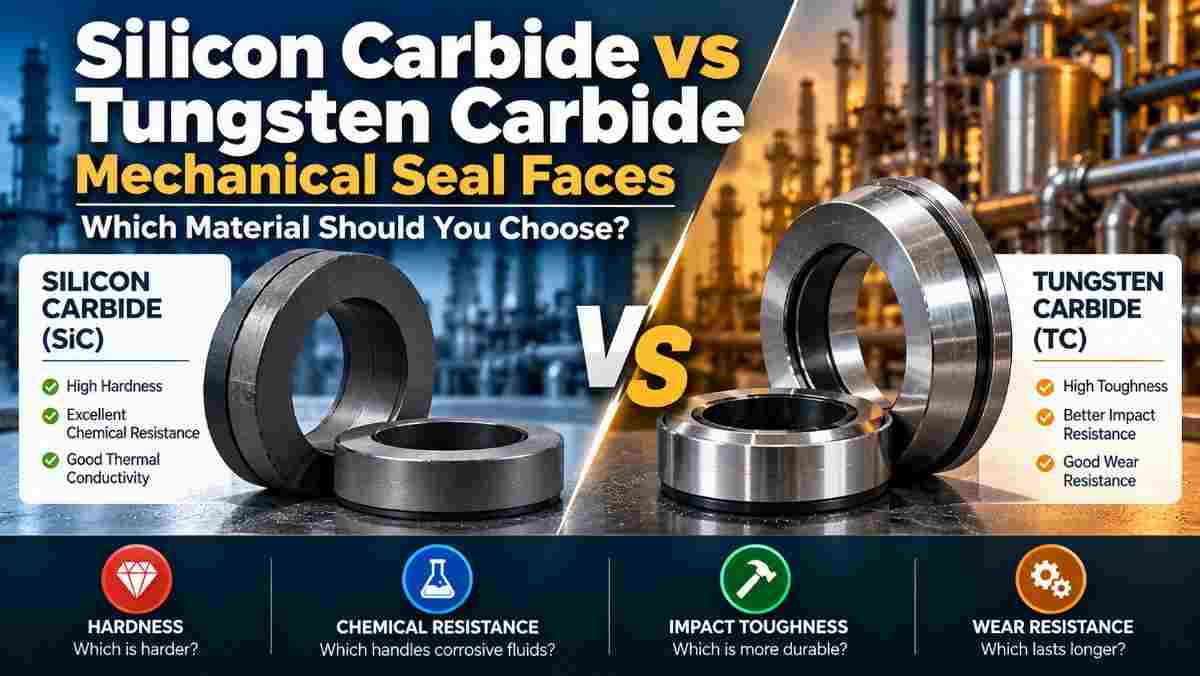
Choosing the right mechanical seal face material is essential for controlling leakage, reducing wear, and maintaining reliable operation in industrial pumps, compressors, mixers, and other rotating equipment.
Silicon carbide and tungsten carbide are two widely used hard-face materials in mechanical sealing systems. Both offer high wear resistance and mechanical durability, but their chemical and physical properties make them suitable for different operating conditions.
The main difference between silicon carbide and tungsten carbide mechanical seal faces is that silicon carbide generally offers higher hardness and broad chemical resistance, while cemented tungsten carbide provides greater fracture toughness and better resistance to mechanical impact.
Silicon carbide is often considered for corrosive and abrasive fluids, while tungsten carbide can be valuable in equipment exposed to vibration, shock loading, and demanding mechanical conditions.
However, neither material is universally superior. Performance depends on the exact material grade, mating face, fluid chemistry, pressure, temperature, shaft speed, and lubrication conditions.
This guide compares silicon carbide vs tungsten carbide mechanical seals to help maintenance engineers, equipment manufacturers, and procurement teams choose suitable seal-face materials for their applications.
What Is a Mechanical Seal Face and Why Is Its Material Important?
A mechanical seal face is a precision-finished sealing surface used to control fluid leakage between rotating and stationary components.
A typical mechanical seal has two main mating faces:
- A rotating face that turns with the shaft.
- A stationary face that remains fixed relative to the equipment housing.
The two faces operate with a thin fluid film between them under suitable liquid-lubricated conditions. This film helps control friction, transfer heat, and limit leakage.
Mechanical seal face materials must withstand the combined effects of mechanical loading, fluid chemistry, frictional heating, and wear.
Important material properties include:
- Hardness
- Wear resistance
- Fracture toughness
- Thermal conductivity
- Chemical compatibility
- Dimensional stability
- Surface finish quality
Arohan Seals supplies rotary and stationary mechanical seal faces for industrial sealing applications where material selection and precision finishing are important.
What Is a Silicon Carbide Mechanical Seal Face?
Silicon carbide, commonly abbreviated as SiC, is a hard technical ceramic used in mechanical seal faces.
It offers high hardness, good thermal conductivity, and resistance to many corrosive environments.
These properties make silicon carbide useful in chemical processing, industrial water handling, and selected abrasive-fluid applications.
However, silicon carbide is relatively brittle compared with cemented tungsten carbide, so mechanical impact and excessive edge loading must be considered.
Silicon carbide seal faces are available in different material grades, including reaction-bonded and sintered silicon carbide.
Buyers can explore Arohan Seals' Silicon Carbide Seal Faces for product configurations and industrial requirements.
What Is a Tungsten Carbide Mechanical Seal Face?
Tungsten carbide, commonly abbreviated as WC or TC in mechanical seal applications, is a hard engineering material frequently manufactured with a metallic binder.
Common binder materials include cobalt and nickel.
The hard tungsten carbide particles provide wear resistance, while the binder contributes to the strength and toughness of the finished material.
Cemented tungsten carbide generally offers greater fracture toughness than silicon carbide, making it useful in selected applications involving mechanical shock or vibration.
However, the metallic binder can affect its chemical compatibility.
Different tungsten carbide grades may perform very differently when exposed to acids, alkalis, seawater, or other aggressive fluids.
Arohan Seals offers Tungsten Carbide Seal Faces with different material and application options for industrial equipment.
What Is the Difference Between Silicon Carbide and Tungsten Carbide Mechanical Seals?
The most important differences involve hardness, impact resistance, chemical compatibility, heat transfer, and material construction.
| Property | Silicon Carbide (SiC) | Tungsten Carbide (TC) |
|---|---|---|
| Material Type | Technical ceramic | Usually cemented carbide with metallic binder |
| Hardness | Generally higher | High, but usually lower than SiC |
| Fracture Toughness | Comparatively lower | Generally higher |
| Impact Resistance | More susceptible to brittle fracture | Better tolerance of mechanical shock |
| Abrasion Resistance | Excellent with suitable grade and operating conditions | Excellent with suitable grade and binder |
| Chemical Resistance | Broad resistance, dependent on SiC type | Strongly influenced by binder composition |
| Thermal Conductivity | Generally high | High, depending on grade |
| Density | Relatively low | Considerably higher |
| Typical Concern | Chipping, cracking, mechanical impact | Binder attack or corrosion |
| Typical Applications | Chemical processing, water treatment, abrasive service | Heavy-duty pumps, slurry systems, high mechanical loading |
This comparison provides general guidance. Actual engineering properties depend on the specific material grade, manufacturing process, operating conditions, and mating-face combination.
Which Is Harder: Silicon Carbide or Tungsten Carbide?
Silicon carbide is generally harder than conventional cemented tungsten carbide grades used in mechanical seal faces.
High hardness helps resist scratching and abrasive wear when particles contact the sealing surfaces.
However, hardness alone does not determine mechanical seal performance.
A harder material may still crack under impact or experience rapid failure if the seal operates without adequate lubrication.
Does Higher Hardness Mean Better Wear Resistance?
Not necessarily.
Wear resistance depends on several interacting factors, including:
- Abrasive particle size
- Particle hardness
- Fluid lubrication
- Seal-face loading
- Material microstructure
- Surface finish
- Mating-face material
- Operating temperature
Silicon carbide's high hardness can be advantageous against fine abrasive particles.
Tungsten carbide may provide additional robustness where mechanical impact, rough handling, or vibration are important concerns.
The complete operating conditions should guide material selection.
Which Material Has Better Impact Resistance?
Cemented tungsten carbide generally provides better fracture toughness and mechanical impact resistance than silicon carbide.
This difference comes partly from the metallic binder used in many tungsten carbide grades.
The binder helps the material resist crack propagation and absorb certain mechanical stresses.
Silicon carbide, by comparison, is a hard ceramic and can be more vulnerable to chipping or cracking under concentrated mechanical loading.
When Is Tungsten Carbide Better for Industrial Pumps?
Tungsten carbide may be worth considering when the equipment experiences:
- Mechanical shock
- High face loading
- Vibration
- Pressure fluctuations
- Possible impact during handling
- Demanding abrasive conditions
However, severe vibration or repeated hydraulic shock should be corrected at the equipment level rather than treated as a normal operating condition.
A tougher seal face may help accommodate certain service demands, but it cannot compensate for an improperly aligned or severely damaged pump.
What Are the Different Types of Silicon Carbide Seal Face Materials?
Silicon carbide mechanical seal faces are available in different grades, and their properties should not be treated as identical.
What Is Reaction-Bonded Silicon Carbide (RBSiC)?
Reaction-bonded silicon carbide is manufactured through a process that commonly leaves a portion of free silicon within the finished material.
It offers high hardness, useful thermal conductivity, and good resistance to many industrial fluids.
However, the free silicon phase can limit chemical resistance in certain aggressive environments, particularly some strong alkaline conditions and chemicals that attack silicon.
Its suitability must be verified against the specific process fluid.
What Is Sintered Silicon Carbide (SSiC)?
Pressureless-sintered silicon carbide is manufactured without relying on the same free-silicon phase found in reaction-bonded grades.
It offers high hardness and broad chemical resistance across many process environments.
SSiC is often evaluated for demanding chemical-processing and corrosive-fluid applications.
However, the exact chemical compatibility depends on the sintered grade, process temperature, and fluid composition.
Which Is Better: Reaction-Bonded or Sintered Silicon Carbide?
Reaction-bonded silicon carbide can be suitable for many standard industrial applications, while sintered silicon carbide may provide greater chemical resistance in certain aggressive environments.
The selection should consider:
- Fluid composition
- Temperature
- Presence of abrasive solids
- Mechanical loading
- Available material grades
- Cost and procurement requirements
Neither option should be selected solely on the basis of its material name.
What Are the Different Types of Tungsten Carbide Seal Faces?
Tungsten carbide seal faces are commonly classified according to their binder composition and manufacturing characteristics.
What Is Cobalt-Bonded Tungsten Carbide?
Cobalt-bonded tungsten carbide uses cobalt as a metallic binding phase.
It generally provides useful hardness, strength, and fracture toughness for heavy-duty mechanical applications.
However, the cobalt binder may be vulnerable to corrosion in certain chemical environments.
Binder attack can weaken the microstructure and contribute to accelerated wear or loss of material.
What Is Nickel-Bonded Tungsten Carbide?
Nickel-bonded tungsten carbide uses nickel as the binding phase.
It can provide improved chemical resistance compared with some cobalt-bonded grades in suitable environments.
However, nickel-bonded tungsten carbide is not universally resistant to all acids, alkalis, or other industrial chemicals.
Material selection should be supported by compatibility data from the relevant supplier.
Why Does the Binder Matter in Tungsten Carbide Seal Faces?
The binder influences fracture toughness, chemical resistance, hardness, and other properties.
If the binder is attacked by the process fluid, the surrounding carbide grains can lose support.
This may result in surface deterioration, grain pull-out, accelerated wear, and seal-face failure.
Consequently, specifying only "tungsten carbide" may not provide enough information for critical applications.
Buyers should confirm whether the required material is cobalt-bonded, nickel-bonded, or another approved carbide grade.
Which Is Better for Corrosive Chemicals: Silicon Carbide or Tungsten Carbide?
Suitable grades of silicon carbide, especially certain sintered SiC materials, generally offer broad resistance to aggressive chemical environments.
Tungsten carbide may also perform well in compatible fluids, but the chemical resistance of its metallic binder must be considered.
For example, an acidic process fluid may attack a cobalt-bonded tungsten carbide grade even when the tungsten carbide particles themselves are highly wear-resistant.
However, no single material is compatible with every chemical.
Which Seal Face Is Better for Acidic Fluids?
Sintered silicon carbide is often worth evaluating for corrosive acidic applications.
However, suitability depends on the acid type, concentration, temperature, and other operating conditions.
Certain highly aggressive chemicals can attack silicon carbide grades or their secondary phases.
Always check chemical compatibility data for the exact material grade.
Can Tungsten Carbide Be Used in Chemical Processing?
Yes, provided the selected carbide and binder are compatible with the process fluid.
Nickel-bonded grades may offer advantages in some corrosive environments compared with cobalt-bonded grades.
However, they still require application-specific verification.
Which Material Is Better for Abrasive Slurry Pumps?
Both silicon carbide and tungsten carbide can be used in mechanical seals for abrasive service.
Silicon carbide offers high hardness and strong resistance to many forms of abrasive wear.
Tungsten carbide offers high wear resistance together with greater mechanical toughness.
The preferred choice depends on whether the main risk involves abrasive cutting, impact loading, vibration, or chemical attack.
When Should You Choose Silicon Carbide for Slurry Applications?
Silicon carbide may be suitable for applications involving fine abrasive particles where high hardness and chemical resistance are important.
In some slurry services, a silicon carbide-to-silicon carbide face combination may be considered.
However, suitability depends on the solids concentration, fluid film conditions, face loading, and the complete seal design.
When Should You Choose Tungsten Carbide for Slurry Applications?
Tungsten carbide may be considered where mechanical toughness, impact resistance, or severe loading are important.
However, its binder must remain compatible with the fluid chemistry.
Severe solids contamination may also require an engineered flush arrangement or a specialized seal configuration.
Can Changing the Seal Face Material Solve Every Slurry Leakage Problem?
No.
Premature slurry seal failure may result from contamination, improper installation, shaft movement, incorrect flush arrangements, or unsuitable operating conditions.
Changing only the seal face material may not resolve these underlying problems.
Arohan Seals offers Cartridge Mechanical Seals with different face material options for applications requiring an integrated seal assembly.
Which Material Has Better Thermal Conductivity?
Both silicon carbide and tungsten carbide can provide relatively high thermal conductivity compared with several other common mechanical seal face materials.
Actual thermal conductivity depends on the specific material grade and manufacturing method.
Good heat transfer can help distribute frictional heat generated at the sealing interface.
However, thermal conductivity alone does not determine whether a seal will operate reliably.
Seal-face geometry, fluid-film stability, pressure, speed, and heat removal through the surrounding equipment also matter.
Does Silicon Carbide Perform Better at High Temperatures?
Silicon carbide has useful thermal properties that support demanding applications, but operating temperature limits depend on the complete seal assembly.
Elastomers, springs, metal components, and lubrication conditions may limit the allowable temperature before the face material itself reaches its thermal capability.
Can Tungsten Carbide Handle High Temperatures?
Tungsten carbide can operate in elevated-temperature applications within appropriate limits.
However, binder composition, thermal expansion, oxidation, and the complete seal design must be considered.
Do not assume a tungsten carbide ring is suitable for every high-temperature application solely because it is a hard material.
Can Silicon Carbide and Tungsten Carbide Mechanical Seals Run Dry?
Conventional liquid-lubricated mechanical seals generally require a suitable fluid film between their mating faces.
Even highly wear-resistant materials can suffer rapid damage when lubrication is inadequate.
Silicon carbide's thermal conductivity does not make an ordinary SiC seal automatically safe for dry running.
Similarly, tungsten carbide's toughness does not prevent excessive frictional heating when the sealing interface operates without suitable lubrication.
Some specialized seal designs are intended for dry or gas-lubricated operation, but they must be specified and approved for that service.
For standard liquid-handling pumps, proper priming, seal-chamber conditions, and lubrication remain essential.
Which Mechanical Seal Face Pairing Should You Choose?
Mechanical seals should be selected as complete face pairs rather than by considering only one ring.
Common combinations include:
- Carbon graphite against silicon carbide
- Carbon graphite against tungsten carbide
- Silicon carbide against silicon carbide
- Tungsten carbide against silicon carbide
- Tungsten carbide against tungsten carbide
Each pairing has different friction, wear, lubrication, and chemical compatibility characteristics.
| Face Pairing | Potential Application | Important Consideration |
|---|---|---|
| Carbon / Silicon Carbide | Many clean or lightly contaminated fluid applications | Carbon grade and lubrication requirements |
| Carbon / Tungsten Carbide | Selected industrial pump applications | Binder compatibility and face loading |
| Silicon Carbide / Silicon Carbide | Selected abrasive or corrosive services | Fluid-film stability and mechanical shock |
| Tungsten Carbide / Silicon Carbide | Selected demanding industrial sealing applications | Tribological compatibility and exact grades |
| Tungsten Carbide / Tungsten Carbide | Selected heavy-duty or abrasive applications | Pressure, heat generation, binder chemistry |
The table presents possible configurations, not universal material recommendations. The final face pairing should be approved for the exact seal design and service conditions.
How Does Carbon Graphite Compare with Silicon Carbide and Tungsten Carbide?
Carbon graphite is commonly used as a mating-face material in mechanical seals.
Compared with silicon carbide and tungsten carbide, carbon graphite generally has lower hardness but offers useful friction and lubrication characteristics.
This can make it suitable for many clean-fluid applications when paired with an appropriate hard face.
However, carbon graphite may wear rapidly in severely abrasive environments.
The exact performance depends on carbon composition, impregnation, process chemistry, and mating-face selection.
Mechanical seal material selection should therefore consider the complete face combination rather than automatically choosing the hardest available materials.
What Are the Common Causes of Silicon Carbide and Tungsten Carbide Seal Face Failure?
Even high-performance seal face materials can fail prematurely when operating conditions are unsuitable.
| Observed Damage | Possible Cause | What to Investigate |
|---|---|---|
| Chipped silicon carbide edges | Impact, handling damage, excessive mechanical loading | Installation, shaft movement, face support |
| Cracked seal faces | Thermal shock, dry running, mechanical stress | Lubrication, operating temperature, startup conditions |
| Tungsten carbide surface deterioration | Binder corrosion or chemical incompatibility | Fluid chemistry and binder grade |
| Severe scoring | Abrasive particle contamination | Fluid solids, flush arrangement, filtration |
| Uneven wear pattern | Misalignment, shaft runout, face distortion | Pump alignment and mechanical condition |
| Rapid face wear after replacement | Incorrect pairing or operating conditions | Material specification, pressure, speed, lubrication |
Inspection results should be reviewed alongside operating records before concluding that the seal material itself was defective.
How Do You Select the Right Seal Face Material for Different Industries?
The correct material depends more on the actual process conditions than on the industry name.
| Industry or Application | Material Worth Evaluating | Main Selection Factor |
|---|---|---|
| Chemical Processing | Suitable silicon carbide grade | Chemical compatibility |
| Mining and Slurry Handling | Silicon carbide or tungsten carbide | Abrasion, impact, solids content |
| Water Treatment | SiC, TC, or suitable carbon/hard-face pairing | Water chemistry and operating conditions |
| Oil and Gas | Application-qualified SiC or TC | Pressure, chemistry, mechanical loading |
| High-Vibration Equipment | Appropriate tungsten carbide grade may be considered | Impact resistance and equipment correction |
| Pharmaceutical Processing | Suitable chemically compatible seal-face combination | Cleanability, contamination control, process compatibility |
| Industrial Chemical Pumps | Sintered SiC or compatible TC grade | Corrosion and face loading |
These recommendations are general screening considerations. Final material selection should follow manufacturer guidance and verified application data.
Is Silicon Carbide More Expensive Than Tungsten Carbide?
There is no universal pricing relationship between silicon carbide and tungsten carbide seal faces.
Costs vary significantly with material grade, dimensions, manufacturing process, surface finish, tolerances, and order quantity.
Important pricing factors include:
- Reaction-bonded or sintered silicon carbide
- Cobalt- or nickel-bonded tungsten carbide
- Inner and outer diameter
- Ring thickness
- Lapping and polishing requirements
- Face flatness and surface finish
- Production quantity
- Inspection requirements
- Custom manufacturing
Buyers should request quotations for the exact material grade and dimensions rather than comparing broad material categories.
How Do You Compare the Lifecycle Cost of Mechanical Seal Face Materials?
The initial purchase price is only one component of mechanical seal cost.
Other factors may include installation labor, replacement frequency, pump downtime, repair costs, and supporting-system maintenance.
A simplified lifecycle cost calculation is:
Lifecycle Cost = Initial Seal Cost + Installation Cost + Maintenance Cost + Replacement Cost + Downtime Cost
For example, a lower-priced face material may become more expensive over time if it is chemically incompatible and requires frequent replacement.
Conversely, using a more expensive material in a mild operating environment may offer no meaningful advantage.
Material selection should therefore balance technical requirements and total operating cost.
What Specifications Should You Provide When Ordering Mechanical Seal Faces?
Industrial buyers should provide detailed product and application information when requesting replacement or customized seal faces.
Which Dimensions Are Required?
Common dimensional requirements include:
- Outer diameter
- Inner diameter
- Face thickness
- Seal ring geometry
- Mounting features
- Required tolerances
A drawing or an approved sample may be needed for non-standard components.
Which Material Specifications Should Be Confirmed?
For silicon carbide, specify the appropriate material grade, such as reaction-bonded or sintered SiC.
For tungsten carbide, confirm the binder system and any relevant manufacturing specifications.
Also define required surface finish, face flatness, and inspection requirements.
What Operating Details Should Be Shared with the Manufacturer?
Provide:
- Equipment type and model
- Process fluid
- Chemical concentration
- Operating pressure
- Operating temperature
- Shaft speed
- Abrasive particle content
- Existing seal configuration
- Mating-face material
- Previous failure symptoms
- Required quantity
These details help establish whether the requested material is suitable for the application.
Can You Replace a Tungsten Carbide Seal Face with Silicon Carbide?
Substitution may be possible in some mechanical seal designs, but it should not be automatic.
Even when the replacement ring has similar dimensions, differences in material properties may affect friction, heat transfer, face loading, and resistance to mechanical shock.
Before approving substitution, verify:
- Material compatibility with the process fluid
- Suitability of the mating face
- Operating pressure and temperature
- Rotational speed
- Face geometry and flatness
- Mechanical loading
- Seal manufacturer requirements
A technically approved material change may improve performance in a particular application, but an unsuitable substitution can lead to premature failure.
What Are the Most Common Mistakes When Choosing Mechanical Seal Face Materials?
Common selection mistakes include:
- Choosing only by hardness: Hardness does not determine all wear and impact behavior.
- Ignoring tungsten carbide binder chemistry: Binder corrosion can cause premature deterioration.
- Assuming all silicon carbide grades are identical: Reaction-bonded and sintered grades have different properties.
- Ignoring mating-face compatibility: The complete face pair determines sealing performance.
- Assuming hard faces can run dry: Conventional liquid-lubricated seals still require suitable lubrication.
- Overlooking equipment vibration: Face material changes do not correct severe shaft or pump problems.
- Ignoring fluid contamination: Solids can cause scoring and accelerated wear.
- Failing to confirm dimensions: Incorrect ring geometry can cause assembly and leakage issues.
- Comparing price without specifications: Different grades and finishes may not be equivalent.
Frequently Asked Questions About Silicon Carbide vs Tungsten Carbide Seals
Which Is Better for Mechanical Seals: Silicon Carbide or Tungsten Carbide?
Silicon carbide generally offers greater hardness and broad chemical resistance, while cemented tungsten carbide provides greater mechanical toughness. The better option depends on the process fluid, operating conditions, and mating-face design.
Which Material Is Harder: SiC or TC?
Silicon carbide is generally harder than conventional cemented tungsten carbide used in mechanical seal applications.
Is Silicon Carbide Suitable for Abrasive Fluids?
Yes. Silicon carbide is widely considered for abrasive applications because of its high hardness and wear resistance. The complete seal design and fluid conditions must still be evaluated.
Is Tungsten Carbide More Impact-Resistant Than Silicon Carbide?
Cemented tungsten carbide generally provides greater fracture toughness and impact resistance than silicon carbide because of its metallic binder structure.
What Is the Difference Between Sintered and Reaction-Bonded Silicon Carbide?
Reaction-bonded silicon carbide commonly contains free silicon, while sintered silicon carbide is manufactured without the same free-silicon phase. This can create differences in chemical resistance and other properties.
Does Tungsten Carbide Rust or Corrode?
Tungsten carbide seal faces can experience chemical deterioration, particularly when the process fluid attacks the metallic binder. Resistance depends on the exact carbide grade and environment.
Can Silicon Carbide and Tungsten Carbide Run Against Each Other?
Yes, some mechanical seals use tungsten carbide against silicon carbide. However, the face pairing must be approved for the intended pressure, speed, lubrication, and chemical conditions.
Is Silicon Carbide Suitable for Dry Running?
Ordinary liquid-lubricated mechanical seals should not be assumed suitable for dry running simply because they contain silicon carbide faces. Dry-running service requires an appropriately engineered seal design.
Which Seal Face Is Better for Chemical Pumps?
A compatible sintered silicon carbide grade is often worth evaluating for corrosive fluids, while tungsten carbide may be suitable where its binder chemistry and mechanical properties match the application.
Is Tungsten Carbide Suitable for Slurry Pumps?
Yes. Appropriate tungsten carbide grades can provide high wear resistance and mechanical toughness for selected slurry-handling applications.
Can You Replace SiC with Tungsten Carbide?
Substitution may be possible if the manufacturer verifies chemical compatibility, dimensions, mating-face selection, heat transfer, and operating limits.
How Do You Choose the Correct Mechanical Seal Face?
Review the process fluid, abrasives, chemical compatibility, operating pressure, temperature, shaft speed, lubrication, mating face, material grade, and equipment condition before choosing the seal face.
Which Mechanical Seal Face Material Should You Choose for Your Application?
Silicon carbide and tungsten carbide both provide valuable characteristics for industrial mechanical seals.
Silicon carbide offers high hardness and broad chemical resistance, making it suitable for many corrosive and abrasive applications.
Tungsten carbide offers high wear resistance and greater mechanical toughness, making it worth considering where shock loading, vibration, and demanding mechanical conditions are important.
However, the final decision should be based on the complete operating environment and seal-face pairing rather than material hardness or initial price alone.
Arohan Seals supplies Silicon Carbide Seal Faces, Tungsten Carbide Seal Faces, and other precision sealing components for pumps and industrial rotating equipment.
To compare materials for a specific application, explore the company's Silicon Carbide Seal Faces and Tungsten Carbide Seal Faces, and share your operating conditions, material requirements, and component dimensions when requesting a quotation.