
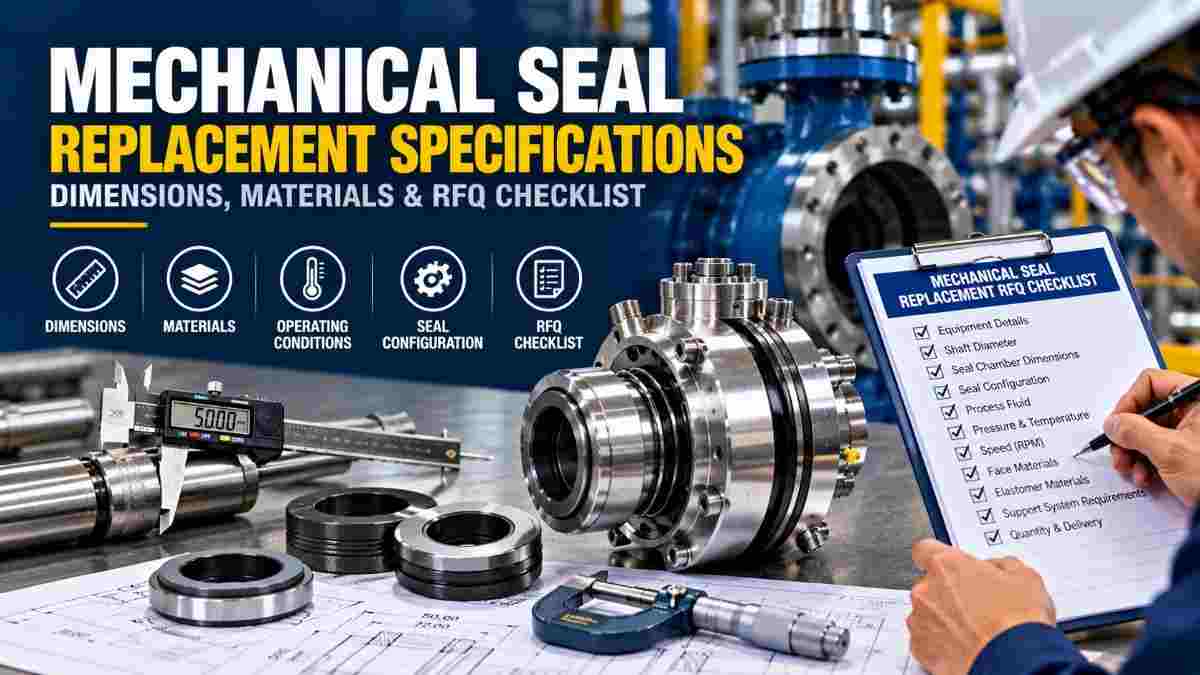
Are you planning to replace a leaking or damaged mechanical seal in an industrial pump, mixer, agitator, or other rotating equipment? Ordering the correct replacement involves more than matching the shaft diameter or finding a seal that looks similar to the existing component.
The most important mechanical seal replacement specifications include shaft diameter, seal chamber dimensions, existing seal configuration, process fluid, operating pressure, temperature, rotational speed, seal face materials, elastomer compatibility, and installation requirements.
An incomplete specification can result in a replacement seal that fits the shaft but is unsuitable for the actual process conditions.
For maintenance engineers, pump manufacturers, chemical plants, and industrial procurement teams, providing accurate information helps suppliers identify suitable replacement options and prepare quotations.
Arohan Seals manufactures and supplies industrial mechanical seals, including cartridge, single-spring, multi-spring, bellows, and agitator sealing configurations.
This mechanical seal replacement specifications guide explains what information to collect, how to check dimensions, which operating conditions matter, and how to prepare a complete replacement seal enquiry.
What Specifications Are Required to Order a Replacement Mechanical Seal?
To order a replacement mechanical seal, provide the equipment model, existing seal identification, shaft dimensions, seal chamber measurements, operating conditions, material requirements, and seal support-system details.
A complete replacement enquiry should include:
-
Equipment identification: Pump or mixer manufacturer, model, and serial number.
-
Existing mechanical seal: Manufacturer, model, and part number, if available.
-
Shaft diameter: Actual shaft or sleeve diameter at the sealing location.
-
Seal chamber dimensions: Bore, depth, and relevant mounting dimensions.
-
Seal configuration: Single, double, cartridge, bellows, or component seal.
-
Process fluid: Chemical composition, concentration, and contaminants.
-
Operating pressure: Normal, minimum, and maximum seal chamber pressures.
-
Temperature: Normal and maximum operating temperatures.
-
Shaft speed: Rotational speed in RPM.
-
Seal face materials: Existing or required material pairing.
-
Elastomers: Required secondary sealing materials.
-
Support system: Flush, quench, cooling, buffer, or barrier arrangement.
-
Failure information: Symptoms and previous service history.
-
Order quantity: Number of replacement seals required.
Where possible, include technical drawings and photographs of the existing seal.
Explore Cartridge Mechanical Seals from Arohan Seals to review available replacement configurations.
Why Is Correct Mechanical Seal Identification Important Before Replacement?
Correct mechanical seal identification is important because different mechanical seals may have similar external appearances but different dimensions, materials, operating limits, and installation requirements.
A mechanical seal is designed to operate within a specific range of equipment and process conditions.
Incorrect identification may cause:
-
Installation difficulties.
-
Incorrect face loading.
-
Excessive leakage.
-
Premature wear.
-
Incompatible materials.
-
Damage to the shaft or sleeve.
-
Unexpected maintenance requirements.
-
Equipment downtime.
Before removing an existing seal, record all available identification markings and the original installation arrangement.
If the seal has failed repeatedly, investigate the cause before selecting an identical replacement.
How Do You Identify an Existing Mechanical Seal?
An existing mechanical seal can be identified using its manufacturer markings, part number, equipment documentation, dimensions, construction type, and material specifications.
Begin by checking:
-
Pump or equipment nameplate.
-
Existing seal manufacturer.
-
Mechanical seal model.
-
Part number or identification code.
-
Shaft diameter.
-
Stationary seat dimensions.
-
Seal installation length.
-
Face materials.
-
Secondary elastomer materials.
-
Available technical drawings.
Photographs showing the assembled seal, individual components, and identification markings can help suppliers evaluate the replacement.
What Should You Do If the Mechanical Seal Part Number Is Missing?
If the mechanical seal part number is missing, identify the construction type and measure the critical dimensions using the equipment documentation and appropriate measuring tools.
Record the shaft or sleeve diameter, seal chamber dimensions, stationary seat dimensions, installed length, and other relevant features.
Do not select a replacement solely by comparing photographs.
Final compatibility should be confirmed against approved drawings and technical specifications.
How Do You Measure Shaft Diameter for Mechanical Seal Replacement?
Measure the shaft diameter at the exact location where the mechanical seal or shaft sleeve will be installed, using an appropriate calibrated measuring instrument.
A mechanical seal designed for one shaft diameter may not fit or operate correctly on another.
During measurement, check:
-
Actual shaft diameter.
-
Shaft sleeve diameter, where applicable.
-
Measurement location.
-
Surface condition.
-
Wear or corrosion.
-
Out-of-roundness.
-
Shaft runout.
-
Applicable dimensional tolerances.
A digital caliper or micrometer may be used depending on the measurement accuracy required.
Is Shaft Diameter Alone Enough to Select a Mechanical Seal?
No. Shaft diameter alone is not sufficient to identify a complete replacement mechanical seal.
Two mechanical seals designed for the same shaft diameter may have different:
-
Seal chamber requirements.
-
Installation lengths.
-
Stationary seat dimensions.
-
Gland arrangements.
-
Face materials.
-
Elastomers.
-
Pressure capabilities.
-
Support-system connections.
The complete seal configuration must be verified before ordering.
What Seal Chamber Dimensions Should You Provide?
Seal chamber dimensions should include the relevant bore diameter, depth, available axial space, gland mounting details, and any critical locating features required for installation.
These dimensions determine whether a replacement assembly can fit and operate correctly.
Important measurements include:
-
Seal chamber bore diameter.
-
Seal chamber depth.
-
Available axial installation space.
-
Gland register dimensions.
-
Gland bolt-hole arrangement.
-
Shaft centerline position.
-
Clearance around rotating components.
-
Existing flush connection locations.
Different seal designs require different installation dimensions.
Where available, provide the equipment manufacturer's seal chamber drawing instead of relying only on measurements taken from used components.
What Is Mechanical Seal Installation Length and Why Does It Matter?
Mechanical seal installation length is the specified axial dimension used to position a seal assembly correctly within the equipment. It helps establish the intended relationship between the rotating and stationary sealing components.
Incorrect installation length can affect face loading and operating performance.
Before ordering, confirm:
-
Required installed length.
-
Shaft shoulder or locating reference.
-
Stationary seat location.
-
Retainer or drive position.
-
Available axial space.
-
Manufacturer setting instructions.
Component mechanical seals may require specific field-setting procedures.
Cartridge seals commonly use factory-established settings, but their mounting dimensions must still match the equipment.
How Do You Choose the Correct Mechanical Seal Configuration?
Choose the mechanical seal configuration according to the equipment dimensions, process fluid, leakage requirements, operating conditions, and maintenance needs.
Common configurations include single, double, cartridge, bellows, and specialized agitator seals.
When Should You Choose a Single Mechanical Seal?
A single mechanical seal may be suitable when one sealing interface meets the application's fluid compatibility, leakage, pressure, and operating requirements.
Single seals are commonly used in appropriate general industrial pumping applications.
When Should You Choose a Double Mechanical Seal?
A double mechanical seal may be appropriate when the application requires additional containment, controlled barrier or buffer fluids, or protection for the sealing interfaces.
Double arrangements require suitable support-system design and monitoring.
When Should You Choose a Cartridge Mechanical Seal?
A cartridge mechanical seal may be suitable when a preassembled sealing unit can simplify installation and reduce certain field-setting errors.
The assembly must still match the equipment dimensions and operating conditions.
Arohan Seals offers Cartridge Mechanical Seals in several configurations.
When Should You Choose a Bellows Mechanical Seal?
A bellows mechanical seal may be suitable for applications where its flexible sealing element and material construction address specific operating or secondary sealing requirements.
The exact design depends on the selected bellows material, operating conditions, and equipment geometry.
Why Should You Specify Process Fluid When Ordering a Mechanical Seal?
Process fluid information is essential because chemical composition, viscosity, solids content, lubricating properties, and temperature influence material compatibility and seal performance.
The same mechanical seal may perform differently in water, oil, solvents, acids, or abrasive slurry.
Provide:
-
Fluid name.
-
Chemical composition.
-
Concentration.
-
Density and viscosity, when relevant.
-
Solids content.
-
Particle size and hardness.
-
Presence of crystallizing materials.
-
Corrosive characteristics.
-
Lubrication behavior.
-
Cleaning chemicals.
Where the process contains multiple fluids, provide the relevant operating and cleaning conditions.
Material compatibility should be verified using accurate process data.
How Does Operating Pressure Affect Mechanical Seal Selection?
Operating pressure affects mechanical seal selection because hydraulic forces influence seal face loading, mechanical balance, and the suitability of the complete sealing arrangement.
The relevant pressure is often the pressure acting at the seal chamber, which may differ from pump discharge pressure.
Specify:
-
Normal operating pressure.
-
Maximum expected pressure.
-
Minimum operating pressure.
-
Vacuum conditions.
-
Startup pressure.
-
Shutdown conditions.
-
Pressure fluctuations.
An application may require a balanced seal configuration or another engineered arrangement.
Do not assume that a seal with a higher published pressure rating is automatically suitable for every service.
How Does Operating Temperature Affect Replacement Seal Specifications?
Operating temperature affects mechanical seal selection because sealing faces, secondary elastomers, metallic components, and support systems have different temperature limitations.
Temperature also affects process fluid viscosity, vapor pressure, lubrication, and material compatibility.
Important information includes:
-
Normal operating temperature.
-
Maximum temperature.
-
Minimum temperature.
-
Startup conditions.
-
Cleaning temperature.
-
Thermal cycling.
-
Potential fluid vaporization.
For demanding temperature conditions, the supplier should evaluate the complete seal construction rather than only the face materials.
Why Is Shaft Speed Important When Ordering a Mechanical Seal?
Shaft speed is important because it affects sliding velocity at the seal faces, frictional heat generation, and the mechanical loading of the sealing assembly.
Rotational speed is generally specified in revolutions per minute (RPM).
Before ordering, provide:
-
Normal shaft speed.
-
Maximum shaft speed.
-
Variable-speed operating range.
-
Direction of rotation, where relevant.
-
Frequency of startup and shutdown.
-
Expected duty cycle.
For certain seal designs, direction of rotation can affect spring or pumping-feature suitability.
Always verify the manufacturer's speed and operating limitations.
Which Mechanical Seal Face Materials Should You Specify?
Common mechanical seal face materials include carbon graphite, silicon carbide, tungsten carbide, and selected ceramics. The appropriate pairing depends on friction, lubrication, wear, chemical compatibility, and operating conditions.
When Should You Consider Carbon Graphite Seal Faces?
Carbon graphite may be suitable for selected clean-fluid applications because suitable grades offer favorable frictional properties when paired with compatible mating faces.
The carbon grade and impregnant must be appropriate for the process.
When Should You Consider Silicon Carbide Seal Faces?
Silicon carbide is commonly considered for applications requiring high hardness, wear resistance, and suitable chemical compatibility.
Different silicon carbide grades have different material characteristics.
When Should You Consider Tungsten Carbide Seal Faces?
Tungsten carbide may be suitable for abrasive and mechanically demanding services where the specified binder grade provides appropriate performance.
Chemical compatibility and lubrication requirements must be checked.
The selected face pairing should be reviewed as part of the complete seal design.
Which Elastomer Materials Should You Specify for Mechanical Seal Replacement?
Secondary sealing materials must be selected according to the process fluid, temperature, chemical concentration, and mechanical seal construction.
Common materials include:
-
NBR.
-
EPDM.
-
FKM.
-
FFKM.
-
PTFE-based sealing components.
Each material has different compatibility and operating characteristics.
For example, an elastomer suitable for water service may not be suitable for certain solvents or oils.
Before placing an order, confirm:
-
Chemical compatibility.
-
Temperature range.
-
Swelling resistance.
-
Compression behavior.
-
Cleaning-fluid exposure.
-
Manufacturer recommendations.
The material identified on an old seal should not automatically be reused if the operating conditions have changed.
What Is the Difference Between Cartridge and Component Mechanical Seal Replacement?
Cartridge mechanical seals are supplied as preassembled units, while component seals generally require individual parts to be assembled and positioned during installation.
Cartridge seals may reduce certain installation and setting errors.
Component seals may be suitable when the existing equipment is designed for that construction.
Important considerations include:
-
Available installation space.
-
Shaft diameter.
-
Seal chamber geometry.
-
Maintenance access.
-
Equipment design.
-
Required seal arrangement.
-
Material compatibility.
-
Installation procedures.
A cartridge seal cannot always replace a component seal without checking the equipment dimensions and mounting arrangement.
Explore Cartridge Mechanical Seals from Arohan Seals for available options.
Should You Replace a Mechanical Seal With the Same Design After Failure?
Not necessarily. Replacing a failed mechanical seal with the same design may be appropriate when the original seal was correctly specified and the failure resulted from normal wear or a corrected equipment problem.
However, repeated premature failure may indicate unsuitable materials, lubrication problems, shaft movement, or operating conditions outside the seal's intended limits.
Before reordering, review:
-
Previous service life.
-
Leakage history.
-
Dry-running incidents.
-
Vibration.
-
Shaft alignment.
-
Seal face condition.
-
Elastomer damage.
-
Fluid contamination.
-
Cooling and flushing arrangements.
Identifying the root cause may prevent repeated replacement costs.
What Seal Support System Information Should You Provide?
Mechanical seal suppliers should receive information about the existing flushing, cooling, quench, buffer, or barrier system because these arrangements influence seal operation and material selection.
Important information includes:
-
Existing flush arrangement.
-
Flush fluid.
-
Flush pressure.
-
Cooling connections.
-
Barrier or buffer fluid.
-
Support-system pressure.
-
Fluid circulation requirements.
-
Monitoring instruments.
-
Available utility connections.
For dual seals, the pressure relationship between the process and support medium is particularly important.
The support system must be compatible with the selected seal configuration.
Can You Order a Mechanical Seal Using an Old Sample?
A replacement mechanical seal may be identified or manufactured using an existing sample when sufficient dimensional, material, and operating information is available.
A used sample can help identify:
-
Overall construction.
-
Seal face dimensions.
-
Stationary seat design.
-
Shaft compatibility.
-
Spring arrangement.
-
Gland geometry.
-
Component relationships.
However, worn or damaged components may no longer represent the original dimensions.
Samples should be supplemented with drawings, equipment information, and application specifications.
Do not assume that copying the physical dimensions of a failed seal guarantees correct performance.
What Quality Checks Should You Perform Before Accepting a Replacement Mechanical Seal?
Replacement mechanical seal inspection should confirm dimensional accuracy, material specifications, sealing face condition, component completeness, and compatibility with the approved purchase requirements.
A practical receiving checklist includes:
-
Correct seal model.
-
Shaft diameter compatibility.
-
Overall assembly dimensions.
-
Gland and mounting dimensions.
-
Seal face material identification.
-
Face condition.
-
Secondary sealing materials.
-
Spring and hardware condition.
-
Required connections.
-
Product markings.
-
Installation instructions.
-
Required inspection documents.
Any discrepancies should be resolved before installation.
How Can You Prevent Installation Problems With Replacement Mechanical Seals?
Prevent replacement seal installation problems by checking equipment condition, confirming dimensional compatibility, following manufacturer instructions, and completing appropriate startup checks.
Before installation:
-
Isolate and secure the equipment.
-
Inspect the shaft or sleeve.
-
Check the seal chamber.
-
Confirm that the replacement matches the approved specification.
-
Inspect the replacement components.
-
Follow the specified installation procedure.
-
Verify gland and connection arrangements.
-
Confirm the required support system.
-
Complete approved commissioning checks.
-
Monitor operation during startup.
Mechanical seals should be installed by trained personnel.
A correctly selected seal can still fail when installed or operated incorrectly.
How Is the Price of a Replacement Mechanical Seal Calculated?
Replacement mechanical seal pricing depends on seal configuration, dimensions, materials, manufacturing complexity, customization, inspection requirements, and order quantity.
Cost factors may include:
-
Shaft diameter.
-
Cartridge or component construction.
-
Single or double arrangement.
-
Seal face materials.
-
Elastomer materials.
-
Metallic components.
-
Custom machining.
-
Support-system requirements.
-
Testing and documentation.
-
Order quantity.
-
Delivery requirements.
A lower component price does not necessarily mean lower total maintenance costs.
Buyers should consider installation requirements, equipment downtime, and expected service conditions.
Why Should Industrial Buyers Consider Arohan Seals for Replacement Mechanical Seals?
Arohan Seals offers multiple mechanical seal designs and customized sealing components for industrial pumps, agitators, compressors, and other rotating equipment.
The company is based in Mumbai, India, and lists cartridge, spring, bellows, and other mechanical seal configurations.
Its cartridge seal product range includes:
-
Single cartridge mechanical seals.
-
Double cartridge mechanical seals.
-
Tandem cartridge seals.
-
Split cartridge seals.
-
Balanced cartridge seals.
-
Unbalanced cartridge seals.
The company also lists several face material and elastomer options.
Visit the Arohan Seals Cartridge Mechanical Seal Collection to review available configurations.
Buyers should confirm exact dimensional compatibility, operating limits, material availability, and commercial terms for each application.
What Information Should You Include in a Mechanical Seal Replacement RFQ?
A mechanical seal replacement RFQ should provide the technical specifications, equipment details, application conditions, required quantity, and delivery requirements needed for supplier evaluation.
Use this procurement checklist:
-
Company: Buyer or plant name.
-
Equipment: Pump, agitator, or compressor model.
-
Existing seal: Manufacturer and part number.
-
Shaft: Diameter and relevant dimensions.
-
Seal chamber: Bore, depth, and gland details.
-
Seal configuration: Single, double, cartridge, or component.
-
Process fluid: Composition and concentration.
-
Operating pressure: Normal and maximum seal chamber conditions.
-
Temperature: Operating and design conditions.
-
Speed: Shaft RPM.
-
Materials: Face and elastomer requirements.
-
Support system: Flush, quench, buffer, or barrier arrangement.
-
Failure history: Previous damage or leakage.
-
Quantity: Required units.
-
Documentation: Drawings and photographs.
-
Delivery: Destination and required schedule.
Providing complete specifications helps manufacturers evaluate the requested replacement and prepare an appropriate quotation.
What Are the Most Frequently Asked Questions About Mechanical Seal Replacement?
Common mechanical seal replacement questions concern shaft dimensions, identifying existing seals, material compatibility, installation requirements, and supplier quotations.
Can You Replace a Mechanical Seal Using Only the Shaft Diameter?
No. Shaft diameter is only one requirement. Seal chamber dimensions, configuration, operating conditions, materials, and installation details must also be verified.
What Is the Most Important Measurement for Mechanical Seal Replacement?
Shaft or sleeve diameter is a critical measurement, but no single dimension determines complete compatibility. The entire installation geometry must be checked.
Can You Replace a Component Mechanical Seal With a Cartridge Seal?
Potentially. The replacement must be evaluated for available space, mounting arrangement, equipment compatibility, and operating conditions.
Can Different Mechanical Seal Brands Be Interchanged?
Some replacement designs may be dimensionally compatible, but interchangeability must be confirmed through technical specifications rather than brand or visual similarity.
Should You Reuse Existing Mechanical Seal Face Materials?
Only when those materials remain suitable for the process and the replacement design. Changes in fluid, pressure, temperature, or failure history may require reconsideration.
Can a Damaged Mechanical Seal Be Repaired?
Some seals can be refurbished by qualified service providers. Repair feasibility depends on the design, damage, material condition, and approved repair requirements.
Does a Cartridge Mechanical Seal Eliminate Installation Errors?
No. Cartridge designs may reduce certain field-setting errors, but correct mounting, alignment, support connections, and startup remain necessary.
Can You Order Customized Mechanical Seals From India?
Yes. Manufacturers may supply customized mechanical seals based on approved drawings, shaft dimensions, operating conditions, and material requirements.
How Long Does a Replacement Mechanical Seal Last?
Service life depends on the seal design, materials, operating conditions, installation quality, lubrication, and equipment maintenance. A universal service-life guarantee is not appropriate.
What Should You Do If a Replacement Mechanical Seal Leaks Immediately?
Follow the equipment's approved safety procedures and investigate installation, compatibility, support-system, and operating issues before restarting. Do not continue operating equipment with potentially hazardous leakage.
How Can You Request a Replacement Mechanical Seal From Arohan Seals?
You can request a replacement mechanical seal from Arohan Seals by providing the existing seal specifications, shaft and chamber dimensions, process fluid, operating conditions, required materials, and quantity.
If the part number is unavailable, provide photographs, measurements, and relevant equipment drawings for evaluation.
Whether you are replacing a cartridge seal, upgrading a conventional component seal, or sourcing a customized sealing solution, accurate specifications are essential for selecting a compatible product.
Looking for a replacement mechanical seal manufacturer in India?
Explore Cartridge Mechanical Seals from Arohan Seals or contact Arohan Seals to discuss your sealing requirements and request a technical quotation.
Technical Note: Mechanical seal selection requires application-specific engineering review. All inspection and replacement work should follow approved isolation, depressurization, cooling, and lockout procedures. Final dimensions, materials, and operating suitability must be verified against manufacturer specifications.