
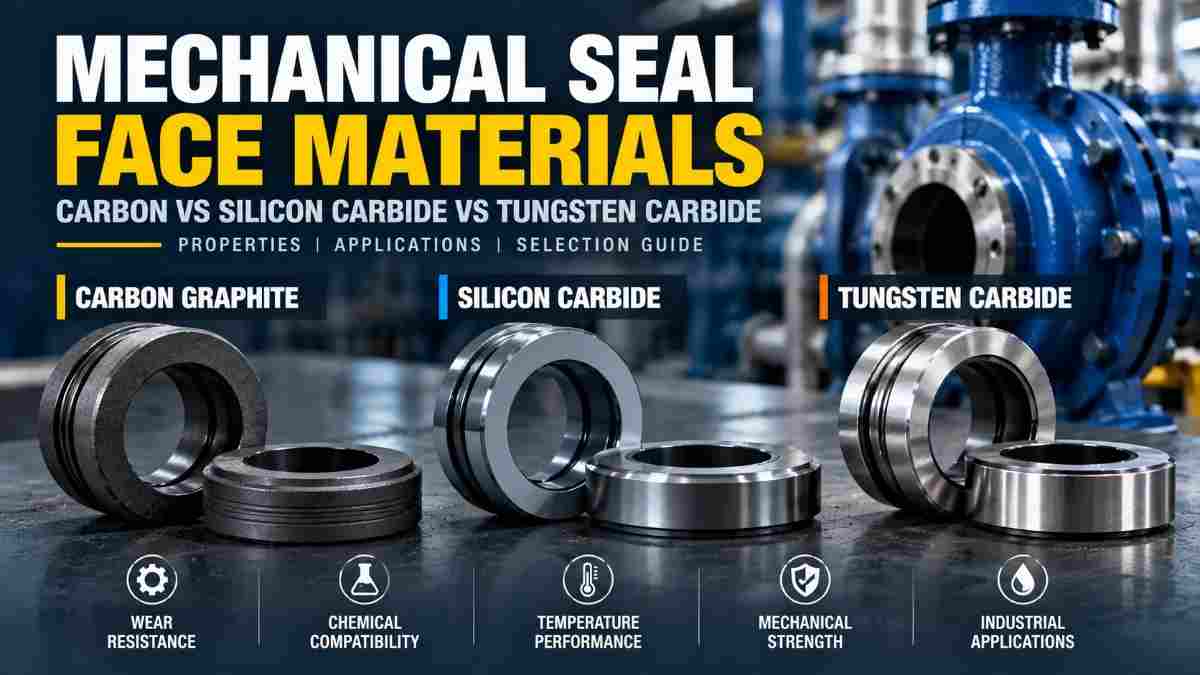
Are you selecting mechanical seal faces for industrial pumps, mixers, agitators, or other rotating equipment? Choosing the right sealing material is essential because mechanical seal faces operate under friction, pressure, temperature changes, and continuous contact with process fluids.
The main difference between carbon, silicon carbide, and tungsten carbide mechanical seal faces is their behavior under friction, abrasive wear, chemical exposure, and mechanical loading. Carbon graphite offers favorable frictional properties, silicon carbide provides high hardness and strong wear resistance, while tungsten carbide combines wear resistance with mechanical toughness.
However, no single material is suitable for every industrial application.
The correct mechanical seal face material selection depends on the process fluid, solids content, operating temperature, seal chamber pressure, shaft speed, lubrication conditions, and compatible mating face.
Arohan Seals manufactures and supplies mechanical seals and sealing components, including silicon carbide seal faces, tungsten carbide seal faces, and rotary and stationary seal components.
This guide explains how these materials differ, which combinations are commonly considered, and what industrial buyers should check before ordering replacement mechanical seal faces.
What Is the Difference Between Carbon, Silicon Carbide, and Tungsten Carbide Seal Faces?
Carbon graphite is a relatively soft sealing material with favorable frictional properties, silicon carbide is a hard ceramic with strong wear and thermal characteristics, and tungsten carbide is a hard composite known for wear resistance and mechanical toughness.
Their main characteristics include:
Carbon graphite seal faces:
-
Favorable frictional behavior.
-
Commonly used as the softer member of a seal face pair.
-
Available in different impregnated grades.
-
Suitable for many clean-fluid applications.
-
Can be vulnerable to rapid wear in abrasive service.
-
Chemical resistance depends on the carbon grade and impregnant.
Silicon carbide seal faces:
-
High hardness.
-
Strong resistance to abrasive wear.
-
Good thermal conductivity.
-
Available in sintered and reaction-bonded grades.
-
Suitable for selected corrosive and abrasive services.
-
Chemical compatibility depends on the exact material grade.
Tungsten carbide seal faces:
-
High hardness and wear resistance.
-
Good mechanical toughness.
-
Resistance to certain impact and shock-loading conditions.
-
Commonly used in demanding industrial applications.
-
Available with different binder materials.
-
Chemical compatibility depends partly on binder composition.
These properties help explain why different applications require different face materials.
Explore the Rotary and Stationary Seal Face Collection for available material options.
What Is a Carbon Graphite Mechanical Seal Face?
A carbon graphite mechanical seal face is a sealing component manufactured from an engineered carbon material, often impregnated with resin or metal to achieve particular mechanical and chemical properties.
Carbon graphite is commonly used as the softer face in mechanical seal assemblies.
It is often paired with a harder material such as silicon carbide or a suitable ceramic.
What Are the Main Benefits of Carbon Graphite Seal Faces?
Carbon graphite seal faces offer favorable frictional properties and can perform well in appropriately lubricated, relatively clean-fluid applications.
Potential advantages include:
-
Relatively low-friction contact behavior.
-
Compatibility with various hard mating faces.
-
Established use in general industrial mechanical seals.
-
Availability in different impregnated material grades.
-
Suitability for selected water, oil, and process-fluid services.
The actual performance depends on the carbon grade, mating surface, seal design, and operating conditions.
Where Are Carbon Graphite Seal Faces Commonly Used?
Carbon graphite seal faces are commonly used in water pumps, selected oil-handling systems, and general industrial pumping applications where the material is compatible with the fluid and loading conditions.
Potential applications include:
-
Water circulation systems.
-
Utility pumps.
-
Certain clean process-fluid pumps.
-
Selected light hydrocarbon services.
-
General-purpose industrial mechanical seals.
Carbon should not automatically be selected for fluids containing abrasive solids.
What Is a Silicon Carbide Mechanical Seal Face?
A silicon carbide mechanical seal face is a hard ceramic sealing component used where wear resistance, thermal performance, and material stability are important.
Silicon carbide is commonly identified by the abbreviation SiC.
It is used in mechanical seals for selected industrial pumps, compressors, mixers, and other rotating equipment.
What Are the Main Benefits of Silicon Carbide Seal Faces?
Silicon carbide seal faces provide high hardness, good thermal conductivity, and strong wear resistance, making suitable grades useful for demanding industrial sealing applications.
Potential advantages include:
-
Resistance to abrasive wear.
-
High surface hardness.
-
Good heat-transfer properties.
-
Dimensional stability under appropriate operating conditions.
-
Compatibility with selected corrosive media.
-
Availability in different engineering grades.
However, silicon carbide can be brittle under certain mechanical loading conditions.
Installation, lubrication, and mating-face selection remain important.
Where Are Silicon Carbide Seal Faces Commonly Used?
Silicon carbide seal faces are commonly considered for chemical processing, wastewater treatment, slurry handling, and other applications requiring a suitable hard-face material.
Potential applications include:
-
Chemical process pumps.
-
Wastewater pumps.
-
Selected slurry systems.
-
Pharmaceutical processing equipment.
-
Industrial mixers.
-
General process-fluid pumps.
Arohan Seals offers different material configurations through its Silicon Carbide Seal Face product range.
What Is the Difference Between Sintered and Reaction-Bonded Silicon Carbide?
Sintered silicon carbide and reaction-bonded silicon carbide differ in their manufacturing processes and resulting material composition, which can affect chemical compatibility and other performance characteristics.
What Is Sintered Silicon Carbide?
Sintered silicon carbide is a ceramic material produced using a sintering process that forms a dense silicon carbide structure.
It is frequently considered for demanding chemical applications because suitable grades offer high hardness and broad chemical resistance.
However, chemical compatibility must still be checked against the specific process fluid and operating temperature.
What Is Reaction-Bonded Silicon Carbide?
Reaction-bonded silicon carbide is manufactured through a reaction-infiltration process and typically contains a residual silicon phase.
It offers useful hardness, wear resistance, and thermal characteristics.
However, the residual silicon phase can make some grades unsuitable for particular aggressive acids or caustic environments.
Before ordering, buyers should confirm whether the proposed product is sintered or reaction-bonded silicon carbide.
These materials should not be treated as interchangeable simply because both are called SiC.
What Is a Tungsten Carbide Mechanical Seal Face?
A tungsten carbide mechanical seal face is a hard, wear-resistant component made from tungsten carbide particles combined with a suitable binder material.
Tungsten carbide is commonly abbreviated as TC or WC.
The binder helps create a dense composite with useful toughness and mechanical properties.
What Are the Main Benefits of Tungsten Carbide Seal Faces?
Tungsten carbide seal faces can provide strong wear resistance and mechanical toughness in applications involving abrasive particles, mechanical loads, or demanding operating conditions.
Potential advantages include:
-
High hardness.
-
Resistance to abrasive wear.
-
Good mechanical toughness.
-
Suitability for certain high-load conditions.
-
Availability in different binder grades.
-
Use in specialized industrial sealing components.
The exact properties vary by composition and manufacturing process.
Where Are Tungsten Carbide Seal Faces Commonly Used?
Tungsten carbide seal faces are commonly considered for abrasive or mechanically demanding equipment, including selected slurry pumps and heavy industrial sealing systems.
Potential applications include:
-
Mining equipment.
-
Slurry-handling pumps.
-
Dredging systems.
-
Certain wastewater applications.
-
Heavy industrial machinery.
-
Selected oil and gas equipment.
Explore Tungsten Carbide Seal Faces from Arohan Seals for available materials and configurations.
What Is the Difference Between Nickel-Bound and Cobalt-Bound Tungsten Carbide?
Nickel-bound and cobalt-bound tungsten carbide use different metallic binders, which influence toughness, corrosion behavior, and suitability for particular industrial fluids.
Cobalt-bound tungsten carbide is often selected where mechanical toughness and wear resistance are important.
Nickel-bound tungsten carbide may offer improved resistance to certain corrosive environments compared with some cobalt-bound grades.
However, neither material is universally resistant to every chemical.
When choosing a tungsten carbide grade, check:
-
Binder composition.
-
Process fluid chemistry.
-
Operating temperature.
-
Abrasive particle content.
-
Mechanical loading.
-
Material compatibility.
-
Manufacturer technical data.
The binder should be specified explicitly when it affects the application.
Which Seal Face Material Is Better for Abrasive Fluids?
Silicon carbide and tungsten carbide are commonly considered for abrasive fluids because both provide high hardness and resistance to wear. The best choice depends on solids concentration, particle characteristics, lubrication, chemical exposure, and mechanical loading.
Abrasive service may involve:
-
Sand.
-
Slurry particles.
-
Mineral solids.
-
Crystallized chemicals.
-
Process contaminants.
-
Suspended industrial particles.
Carbon graphite may experience accelerated wear when abrasive solids enter the sealing interface.
For demanding service, engineers may consider suitable hard-face combinations.
However, harder materials alone do not eliminate abrasion-related problems.
Seal design, flushing arrangements, and fluid conditions must also be evaluated.
Which Mechanical Seal Face Material Has Better Chemical Resistance?
Sintered silicon carbide is frequently considered for aggressive chemical environments because suitable grades offer broad chemical resistance. Carbon graphite and tungsten carbide may also be suitable for selected fluids, depending on their compositions.
Chemical resistance depends on:
-
Process fluid.
-
Chemical concentration.
-
Operating temperature.
-
Exposure duration.
-
Carbon impregnant.
-
Tungsten carbide binder.
-
Silicon carbide grade.
-
Seal support fluid.
For example, some reaction-bonded silicon carbide grades may be unsuitable for specific aggressive chemical environments.
Similarly, a tungsten carbide grade may experience binder-related corrosion even when its hard particles are resistant.
Chemical compatibility must be verified for the complete material grade.
Which Seal Face Material Handles High Temperatures Better?
Silicon carbide and tungsten carbide offer useful thermal properties, but the most suitable seal face material depends on the complete seal design, fluid lubrication, heat generation, and operating temperature.
Silicon carbide generally offers strong thermal conductivity and dimensional stability.
Tungsten carbide also provides useful heat-transfer and mechanical properties.
Carbon graphite can offer favorable frictional behavior in compatible applications.
However, temperature suitability cannot be determined by face material alone.
Engineers must also consider:
-
Secondary elastomer limits.
-
Springs and metallic components.
-
Process fluid vapor pressure.
-
Lubrication conditions.
-
Cooling arrangements.
-
Thermal expansion.
-
Seal chamber geometry.
A face material with good thermal properties can still fail if the seal operates outside its design limits.
Which Mechanical Seal Face Pairing Is Better for Industrial Pumps?
The best mechanical seal face pairing depends on the process fluid, lubrication conditions, expected wear, chemical compatibility, and equipment requirements. Common arrangements include carbon against silicon carbide and selected hard-face combinations.
When Should You Consider Carbon Against Silicon Carbide?
Carbon against silicon carbide is commonly used in industrial sealing applications where a softer carbon face and harder silicon carbide mating face provide suitable frictional and wear behavior.
Potential applications include:
-
Clean water pumps.
-
Selected process-fluid systems.
-
General industrial services.
-
Certain chemical applications.
The selected carbon and SiC grades must be compatible with the process.
When Should You Consider Silicon Carbide Against Silicon Carbide?
Silicon carbide against silicon carbide may be considered for abrasive or chemically demanding services when the complete seal design provides appropriate lubrication and operating conditions.
This pairing may be useful in selected:
-
Slurry-handling systems.
-
Wastewater applications.
-
Chemical process pumps.
-
Abrasive-fluid services.
It should not be assumed to tolerate continuous dry running.
When Should You Consider Tungsten Carbide Against Tungsten Carbide?
Tungsten carbide against tungsten carbide may be considered for certain abrasive and mechanically demanding applications when the binder grades, lubrication, and operating conditions are suitable.
These combinations require application-specific evaluation.
A hard-face pairing should not be selected solely because it offers greater hardness.
Can the Wrong Seal Face Material Cause Mechanical Seal Failure?
Yes. Incorrect seal face material selection can contribute to premature wear, chemical deterioration, thermal damage, cracking, and leakage.
Potential failure mechanisms include:
-
Abrasion from suspended solids.
-
Chemical attack on binders or impregnants.
-
Thermal cracking.
-
Excessive face friction.
-
Inadequate lubrication.
-
Mechanical chipping.
-
Surface distortion.
-
Accelerated wear.
Replacing a damaged face with the same material without identifying the failure mechanism may lead to repeated problems.
Material selection should be part of a complete failure investigation.
Does a Harder Seal Face Always Last Longer?
No. Greater hardness does not automatically guarantee longer mechanical seal life. Seal performance depends on friction, lubrication, chemical compatibility, thermal characteristics, mating-face behavior, and operating conditions.
A very hard material may resist abrasion but still be unsuitable for:
-
Certain chemicals.
-
Severe mechanical shock.
-
Poor lubrication.
-
Excessive thermal cycling.
-
An incompatible mating material.
For example, a carbon-based face may be appropriate in a clean-fluid application even when harder materials are available.
The goal is to select a compatible face pairing, not simply the hardest material.
What Should You Check Before Ordering Replacement Mechanical Seal Faces?
Before ordering replacement seal faces, verify the material grade, dimensions, face configuration, mating material, operating conditions, and equipment compatibility.
A practical purchasing checklist includes:
-
Seal type: Existing mechanical seal configuration.
-
Face material: Carbon, SiC, TC, or another specified material.
-
Material grade: Sintered SiC, reaction-bonded SiC, nickel-bound TC, or another grade.
-
Dimensions: Inner diameter, outer diameter, and thickness.
-
Geometry: Required face design and mounting arrangement.
-
Mating face: Material of the opposing sealing component.
-
Fluid: Process liquid and relevant chemical composition.
-
Temperature: Normal and maximum operating conditions.
-
Pressure: Seal chamber pressure.
-
Speed: Shaft rotational speed.
-
Solids: Particle concentration and characteristics.
-
Quantity: Required number of components.
-
Documentation: Applicable drawings and technical specifications.
Measurements should be taken using appropriate tools and verified against approved drawings.
How Can You Verify the Quality of Mechanical Seal Faces?
Mechanical seal face quality should be evaluated through material identification, dimensional inspection, surface condition, flatness verification, and relevant manufacturing documentation.
Important quality checks include:
-
Correct material designation.
-
Required dimensions.
-
Surface finish.
-
Lapped-face condition.
-
Face flatness.
-
Visible cracks or chips.
-
Edge damage.
-
Material uniformity.
-
Appropriate identification.
-
Required inspection records.
The permitted surface finish and flatness tolerances depend on the seal design and manufacturer specifications.
A visually smooth seal face is not necessarily acceptable without suitable dimensional and technical verification.
Why Should Industrial Buyers Consider Arohan Seals for Mechanical Seal Faces?
Arohan Seals offers multiple mechanical seal face materials and related sealing components for industrial pumps, mixers, agitators, and other rotating equipment.
Based in Mumbai, India, the company provides different sealing products for industrial applications.
Relevant product categories include:
-
Carbon graphite seal faces.
-
Silicon carbide seal faces.
-
Tungsten carbide seal faces.
-
Rotary seal faces.
-
Stationary seal faces.
-
Cartridge mechanical seals.
Its product pages describe material configurations, dimensional options, and customized sealing components.
Buyers can review:
Actual product suitability, availability, and technical specifications should be confirmed before purchasing.
What Information Should You Include in a Seal Face Material Quotation Request?
A seal face quotation request should include the required material, dimensions, mating-face specification, equipment details, operating conditions, and order quantity.
Provide:
-
Equipment manufacturer and model.
-
Mechanical seal model or drawing.
-
Required face material.
-
Material grade.
-
Inner and outer diameters.
-
Face thickness.
-
Required face geometry.
-
Mating-face material.
-
Process fluid.
-
Operating temperature.
-
Seal chamber pressure.
-
Shaft speed.
-
Abrasive particle content.
-
Existing failure history.
-
Required quantity.
-
Delivery destination.
If the existing material is unknown, provide clear photographs, measurements, and available technical records.
Submit the details through the Arohan Seals website for product and quotation enquiries.
What Are the Most Frequently Asked Questions About Mechanical Seal Face Materials?
Common questions about mechanical seal face materials concern wear resistance, chemical compatibility, face pairings, dry running, high-temperature performance, and replacement selection.
Is Silicon Carbide Better Than Tungsten Carbide for Mechanical Seals?
Neither material is universally better. Silicon carbide is often considered where chemical resistance and thermal behavior are important, while tungsten carbide may be preferred for certain mechanically demanding or impact-related conditions.
Is Carbon Graphite Suitable for Mechanical Seal Faces?
Yes. Engineered carbon graphite grades are widely used in mechanical seals, often as the softer face paired with a suitable hard material.
Which Seal Face Material Is Best for Slurry Pumps?
Suitable silicon carbide or tungsten carbide combinations may be considered for slurry pumps. Selection depends on solids content, chemical conditions, lubrication, seal arrangement, and equipment design.
Can Silicon Carbide Seal Faces Handle Corrosive Chemicals?
Certain silicon carbide grades can perform well in corrosive environments. Chemical compatibility must be verified because sintered and reaction-bonded grades can differ.
Does Tungsten Carbide Rust or Corrode?
Tungsten carbide composites can experience corrosion or binder deterioration in unsuitable chemical environments. Performance depends on binder composition and service conditions.
Can Carbon Seal Faces Handle Dry Running?
Certain carbon grades provide favorable frictional properties under marginal lubrication, but conventional mechanical seals should not automatically be considered safe for continuous dry running.
Which Material Is Harder: Carbon, Silicon Carbide, or Tungsten Carbide?
Silicon carbide and tungsten carbide are substantially harder than commonly used mechanical carbon-graphite grades. However, hardness alone does not determine the best face pairing.
Can Silicon Carbide and Carbon Be Used Together?
Yes. Carbon and silicon carbide form a commonly used hard-soft sealing combination when the material grades and operating conditions are compatible.
Can You Replace Carbon With Silicon Carbide in an Existing Mechanical Seal?
Possibly, but material substitution should be reviewed by the seal manufacturer or a qualified engineer. Changing one face material can affect friction, heat generation, loading, and mating-face compatibility.
How Long Do Mechanical Seal Faces Last?
Service life varies with seal design, material pairing, operating conditions, fluid characteristics, installation quality, and maintenance. No universal service-life guarantee applies to all mechanical seal faces.
How Can You Request Carbon, Silicon Carbide, or Tungsten Carbide Seal Faces From Arohan Seals?
You can request mechanical seal faces from Arohan Seals by sharing the required material grade, component dimensions, mating-face specifications, equipment details, process conditions, and quantity.
Selecting the correct sealing material is important for reducing avoidable wear and matching the seal to the intended industrial service.
Whether you are maintaining a water pump, chemical process pump, slurry system, or industrial agitator, material selection should account for the complete seal assembly rather than an individual component alone.
Looking for a mechanical seal face manufacturer in India?
Explore Silicon Carbide Seal Faces, Tungsten Carbide Seal Faces, or Rotary and Stationary Seal Faces from Arohan Seals.
For application-specific recommendations and bulk quotations, contact Arohan Seals with your technical requirements.
Technical Note: Seal face materials must be selected using verified process conditions, material compatibility data, and manufacturer specifications. Replacing or changing a seal face material without engineering review can affect seal performance and equipment safety.