
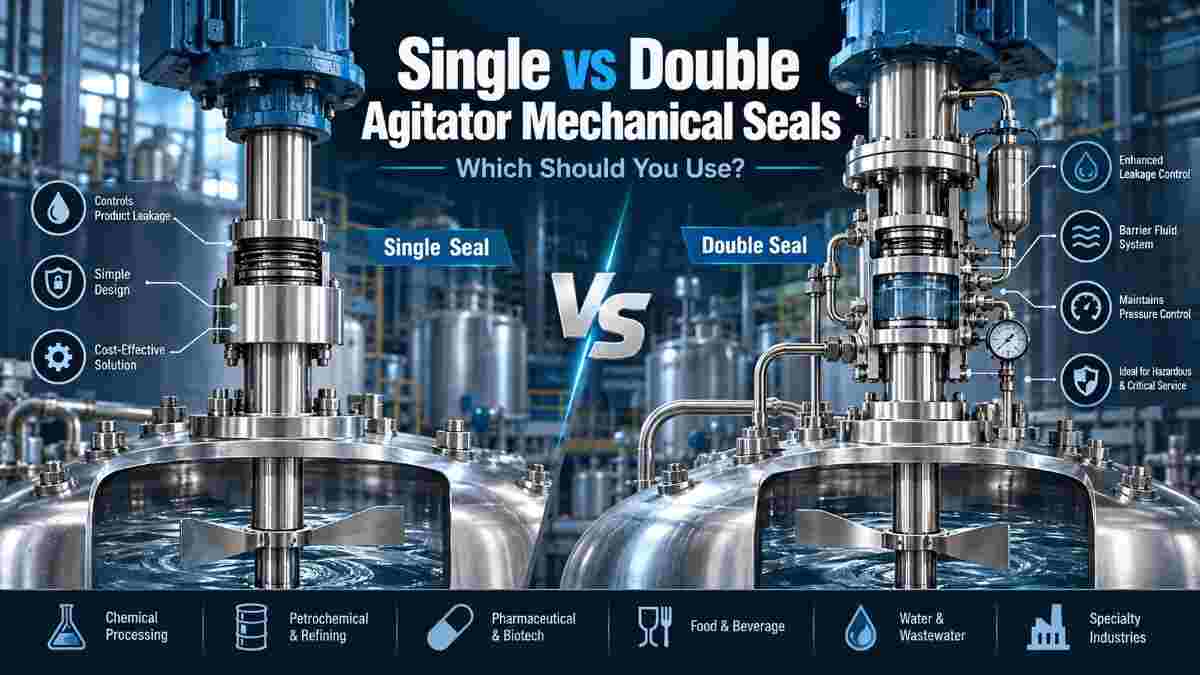
Choosing the right mechanical seal for an industrial agitator or reactor is essential for controlling process leakage, protecting equipment, and maintaining safe operating conditions.
Agitators and reactors are used in chemical processing, pharmaceutical production, food manufacturing, polymer processing, and other industries where reliable shaft sealing is important.
Two commonly used sealing arrangements are single mechanical seals and double mechanical seals. Both are designed to control leakage around rotating shafts, but their construction, operating requirements, and containment capabilities differ.
The main difference between single and double agitator mechanical seals is that a single seal uses one primary sealing interface, while a double seal uses two sealing interfaces with an intermediate chamber that may contain a buffer or barrier fluid.
Single mechanical seals are often suitable for compatible, lower-risk process fluids and operating conditions. Double mechanical seals are frequently considered when enhanced containment, additional lubrication, or protection against hazardous and contamination-sensitive fluids is required.
However, choosing a double seal does not automatically guarantee better performance. The correct arrangement depends on process chemistry, pressure, temperature, shaft movement, vessel configuration, and supporting systems.
This guide explains the differences between single and double mechanical seals for agitators and reactors, including their working principles, applications, fluid support systems, maintenance requirements, and selection criteria.
What Is an Agitator Mechanical Seal?
An agitator mechanical seal is a shaft-sealing device designed to control leakage where a rotating agitator shaft passes through a stationary vessel or equipment housing.
Industrial agitators are used to mix, blend, suspend, dissolve, or react materials inside processing vessels.
Unlike many conventional pump installations, agitator applications may involve long shafts, relatively low rotational speeds, shaft deflection, changing liquid levels, vessel pressure fluctuations, and different mounting orientations.
These operating conditions create specific sealing challenges.
Agitator mechanical seals are therefore available in different constructions to accommodate the application requirements.
Common configurations include:
- Single agitator mechanical seals
- Double agitator mechanical seals
- Dry-running agitator seals
- Reactor double mechanical seals
- Split mechanical seals
- Cartridge-style agitator seals
Arohan Seals provides an Agitator Mechanical Seal product range for mixers, reactors, and other industrial processing equipment.
What Is a Single Agitator Mechanical Seal?
A single agitator mechanical seal has one primary sealing interface formed by a rotating face and a stationary face.
The seal faces operate together to control the movement of process fluid or vapor along the rotating shaft.
Additional secondary sealing components, springs, and mounting hardware help maintain the intended sealing conditions.
Depending on the design, the seal faces may be lubricated by the process fluid or another approved sealing medium.
Single agitator mechanical seals are commonly considered for applications where:
- The process fluid is compatible with the seal materials.
- Limited controlled leakage is acceptable.
- Process conditions fall within the seal's pressure and temperature ratings.
- The fluid provides appropriate lubrication or a suitable support arrangement is available.
- The application does not require a separate containment interface.
A single seal can be a practical solution for many general-purpose industrial mixing operations.
However, it may not provide adequate containment for every hazardous, volatile, or contamination-sensitive process.
What Is a Double Mechanical Seal for an Agitator?
A double agitator mechanical seal contains two sealing interfaces arranged to provide an additional level of containment around the rotating shaft.
The chamber between the seals may contain a compatible liquid or gas used for lubrication, cooling, contamination control, or process-fluid containment.
Double seals may be configured with a pressurized barrier system or an unpressurized buffer system, depending on the arrangement.
They are commonly considered for:
- Hazardous chemical processing
- Volatile or toxic process fluids
- Contamination-sensitive production
- Selected pressurized reactors
- Vacuum processing applications
- Specialized pharmaceutical equipment
- Processes needing additional leakage containment
The suitability of a double seal depends on the complete equipment design and the availability of an appropriately engineered support system.
Arohan Seals lists double configurations within its industrial agitator sealing range, including options for demanding reactor applications.
What Is the Difference Between Single and Double Agitator Mechanical Seals?
The key differences involve sealing construction, containment capability, support-system requirements, cost, and maintenance.
| Feature | Single Agitator Seal | Double Agitator Seal |
|---|---|---|
| Primary Sealing Interfaces | One | Two |
| Construction | Generally simpler | More complex |
| Leakage Control | Controlled leakage through one interface | Additional containment capability |
| Buffer or Barrier Fluid | Not normally a separate intermediate system | May require a dedicated fluid or gas system |
| Installation | Generally simpler | Additional connections and checks may be required |
| Initial Cost | Usually lower | Usually higher |
| Maintenance | Fewer sealing interfaces | Two interfaces and support equipment may need attention |
| Hazardous Fluid Applications | Only where approved for the service | Often considered for enhanced containment |
| Contamination Control | Application-dependent | Can provide additional separation with suitable fluid management |
| Selection Criteria | Fluid, pressure, temperature, shaft conditions | Same factors plus support system and containment requirements |
These differences represent general design characteristics. Actual performance depends on the manufacturer's seal configuration and approved operating limits.
How Does a Single Mechanical Seal Work in an Agitator?
A conventional single mechanical seal operates through controlled contact and a thin lubricating film between two precision-finished faces.
One face rotates with the agitator shaft, while the other remains stationary.
The spring mechanism and hydraulic forces maintain the required face loading.
When the seal is properly selected and operated, the sealing interface restricts leakage while permitting shaft rotation.
However, a conventional contact seal generally requires adequate lubrication and heat removal.
Does a Single Agitator Seal Require Liquid Lubrication?
Many conventional single mechanical seals require a suitable fluid film at the sealing faces.
However, not every agitator seal operates under the same lubrication conditions.
Top-entry agitators may have their sealing arrangement above the normal process-liquid level, creating a possible dry-running condition.
In such cases, a purpose-designed dry-running seal or another suitable support arrangement may be required.
Can a Single Mechanical Seal Handle Vacuum Conditions?
Some single agitator seal designs are suitable for vacuum service, but compatibility depends on the pressure direction, face loading, and equipment configuration.
A seal intended for positive internal pressure may not automatically perform correctly under vacuum.
The required vacuum rating should be confirmed with the manufacturer.
How Does a Double Mechanical Seal Work in a Reactor?
A double mechanical seal uses two sealing interfaces with an intermediate chamber between them.
This chamber may contain a compatible liquid or gas supplied at a controlled pressure.
Depending on the configuration, the intermediate fluid may provide lubrication, cooling, contamination control, or additional containment.
The fluid's pressure relationship to the process is especially important.
Some double arrangements operate with the intermediate fluid at a lower pressure than the process, while others use a pressurized barrier fluid.
What Is the Role of the Inner Mechanical Seal?
The inboard or process-side mechanical seal separates the process fluid from the intermediate sealing chamber.
Its materials and operating limits must be compatible with the actual process conditions.
What Is the Role of the Outer Mechanical Seal?
The outboard seal separates the intermediate chamber from the external environment.
Its function depends on the arrangement, but it may provide additional containment and help manage leakage from the intermediate fluid system.
Do Double Mechanical Seals Provide Zero Leakage?
Double mechanical seals can substantially reduce process-fluid emissions when correctly engineered, installed, and maintained.
However, absolute zero leakage should not be assumed.
The achievable containment depends on the design, fluid system, operating conditions, inspection, and maintenance practices.
What Is the Difference Between Barrier Fluid and Buffer Fluid?
Barrier fluids and buffer fluids are used in certain dual mechanical sealing arrangements.
The most important distinction is their operating pressure relative to the process fluid.
| Feature | Barrier Fluid | Buffer Fluid |
|---|---|---|
| Typical Pressure | Higher than the process pressure | Lower than the process pressure |
| Typical Arrangement | Pressurized dual seal | Unpressurized dual seal |
| Primary Purpose | Lubrication, cooling, process containment | Leakage collection, containment, support |
| Possible Leakage Direction | Barrier fluid may enter the process | Process fluid may enter the buffer system |
| Main Consideration | Barrier compatibility and pressure control | Collection, monitoring, and safe handling |
The appropriate fluid and pressure setting depend on the seal arrangement and equipment specification.
Mechanical seal manufacturer John Crane also distinguishes pressurized barrier systems from unpressurized buffer arrangements in its technical guidance.
When Should You Use a Pressurized Double Mechanical Seal?
A pressurized double seal may be suitable when the process requires enhanced containment or when the process fluid cannot reliably lubricate the primary sealing faces.
In this arrangement, barrier fluid pressure is maintained above the relevant process pressure according to the manufacturer's design requirements.
This helps control the direction of leakage across the process-side sealing interface.
Applications may include:
- Selected toxic or hazardous chemical services
- Contamination-sensitive processes where the barrier fluid is acceptable
- Fluids with poor lubrication characteristics
- Selected crystallizing or solids-containing fluids
- High-consequence reactor applications
The barrier fluid must be compatible with the process because some fluid transfer toward the process may occur.
For demanding chemical processing equipment, Arohan Seals offers Reactor Double Mechanical Seals for specialized operating conditions.
When Is an Unpressurized Double Seal Suitable?
An unpressurized double mechanical seal uses an intermediate buffer fluid maintained below the process-side pressure under the intended arrangement.
It may be selected where additional leakage collection and monitoring are required without introducing a pressurized barrier fluid into the process.
The suitability depends on the process fluid, containment requirements, and design of the buffer system.
An unpressurized arrangement should not be assumed sufficient for every toxic or hazardous application.
Which Mechanical Seal Is Better for Chemical Reactors?
The best mechanical seal for a chemical reactor depends on the fluid's toxicity, volatility, corrosiveness, temperature, pressure, and potential to crystallize or solidify.
A single mechanical seal may be suitable for a compatible, lower-risk process where its expected leakage is acceptable.
A double mechanical seal may be preferred when additional containment or a controlled intermediate fluid system is necessary.
Are Double Seals Better for Hazardous Chemicals?
Double mechanical seals are commonly evaluated for hazardous process fluids because they can provide an additional containment interface.
However, the sealing arrangement must be selected according to the fluid's hazards and the facility's engineering and environmental requirements.
Can a Single Seal Handle Corrosive Chemicals?
Yes, in suitable applications.
Single-seal suitability depends on selecting compatible seal faces, elastomers, and metallic components, as well as ensuring that the leakage-control requirements can be met.
Corrosive service does not automatically require a double seal, but the complete process risks must be evaluated.
Which Seal Is Better for Pharmaceutical and Food Processing?
Pharmaceutical and food-processing equipment may require strict control of process contamination, hygienic design, cleaning procedures, and material compatibility.
Both single and double mechanical seals can be used where their designs meet the application requirements.
A double seal may provide useful additional separation, but barrier-fluid selection is critical because some arrangements can introduce the barrier medium into the process.
Important considerations include:
- Process-contact material compatibility
- Cleanability and hygienic construction
- Approved lubricants or barrier fluids
- Cleaning-in-place requirements
- Sterilization conditions, where applicable
- Seal support and drainability
- Contamination monitoring
The seal design should be evaluated against relevant plant quality and validation requirements.
Why Do Agitator Seals Need to Handle Shaft Deflection?
Agitators may have longer shafts than conventional centrifugal pumps, increasing the possibility of shaft deflection or movement during mixing.
The magnitude of this movement depends on shaft geometry, bearing support, mixing forces, and equipment design.
Excessive movement can disturb seal-face loading or damage secondary sealing components.
Agitator seals may therefore incorporate design features such as suitable bearings, increased clearances, flexible arrangements, or specially engineered seal geometry.
Can a Double Seal Compensate for Severe Shaft Misalignment?
No.
Double-seal construction does not automatically correct misalignment, excessive shaft movement, or damaged bearings.
The equipment should operate within the seal manufacturer's allowable shaft movement and runout limits.
Why Is Mounting Position Important?
Top-entry, side-entry, and bottom-entry agitators can create different lubrication, drainage, pressure, and product-exposure conditions.
The mounting position must be considered when selecting the seal arrangement and support system.
Which Mechanical Seal Is Best for Top-Entry Agitators?
Top-entry agitators frequently place the shaft seal above the normal process-liquid level.
In this arrangement, the seal may not receive continuous lubrication from the process liquid.
A conventional liquid-lubricated seal should not be assumed suitable for dry operation.
Specialized dry-running mechanical seals or suitable gas- or liquid-supported designs may be required.
Arohan Seals offers Agitator Dry Running Mechanical Seals for specified mixing and reactor applications.
Which Seal Is Better for Bottom-Entry Reactors?
Bottom-entry reactors can expose the seal directly to process fluid and static liquid head.
Potential challenges include:
- Process leakage at the lower vessel connection
- Pressure loading
- Solids settling near the seal chamber
- Maintenance accessibility
- Fluid compatibility
- Containment during shutdown
A single or double seal may be suitable depending on process hazards, operating pressure, fluid characteristics, and required containment.
For hazardous or demanding service, a double reactor seal with an appropriate support system may be necessary.
What Seal Face Materials Are Used in Agitator and Reactor Seals?
Common mechanical seal face materials include:
- Carbon graphite
- Silicon carbide
- Tungsten carbide
- Selected specialized ceramic materials
Secondary seal and structural materials may include:
- FKM
- EPDM
- PTFE
- FFKM
- Stainless steel
- Hastelloy and other corrosion-resistant alloys
The correct combination depends on fluid chemistry, temperature, pressure, abrasion, lubrication, and equipment design.
Is Silicon Carbide Better for Corrosive Reactor Fluids?
Suitable grades of silicon carbide may offer useful chemical and wear resistance in aggressive fluids.
However, material compatibility must be checked for the specific chemical mixture and temperature.
When Should You Consider Tungsten Carbide?
Appropriate tungsten carbide grades may be useful where mechanical toughness and abrasive resistance are important.
The binder material must also be compatible with the process chemistry.
What Are the Common Causes of Agitator Mechanical Seal Leakage?
Leakage may result from seal defects, equipment problems, or support-system failures.
| Common Problem | Possible Cause | Recommended Check |
|---|---|---|
| Leakage after installation | Incorrect setting or damaged secondary seal | Inspect assembly and dimensions |
| Overheated seal faces | Insufficient lubrication or cooling | Review lubrication and support flow |
| Repeated face damage | Excessive shaft movement | Inspect bearings, shaft and alignment |
| Barrier fluid pressure loss | Support system leak or malfunction | Check piping, reservoir and pressure controls |
| Rapid abrasive wear | Solids entering sealing interface | Review fluid contamination and seal arrangement |
| Elastomer deterioration | Chemical or thermal incompatibility | Verify secondary sealing materials |
| Unexpected process contamination | Incorrect barrier fluid or pressure conditions | Review dual seal design and support requirements |
Maintenance teams should identify the underlying cause before replacing a failed seal.
How Do You Maintain Single and Double Agitator Mechanical Seals?
Preventive maintenance helps identify unfavorable operating conditions before they cause repeated failures.
What Maintenance Is Required for Single Agitator Seals?
Important activities may include:
- Checking for abnormal leakage
- Monitoring process pressure and temperature
- Inspecting shaft vibration and bearings
- Confirming adequate lubrication
- Reviewing startup and shutdown procedures
- Investigating unusual noise or heat
What Additional Maintenance Is Required for Double Seals?
Double seals may require additional monitoring of:
- Barrier or buffer fluid pressure
- Fluid level and condition
- Support-system temperature
- Cooling and circulation performance
- Pressure regulators
- Reservoir and piping connections
- Leakage collection and alarms
All inspection and maintenance work should follow the manufacturer's instructions and plant safety procedures.
Are Double Mechanical Seals More Expensive Than Single Seals?
Double agitator mechanical seals generally have a higher initial cost because they contain two sealing interfaces and may require additional components and supporting equipment.
Single seals often cost less initially, making them suitable for certain cost-sensitive applications.
However, material selection should not be based on purchase price alone.
Important cost factors include:
- Shaft diameter
- Seal configuration
- Face material selection
- Elastomer specifications
- Pressure and temperature ratings
- Vessel mounting arrangement
- Barrier or buffer system
- Inspection and testing
- Installation and maintenance
Double seals may provide long-term economic benefits where additional containment reduces the risk of costly leakage or contamination.
How Do You Compare the Lifecycle Cost of Single and Double Seals?
Lifecycle cost includes the expenses associated with purchasing, installing, operating, maintaining, and replacing the sealing system.
Lifecycle Cost = Seal Purchase + Installation + Support System + Maintenance + Replacement + Downtime Costs
For example, a single seal may offer a lower purchase price but may be unsuitable where additional containment is necessary.
A double seal can involve higher upfront costs and ongoing support-fluid maintenance, but may be economically justified if it reduces operational and containment risks in a specific process.
Lifecycle cost should be calculated using actual site conditions and supplier quotations.
Cost savings should not be assumed without supporting application-specific data.
How Do You Choose Between a Single and Double Mechanical Seal?
The selection should begin with the process-fluid characteristics and equipment requirements.
| Application Requirement | Seal Worth Evaluating | Main Consideration |
|---|---|---|
| Compatible, lower-risk mixing fluid | Single agitator seal | Controlled leakage and operating limits |
| Hazardous chemical reactor | Engineered double seal | Containment and safety requirements |
| Contamination-sensitive process | Suitable single or dual configuration | Process purity and fluid compatibility |
| Top-entry mixer above liquid level | Dry-running or supported seal | Lubrication conditions |
| Pressurized reactor | Appropriately rated seal system | Pressure rating and containment |
| Vacuum reactor | Vacuum-qualified seal | Pressure direction and face stability |
| Abrasive process mixture | Application-specific arrangement | Face materials, solids and flushing |
These are general selection considerations. Final approval requires review of the actual equipment and process specifications.
What Specifications Should You Provide When Ordering Agitator Mechanical Seals?
Buyers should share a complete technical specification with the seal manufacturer.
Which Equipment Details Are Required?
- Agitator or reactor manufacturer and model
- Shaft diameter
- Maximum shaft speed
- Shaft runout and expected movement
- Top-entry, side-entry or bottom-entry mounting
- Vessel connection dimensions
- Available installation space
- Existing seal design
Which Process Details Should Be Included?
- Process fluid composition
- Chemical concentration
- Operating and design pressure
- Operating and maximum temperature
- Vacuum conditions, if applicable
- Fluid viscosity
- Solids concentration
- Normal and minimum liquid level
- Hazard and containment requirements
- Cleaning or sterilization conditions
Which Seal Support Details Should Be Confirmed?
- Single or double arrangement
- Required buffer or barrier fluid
- Fluid compatibility
- Support system pressure
- Cooling or circulation requirements
- Monitoring and alarm provisions
- Available utilities
For demanding applications, provide an equipment drawing and existing seal details so the manufacturer can evaluate dimensional compatibility.
What Are the Common Mistakes When Selecting Agitator and Reactor Seals?
Common selection errors include:
- Choosing only by price: Ignoring containment and operational requirements.
- Assuming double seals cannot leak: Every arrangement has defined operating limitations.
- Ignoring shaft deflection: Excessive movement can damage seal faces.
- Using an ordinary liquid-lubricated seal in dry service: Lubrication failure may cause rapid damage.
- Specifying the wrong barrier fluid: Incompatible fluid may contaminate the process or damage components.
- Ignoring mounting orientation: Top-entry and bottom-entry systems may require different designs.
- Using incorrect pressure settings: Improper pressure differentials can affect sealing performance.
- Overlooking chemical compatibility: Seal faces and secondary components must suit the actual process.
- Ignoring support-system maintenance: A double seal depends on the correct operation of its supporting equipment.
- Replacing seals without investigating failures: Equipment-related problems may remain unresolved.
Frequently Asked Questions About Single vs Double Agitator Mechanical Seals
What Is the Main Difference Between Single and Double Agitator Seals?
A single agitator seal contains one primary sealing interface. A double agitator seal contains two sealing interfaces with an intermediate chamber that may use a buffer or barrier fluid.
Which Mechanical Seal Is Better for Chemical Reactors?
The best arrangement depends on the chemical hazards, pressure, temperature, leakage limits, and compatibility requirements. Double seals are commonly evaluated where additional process containment is necessary.
Are Double Mechanical Seals Safer Than Single Seals?
A properly engineered double seal can provide additional containment for demanding applications. However, safety depends on the complete system, including fluid support, monitoring, maintenance, and operating conditions.
Do Double Mechanical Seals Require Barrier Fluid?
Not every dual arrangement uses a pressurized barrier fluid. Some designs use an unpressurized buffer fluid, while specialized configurations may use gas-based systems.
Can a Single Mechanical Seal Be Used in a Reactor?
Yes. A single mechanical seal can be suitable where the process fluid, pressure, temperature, and containment requirements fall within the seal's approved operating limits.
What Is a Reactor Double Mechanical Seal?
A reactor double mechanical seal is a dual sealing arrangement designed for process vessels requiring additional containment or specialized operating capabilities.
Which Seal Is Suitable for a Top-Entry Agitator?
The correct choice depends on whether the seal operates with sufficient lubrication. Specialized dry-running or appropriately supported designs may be required when the process liquid does not reach the sealing interface.
Can Double Seals Prevent Product Contamination?
Properly selected double seals can support contamination control, but the barrier fluid and pressure arrangement must be compatible with the process. Some pressurized arrangements may allow barrier fluid to enter the product.
Are Double Mechanical Seals More Expensive?
They generally have higher initial and support-system costs because they contain additional sealing components. The total economic value depends on the process and containment requirements.
Can a Single Agitator Seal Be Replaced with a Double Seal?
Sometimes. A retrofit requires verification of shaft dimensions, available space, vessel connections, operating limits, and support-system requirements.
Is a Double Mechanical Seal Suitable for Vacuum Service?
Some double seal designs are suitable for vacuum applications. The pressure differential, seal configuration, and support system must be specifically approved for the operating conditions.
How Do You Choose the Right Agitator Mechanical Seal?
Evaluate process chemistry, containment needs, pressure, temperature, shaft movement, mounting orientation, lubrication conditions, material compatibility, and maintenance requirements before selecting the seal.
Which Agitator or Reactor Mechanical Seal Should You Choose?
Single and double mechanical seals both play important roles in industrial agitators, mixers, and reactors.
Single seals offer a simpler construction and can be suitable for compatible, lower-risk processes where their controlled leakage and operating limits are acceptable.
Double seals provide an additional sealing interface and can support more demanding containment requirements when paired with the appropriate fluid or gas support system.
However, selection must also account for mounting position, shaft deflection, lubrication, pressure, temperature, and material compatibility.
Arohan Seals offers agitator single, double, dry-running, and reactor-specific mechanical sealing configurations for different industrial requirements.
Explore Arohan Seals' Agitator Mechanical Seals and Reactor Double Mechanical Seals to review the available options and request a sealing solution based on your equipment specifications and process conditions.