
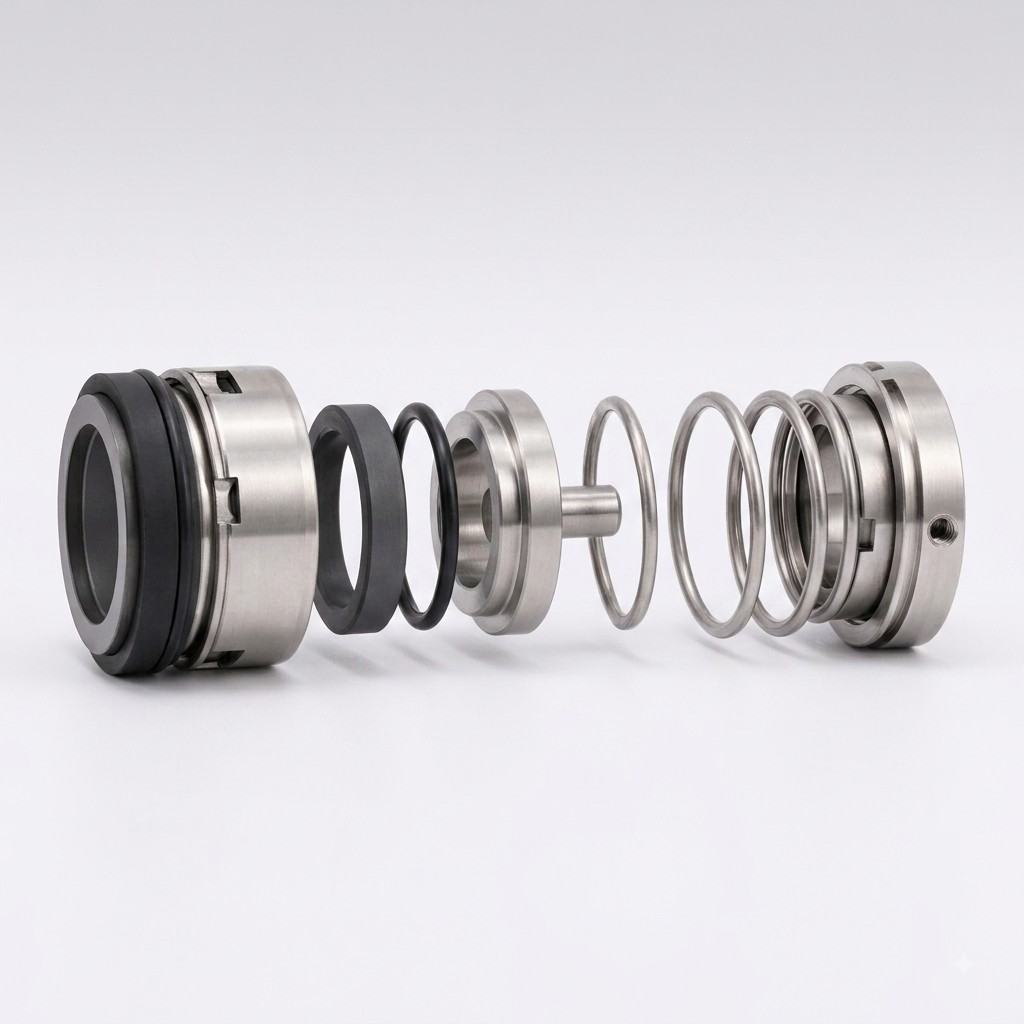
In industrial fluid handling, reliable sealing systems are essential for maintaining operational efficiency, safety, and continuous production. Pumping equipment across chemical processing, wastewater treatment, mining, and pulp processing frequently encounters challenging media—including thick sludges, viscous resins, abrasive slurries, and fluids with high suspended solid content. Standard mechanical seals often experience rapid failure in these hostile environments because fine spring mechanisms easily clog, bind, and lose initial tension.
Single-spring balanced mechanical seals offer an engineered solution specifically designed to withstand these harsh conditions. By featuring a single heavy-duty helical coil spring combined with a hydraulically balanced face design, these seals deliver consistent face pressure, resist particulate packing, and minimize thermal wear under variable operating conditions.
What Is a Single-Spring Balanced Mechanical Seal?
A single-spring balanced mechanical seal is a shaft-sealing device that uses a single, large-diameter coil spring positioned centrally around the pump shaft or sleeve. The primary function of the spring is to provide initial mechanical closing force on the seal faces, ensuring continuous contact even when the equipment is shut down or experiencing axial movement.
The term "balanced" refers to the specific geometry of the seal's internal components. By incorporating a stepped shaft, sleeve, or seal ring shoulder, the seal reduces the surface area exposed to fluid pressure inside the stuffing box. This hydraulic balancing lowers the net closing force acting on the rotating and stationary faces during operation.
Core Mechanical Components
-
Primary Seal Faces: Typically fabricated from hard-wearing materials such as silicon carbide, tungsten carbide, or carbon graphite to resist abrasive wear and chemical attack.
-
Single Heavy Coil Spring: Constructed with thick wire and generous space between coils, allowing solid particles and thick fluids to pass through without causing mechanical binding or spring freeze.
-
Secondary Elastomeric Seals: O-rings, V-rings, or elastomeric bellows made from Viton, EPDM, Nitrile, or Kalrez that prevent fluid bypass along the shaft and stationary housing.
-
Drive Mechanism: Set screws, drive pins, or keyways that transmit rotational torque from the shaft directly to the rotating seal ring, isolating the spring from torsional stress.
How the Single Heavy-Coil Design Prevents Clogging and Binding
The primary failure mode for multi-spring seals in viscous or slurry service is spring clogging. Small-diameter springs have narrow gaps that easily trap suspended fibers, crystallization products, and abrasive particulates. Once particulates pack inside a fine spring, it loses its elasticity and can no longer press the seal faces together uniformly, resulting in fluid leakage.
Single-spring designs eliminate this vulnerability through distinct structural advantages:
1. Large Open Gap Clearance
The single helical coil features substantial distance between each spiral turn. This wide-open clearance prevents solids, polymer strings, and viscous liquids from building up or drying out around the spring. Any particulate matter that enters the spring cavity is easily washed away by normal fluid turbulence.
2. Thick Wire Construction for Torsional Strength
Because a single spring must supply the full required mechanical load, it is manufactured from significantly thicker wire than small multi-spring units. This robust construction provides higher resistance to fatigue, stress corrosion cracking, and mechanical distortion caused by high-viscosity drag.
3. Self-Cleaning Action During Shaft Rotation
As the pump shaft rotates, the large single spring creates fluid agitation inside the stuffing box cavity. This churning action helps keep solid particles in suspension rather than allowing them to settle, drop out, and form abrasive cakes around the seal assembly.
The Critical Role of Hydraulic Pressure Balancing
In unbalanced mechanical seals, system fluid pressure acts directly over the full surface area of the seal faces. As operational pressure rises, the force pushing the faces together increases proportionally. In high-pressure applications, this excessive force squeezes out fluid lubrication, causing dry running, severe friction, rapid face wear, and high power consumption.
A balanced seal design mitigates these issues by altering the hydraulic loading area:
-
Lower Friction and Heat Generation: By balancing the hydraulic forces, the net pressure pushing the primary seal faces together is reduced. This allows a thin, stable fluid film to remain between the faces, minimizing friction and operational temperature.
-
Extended Service Life: Reduced face pressure prevents premature face scoring, chipping, and thermal cracking, extending overall mean time between maintenance intervals (MTBF).
-
Energy Savings: Lower frictional drag reduces shaft resistance, decreasing the electric motor energy required to drive high-pressure process pumps.
Operational Advantages in Heavy-Duty Industrial Environments
Deploying single-spring balanced mechanical seals in challenging pump services delivers measurable operational benefits:
Accommodating Shaft Deflection and Vibration
Industrial pumps operating under high heads or fluctuating flow rates often suffer from minor shaft deflection, axial end-play, and mechanical vibration. The large single spring offers a wide dynamic operating range, absorbing shaft movement without losing contact pressure across the seal faces.
Bi-Directional Rotation Capability
Standard single-spring seals are often manufactured with specific left-hand or right-hand coil directions that depend on shaft rotation. However, modern heavy-duty single-spring balanced seals utilize positive mechanical drive mechanisms—such as drive pins or set-screw collars—allowing the seal to operate reliably in both clockwise and counter-clockwise directions without uncoiling the spring.
Simplified Maintenance and Cleaning
Because a single-spring seal consists of fewer individual components than multi-spring or complex cartridge seals, inspection, manual cleaning, and field replacement are significantly easier. Maintenance technicians can quickly clean debris from the single coil without needing specialized ultrasonic bath equipment.
Primary Industrial Applications
Single-spring balanced mechanical seals are specified across many severe-service process industries:
-
Wastewater and Municipal Sewage: Pumping raw sewage, biological sludges, and industrial effluent containing suspended grit, sand, and fibrous debris.
-
Chemical and Petrochemical Processing: Handling polymer resins, latex mixtures, paints, tars, and crystallizing chemical solutions that bind delicate mechanisms.
-
Pulp and Paper Manufacturing: Sealing process pumps handling raw wood pulp slurries, black liquor, and fiber suspensions without spring clogging.
-
Mining and Mineral Processing: Operating inside slurry transfer pumps, tailing lines, and mineral extraction circuits laden with abrasive ore particles.
-
Food and Beverage Processing: Managing thick viscous media such as syrups, molasses, peanut butter, and starch slurries where food-grade heavy springs resist product buildup.
Selection Considerations for Optimal Seal Performance
To maximize the performance and lifespan of a single-spring balanced seal, engineers must carefully evaluate several process variables:
-
Fluid Viscosity and Solid Percentage: High-viscosity fluids require proper shaft clearance to ensure adequate fluid movement around the seal faces.
-
Material Compatibility: Ensure that primary face combinations (e.g., Silicon Carbide vs. Silicon Carbide for abrasives) and secondary elastomers match the chemical aggressiveness and temperature of the pumped fluid.
-
Stuffing Box Dimensions: Because single springs require larger radial and axial clearance around the shaft, verify that the pump seal chamber has sufficient internal room to house the assembly without rubbing.
To protect critical rotating equipment, prevent costly fluid leaks, and reduce unplanned maintenance downtime in heavy fluid applications, source certified single-spring balanced mechanical seal units manufactured to strict international API and DIN standards.