
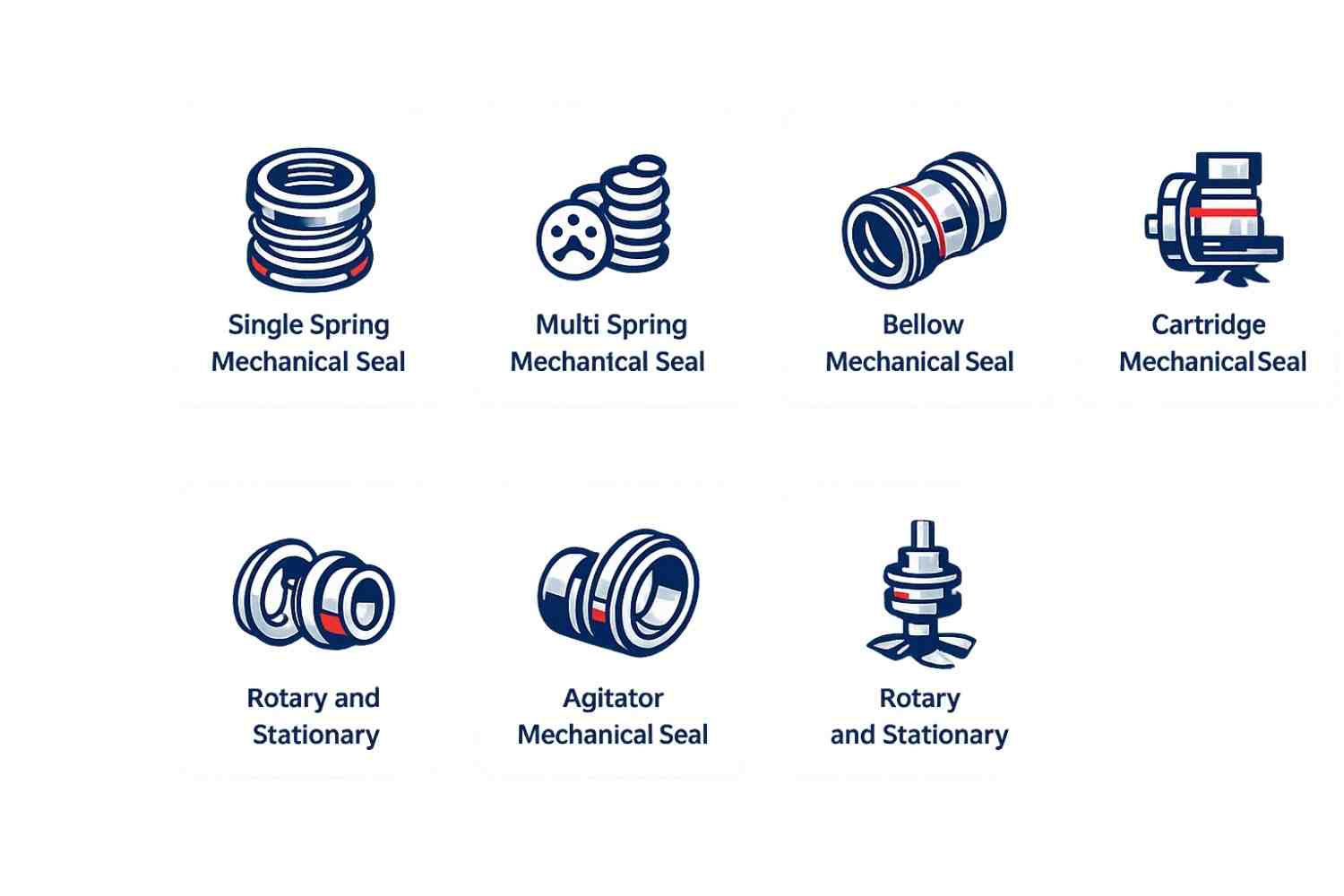
Mechanical seals are critical components in any rotating equipment that handles fluids. Choosing the right type for your application directly affects equipment reliability, maintenance intervals, and operating costs. This guide covers every major type of mechanical seal, their construction, working principle, and ideal use cases — to help plant engineers, procurement teams, and OEMs make the right selection.
What Is a Mechanical Seal?
A mechanical seal is a precision-engineered device installed where a rotating shaft passes through the stationary housing of a pump, compressor, reactor, agitator, or mixer. Its job is to prevent the process fluid from leaking along the shaft while allowing the shaft to rotate freely.
A mechanical seal consists of three primary components:
- Rotating seal face — attached to the shaft and rotates with it
- Stationary seal face — fixed in the housing
- Spring mechanism — maintains controlled contact pressure between the faces
A microscopic film of process fluid lubricates the gap between the faces, providing lubrication while maintaining a near-zero leakage barrier.
1. Single Spring Mechanical Seal
What It Is
A single spring mechanical seal uses one large coil spring to generate the closing force that keeps the two seal faces in contact.
Construction
The spring sits concentrically around the shaft, pushing the rotating face against the stationary face. Secondary sealing is achieved via O-rings or rubber components.
Key Features
- Simple, compact construction
- Easy to install and replace
- Cost-effective for general-purpose use
- Available in balanced and unbalanced configurations
Sub-types
- Single Spring Balanced Mechanical Seal — designed for higher pressure applications; balances hydraulic pressure to reduce face loading
- Single Spring Unbalanced Mechanical Seal — standard design for low-to-medium pressure
- Conical Spring Mechanical Seal — uses a conical spring instead of a standard coil, providing stable closing force across a wider range of shaft positions
- Wave Spring Mechanical Seal — uses a wave-form spring for a more compact axial profile in space-limited installations
Best For
Water pumps, light chemical transfer pumps, oil circulation systems, compressors, and industrial mixers running at moderate speeds and pressures.
2. Multi Spring Mechanical Seal
What It Is
A multi spring mechanical seal uses multiple small coil springs evenly distributed around the circumference of the seal, rather than a single large spring.
Construction
The springs are spaced at equal angular intervals around the shaft, distributing the closing force uniformly across the seal face.
Key Features
- Uniform face pressure distribution
- Better performance at high rotational speeds
- More resistant to vibration and shaft runout
- Excellent thermal stability under continuous operation
Sub-types
- Multi Spring Balanced Mechanical Seal — for high-pressure applications with hydraulic pressure compensation
- Multi Spring Unbalanced Mechanical Seal — standard design for moderate pressures
- Multi Spring Reverse Balanced Mechanical Seal — designed for applications where pressure acts from the atmospheric side
Best For
High-speed centrifugal pumps, chemical processing equipment, petrochemical applications, and any equipment running under continuous high-load conditions where face alignment is critical.
3. Bellow Mechanical Seal
What It Is
A bellow mechanical seal replaces the traditional spring and secondary O-ring with a flexible bellows element. The bellows acts simultaneously as the spring (providing closing force) and the secondary seal (preventing bypass leakage).
Construction
The bellows — a corrugated, accordion-like element — is welded or bonded to the rotating face and fixed to a drive collar. As the shaft rotates, the bellows flexes to maintain face contact while also sealing against the shaft.
Key Features
- Eliminates the O-ring, making it suitable for media that crystallises, polymerises, or corrodes elastomers
- Self-cleaning action — the rotating bellows sheds deposits
- Works effectively with viscous and abrasive fluids
Sub-types
- Rubber Bellow Mechanical Seal — most common; suitable for water, mild chemicals, and food-grade applications
- PTFE Bellow Mechanical Seal — excellent chemical resistance; used for aggressive acids, alkalis, and solvents
- Metal Bellow Mechanical Seal — high-temperature and high-pressure applications; no elastomers required
- Teflon Bellow Mechanical Seal — similar to PTFE; used in highly corrosive chemical environments
Best For
Pharmaceutical and food processing (hygienic requirements), chemical pumps handling corrosive or crystallising media, high-temperature applications where rubber would degrade.
4. Cartridge Mechanical Seal
What It Is
A cartridge mechanical seal is a self-contained, pre-assembled unit where all seal components are housed in a cartridge that mounts directly onto the equipment shaft.
Construction
Unlike component seals that are assembled piece-by-piece onto the shaft, a cartridge seal arrives as a complete unit with the rotating face, stationary face, spring, and gland plate already assembled and set at the correct working length.
Key Features
- No shaft measurement required during installation
- Dramatically reduces installation errors
- Eliminates the need for special fitting skills
- Faster maintenance and replacement
- Better suitability for hazardous media (less open handling)
Sub-types
- Cartridge Single Mechanical Seal — standard single-seal cartridge; suitable for non-toxic, non-hazardous fluids
- Cartridge Double Mechanical Seal — two seal faces with a barrier/buffer fluid between; used for toxic, hazardous, or high-value fluids
- Grundfos Cartridge Mechanical Seal — designed as a direct replacement for Grundfos pump seals
- Metal Bellow Cartridge Mechanical Seal — combines metal bellow construction with cartridge ease of installation
Best For
Applications where installation accuracy is critical, equipment with frequent maintenance cycles, handling of hazardous or toxic fluids (double cartridge), and OEM pump manufacturers.
5. Agitator Mechanical Seal
What It Is
Agitator mechanical seals are specifically engineered for agitators, mixers, and reactors, which operate under different mechanical conditions than standard pumps — typically higher shaft deflection, overhung loads, and variable speeds.
Construction
These seals are designed with wider, more robust faces and housings to accommodate shaft movement, radial and axial loads, and higher face pressure required by agitator applications.
Sub-types
- Agitator Single Mechanical Seal — for mixing applications with low to moderate pressure and non-hazardous media
- Agitator Double Mechanical Seal — double-face arrangement with barrier fluid; for hazardous, toxic, or contamination-sensitive processes
- Agitator Dry Running Mechanical Seal — designed to run without lubrication from the process fluid; used in gas-phase or near-dry applications
- Reactor Double Mechanical Seal — engineered for pressurised reactors with high temperature and pressure differentials
- Split Mechanical Seal — can be installed without disassembling the equipment; ideal for large, difficult-to-dismantle agitators
Best For
Chemical reactors, pharmaceutical mixing vessels, food & beverage blending tanks, petrochemical stirred reactors, and any rotating shaft mounted vertically or at an angle in a vessel.
6. Seal Face Materials
The seal face material determines chemical compatibility, wear resistance, and temperature capability. Common materials include:
| Material | Properties | Typical Use |
|---|---|---|
| Carbon / Graphite | Self-lubricating, low friction | General-purpose, water, oils |
| Silicon Carbide (SiC) | High hardness, excellent chemical resistance | Chemical, pharma, aggressive fluids |
| Tungsten Carbide (TC) | Shock and abrasion resistant | Abrasive slurries, high-load applications |
| Ceramic (Al?O?) | Economical hardness, good corrosion resistance | Water pumps, light-duty applications |
| PTFE | Chemical inertness | Highly corrosive media |
Most mechanical seals use a hard/soft face combination — e.g., silicon carbide vs. carbon — to reduce friction and extend seal life.
How to Choose the Right Mechanical Seal
When selecting a mechanical seal for your application, consider:
- Shaft diameter and speed — determines spring configuration and face geometry
- Operating pressure and temperature — determines balanced vs. unbalanced, material grade
- Fluid type — corrosive, abrasive, viscous, crystallising, or hazardous fluids each require specific designs
- Equipment type — pump, agitator, reactor, compressor each have different mechanical loads
- Installation constraints — limited space, vertical/horizontal mounting, access for maintenance
If you are unsure which seal suits your application, our technical team at Arohan Seals will help you select the right product based on your operating parameters.
Frequently Asked Questions
Q: Which mechanical seal type is best for a centrifugal pump?
For most centrifugal pumps, a single spring balanced or multi spring balanced mechanical seal is suitable. For high-speed pumps or pumps handling aggressive chemicals, a multi spring or bellow type is preferred.
Q: What is the advantage of a cartridge seal over a component seal?
Cartridge seals are pre-set to the correct working length and require no precision measurement during installation. This reduces fitting errors significantly, which is the primary cause of early seal failure.
Q: How long does a mechanical seal last?
A properly selected and installed mechanical seal should last 12–24 months under normal operating conditions. Improper installation, misalignment, dry running, or incorrect material selection are the main causes of early failure.
Q: Can mechanical seals handle abrasive fluids?
Yes. For abrasive slurries, tungsten carbide or silicon carbide seal faces are recommended. A double mechanical seal with a clean barrier fluid can further protect the seal faces from abrasive wear.
Arohan Seals manufactures all the seal types described in this guide. Contact us at info@arohanseals.com or call +91-89768-12664 to discuss your specific application.