
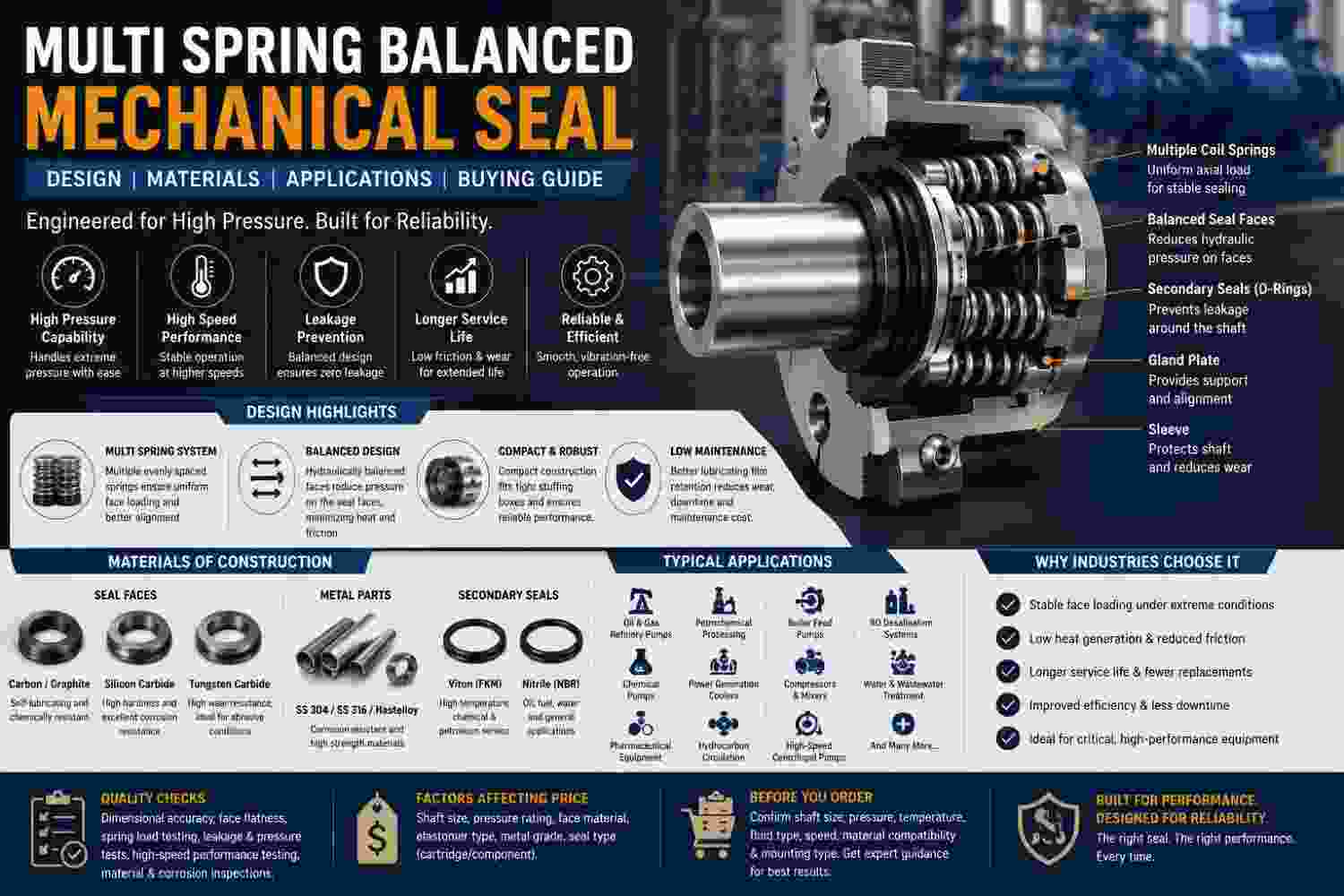
Choosing a shaft seal for high-pressure, high-speed equipment comes down to how the design handles heat, wear, and face loading over time. This guide breaks down the Multi Spring Balanced Mechanical Seal across design, materials, and applications so you can determine whether it's the right fit for your system.
Design
What Is a Multi Spring Balanced Mechanical Seal?
It's a rotating shaft seal built with a hydraulically balanced face design and multiple evenly spaced coil springs, used to stop leakage between a rotating shaft and a stationary housing in pumps, compressors, and process machinery. Unlike a standard unbalanced seal, the balanced geometry reduces the hydraulic pressure applied directly to the sealing faces, which keeps friction and heat generation lower even under demanding conditions.
How Does the Balanced Design Work?
Several small springs, spaced evenly around the shaft, apply stable axial loading so the sealing faces stay properly aligned during high-speed rotation. Because the balanced face geometry limits how much hydraulic pressure reaches the faces directly, the seal can operate reliably at higher pressures and speeds without breaking down from thermal stress.
What Are the Main Components?
A typical assembly includes multiple coil springs, a spring retainer, balanced seal faces, a gland plate, drive screws, a sleeve, and elastomeric secondary seals such as O-rings. Each component plays a specific role — the springs maintain axial load, the secondary seals prevent leakage around the shaft and gland, and the balanced faces run against each other on a thin lubricating film to maintain a stable seal.
What Configurations Are Available?
Common configurations include stationary spring, rotary spring, cartridge-mounted, and pusher-type balanced designs. The right configuration generally depends on shaft size, installation preferences, and how the equipment is expected to run — cartridge designs, for example, tend to simplify installation and alignment compared to component-style seals.
Advantages & Limitations
What Are the Key Advantages?
The design distributes pressure evenly across the seal faces, which supports stable performance under high-pressure and high-speed conditions. This translates into reduced friction, lower heat generation, longer seal life, and smoother, vibration-free operation. The compact construction also makes it suitable for tight stuffing boxes, and the improved lubricating film retention between faces generally means less maintenance and downtime over the seal's service life.
What Are the Limitations to Be Aware Of?
These seals typically cost more than standard unbalanced designs due to their added components and manufacturing complexity. They also require precise installation and alignment to perform as intended, and the multiple small springs can be prone to clogging in dirty or slurry applications. For heavily crystallized or fibrous media, a flushing system is usually recommended to keep the seal functioning properly.
Materials
What Materials Are Used for the Seal Faces?
Seal faces are commonly made from carbon/graphite, silicon carbide, or tungsten carbide. Resin-impregnated carbon offers self-lubrication and good chemical resistance for general-duty applications, while antimony-impregnated carbon handles higher speeds and mildly abrasive conditions better. Silicon carbide provides exceptional hardness and chemical compatibility for demanding services, and tungsten carbide is typically chosen where shock loads, vibration, or abrasive slurries could cause a more brittle material to chip or fracture.
What Materials Are Used for Hardware and Secondary Seals?
Metal components such as springs, glands, sleeves, and retainers are generally made from SS 304, SS 316, or Hastelloy for corrosion resistance and structural integrity. Secondary seals often use Viton (FKM) for high-temperature chemical and petroleum service, or nitrile rubber (NBR) for standard oil, fuel, and general water applications, depending on the temperature range and fluid compatibility required.
How Should Material Combinations Be Selected?
Material selection depends primarily on the process fluid, operating temperature, pressure, and shaft speed. A harder face pairing like tungsten carbide against tungsten carbide suits abrasive, high-shock conditions, while a softer carbon-against-ceramic pairing is often sufficient for cleaner, lower-speed services. Getting this pairing right has a direct impact on how long the seal lasts before it needs replacement.
Applications
Where Are These Seals Commonly Used?
Typical applications include oil and gas refinery pumps, petrochemical processing systems, high-pressure boiler feed pumps, reverse osmosis desalination systems, chemical transfer pumps, hydrocarbon circulation systems, pharmaceutical processing equipment, power generation coolers, industrial compressors and mixers, water and wastewater treatment plants, and high-speed centrifugal pumps.
Why Do Industries Choose This Seal Type for Critical Equipment?
Industries handling high-pressure fluids and high-speed rotating equipment generally prefer this design because of its stable face loading, reduced thermal stress, and extended operational reliability. The balanced geometry also helps equipment run more efficiently by cutting down on unplanned downtime and the frequency of seal replacement.
Quality & Buying Considerations
How Is Seal Quality Verified Before Use?
Quality checks typically include dimensional accuracy testing, seal face flatness inspection, spring load and compression testing, dynamic leakage testing, pressure resistance verification, high-speed rotational performance testing, material composition analysis, corrosion resistance inspection, and elastomer flexibility testing, followed by a final visual and assembly check.
What Factors Influence Price?
Price is generally driven by shaft size, seal type, pressure rating, seal face material, elastomer material, and metal component grade. Premium materials like silicon carbide, tungsten carbide, or Hastelloy tend to push the price higher but also extend service life and reliability in demanding conditions, so it's worth weighing upfront cost against expected operating life.
What Should I Check Before Ordering?
Confirm your shaft size, operating pressure and temperature range, fluid type, and rotational speed before selecting a material combination. It also helps to clarify whether a cartridge or component-style mounting suits your installation setup, and to request technical guidance if your application involves abrasive, corrosive, or high-temperature media.
Final Thoughts
A well-matched multi spring balanced mechanical seal comes down to selecting the right configuration, face material, and hardware combination for your specific operating conditions. Paying attention to pressure rating, fluid compatibility, and installation precision will help you get stable, leak-free performance and a longer service life out of your rotating equipment.
Reach out to a technical team with your shaft size, pressure, and fluid details for guidance on material selection and customized sealing solutions.