Choosing a seal for compact, low- to medium-pressure rotating equipment often comes down to how well it resists clogging and how easily it installs. This guide breaks down the Conical Spring Mechanical Seal across design, materials, and applications so you can determine whether it's the right fit for your system.
Design
What Is a Conical Spring Mechanical Seal?
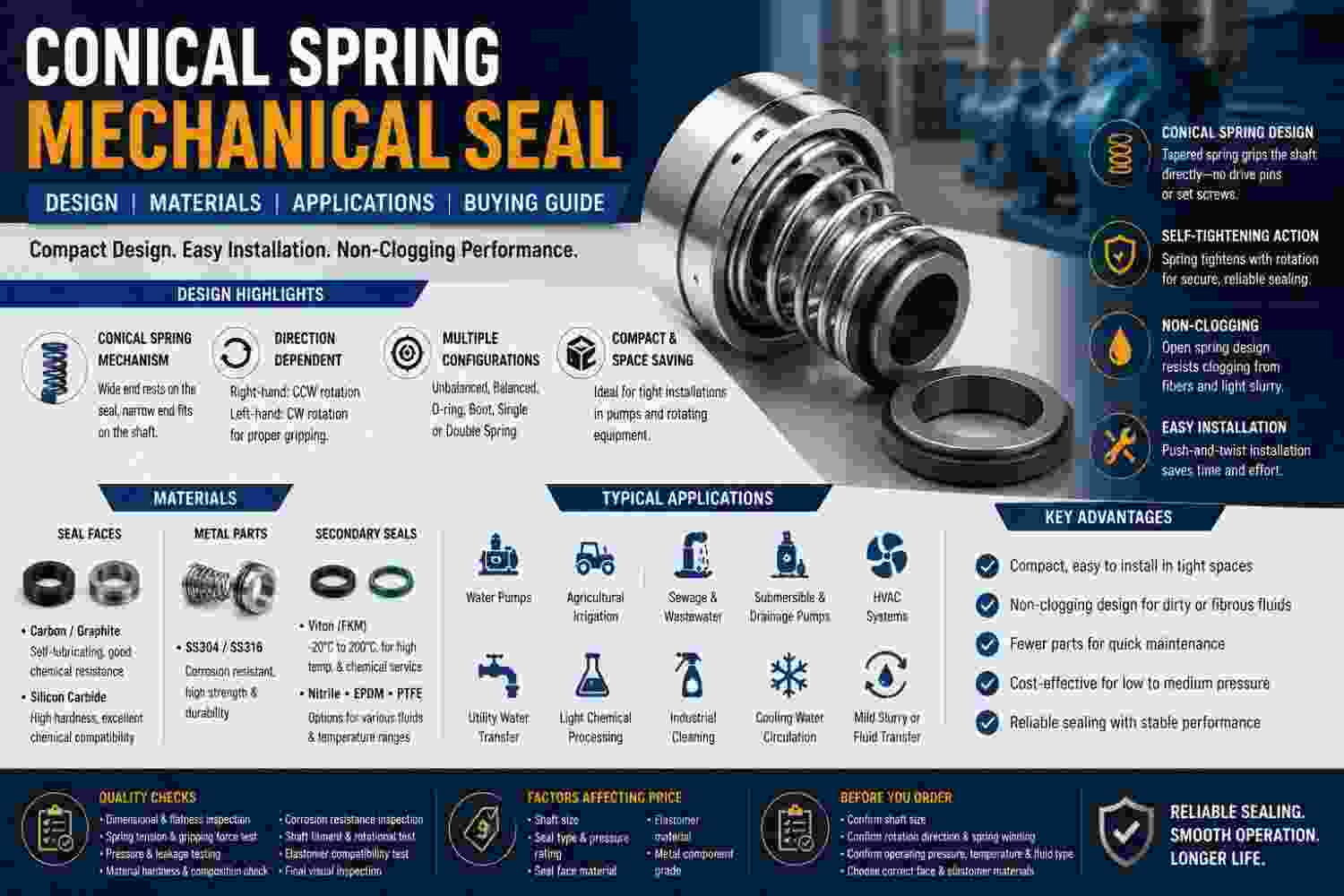
It's a single-spring seal that uses a tapered, cone-shaped coil to apply sealing pressure between the rotating and stationary faces. Unlike seals that rely on separate drive pins or set screws, the conical spring itself acts as the drive mechanism, gripping the shaft directly as it rotates.
How Does the Conical Spring Work?
The wide end of the spring rests against the seal assembly while the narrow end fits snugly around the shaft. As the shaft turns, friction between the coils and the shaft tightens the spring radially, locking it in place and transferring rotational tension to the moving seal face. This self-tightening action is what allows the design to skip additional drive hardware.
Why Does Rotation Direction Matter?
The winding direction of the spring determines which way the shaft must turn for the seal to grip properly. A right-hand wound spring is built for counter-clockwise rotation, while a left-hand wound spring suits clockwise rotation. Installing the wrong winding direction for your shaft's rotation will cause the spring to loosen instead of tighten, so confirming this detail before ordering is essential.
What Configurations Are Available?
Common types include unbalanced conical spring seals for economical, low-pressure use, balanced versions for reduced face loading and improved sealing efficiency, O-ring mounted seals for flexible shaft sealing, elastomer boot seals for added shaft protection, and single or double conical spring arrangements depending on how much leakage control the application demands.
Advantages & Limitations
What Are the Main Advantages?
The design is compact and space-saving, which makes it easy to install in tight assemblies using a simple push-and-twist process. Its open, single-spring structure resists clogging from fibers or light slurry far better than seals with multiple small springs, and fewer overall parts make maintenance and replacement quicker. These qualities make it a practical, cost-effective choice for utility and general-service applications.
What Are the Limitations to Consider?
Performance is strictly direction-dependent, so incorrect shaft rotation relative to the spring's winding will cause the seal to fail. The design also has pressure and speed limitations compared to multi-spring balanced seals, making it less suited to high-speed or high-pressure systems. Under aggressive chemical conditions, performance can decline as well, so material compatibility should be confirmed before use.
Materials
What Materials Are Used for the Seal Faces?
Faces are commonly made from carbon/graphite or silicon carbide. Resin-impregnated carbon offers self-lubrication and solid chemical resistance for general-duty water pump applications, while antimony-impregnated carbon adds hardness for higher speeds and mildly abrasive conditions. Silicon carbide is generally reserved for more demanding services where exceptional hardness and chemical compatibility are required.
What Materials Are Used for Hardware and Secondary Seals?
Metal hardware such as springs, glands, sleeves, and retainers is typically made from SS304 or SS316 for corrosion resistance and structural durability. Secondary seals often use Viton (FKM) for high-temperature chemical and petroleum service, ranging roughly from -20°C to 200°C, while other elastomer options like nitrile, EPDM, and PTFE cover different fluid and temperature requirements.
How Should I Select the Right Material Combination?
Material selection comes down to the process fluid, temperature, pressure, and shaft speed involved. A straightforward carbon-against-ceramic pairing is usually enough for clean water or general utility service, while silicon carbide combinations are better suited to mildly abrasive or chemically aggressive fluids where longer service life justifies the added cost.
Applications
Where Is This Seal Type Commonly Used?
Typical applications include domestic and commercial water pumps, agricultural irrigation systems, sewage and wastewater transfer pumps, submersible and drainage pumps, HVAC circulation systems, utility water transfer equipment, light chemical processing systems, industrial cleaning and washing systems, cooling water circulation pumps, and transfer of mild slurry or fluids.
Why Do Industries Prefer This Design for These Uses?
The compact size and non-clogging structure make it well suited to systems with limited installation space and fluids that carry light debris or fibers. Its simplified installation and lower part count also reduce maintenance time, which matters in utility and municipal settings where equipment needs to stay operational with minimal downtime.
Quality & Buying Considerations
How Is Seal Quality Verified Before Use?
Quality checks generally include dimensional accuracy testing, seal face flatness verification, spring tension and gripping force inspection, pressure and leakage testing, material hardness and composition verification, corrosion resistance inspection, shaft fitment and rotational testing, and elastomer compatibility testing, followed by a final visual inspection.
What Factors Influence Price?
Price is generally shaped by shaft size, seal type, pressure rating, face material, and elastomer selection. Premium combinations such as silicon carbide faces or Viton elastomers tend to cost more but offer better wear resistance and chemical compatibility, so it's worth weighing the fluid conditions against the expected service life before choosing a lower-cost option.
What Should I Check Before Ordering?
Confirm shaft size, rotation direction, and the corresponding spring winding before placing an order, since a mismatch here will cause the seal to fail regardless of material quality. It also helps to clarify the operating pressure, temperature range, and fluid type so the face and elastomer materials can be matched correctly to your application.
Final Thoughts
A well-matched conical spring mechanical seal comes down to getting the rotation direction, spring winding, and material pairing right for your specific system. Paying attention to shaft compatibility, fluid conditions, and installation details will help you get reliable, non-clogging sealing performance in compact, low- to medium-pressure equipment.
Reach out to a technical team with your shaft size, rotation direction, and fluid details for guidance on material selection and customized sealing solutions.