
Choosing the right mechanical seal is essential for controlling fluid leakage, reducing pump maintenance, and improving reliability in industrial rotating equipment. Two commonly used options are cartridge mechanical seals and conventional component mechanical seals.
Both designs perform the same basic sealing function, but they differ in construction, installation procedures, maintenance requirements, initial cost, and suitability for different pump configurations.
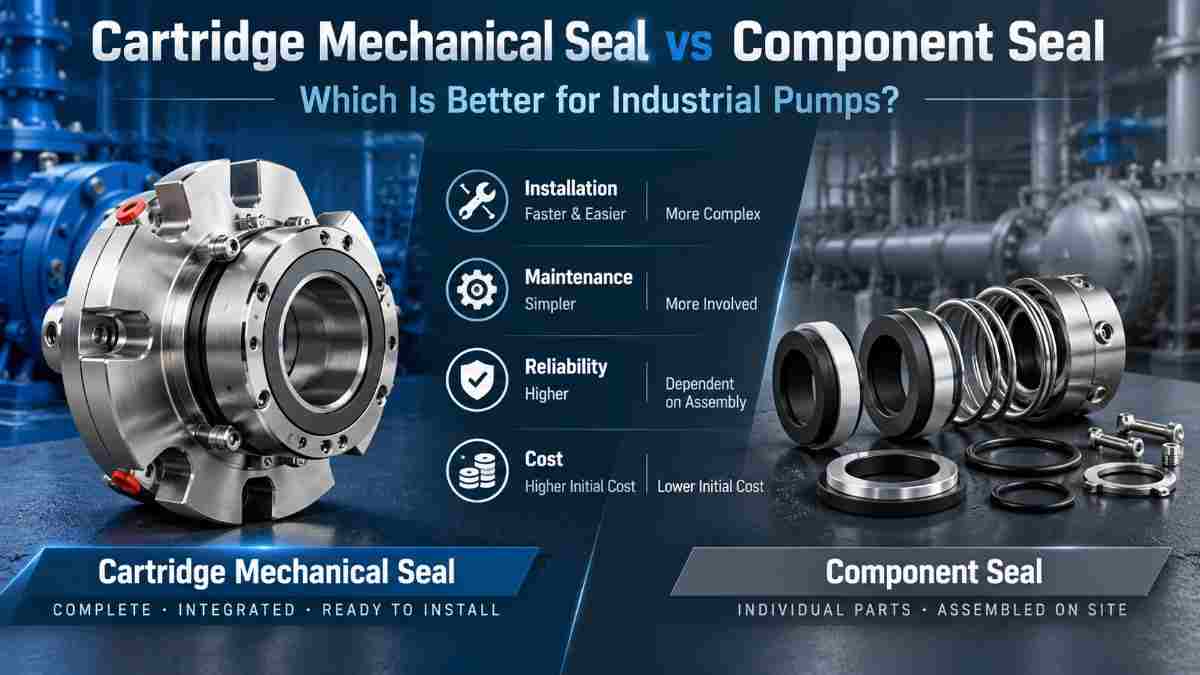
The main difference between a cartridge mechanical seal and a component seal is that a cartridge seal comes as a preassembled, factory-preset unit, while a component mechanical seal requires individual sealing parts to be installed and positioned in the equipment.
Cartridge seals are often preferred where faster installation, repeatable assembly, and reduced maintenance downtime are priorities. Component seals may be more economical for standard applications, compact equipment, and installations where experienced technicians can perform the required adjustments.
However, neither design is automatically better for every industrial pump.
This guide compares cartridge seal vs component seal construction, installation, maintenance, reliability, costs, and applications to help engineers and procurement teams make an informed selection.
What Is a Cartridge Mechanical Seal?
A cartridge mechanical seal is a preassembled sealing unit designed to fit onto a rotating shaft or shaft sleeve and into the seal chamber of industrial equipment.
Unlike a traditional component seal, the main sealing parts are assembled and preset before delivery.
A typical cartridge assembly may include:
- Rotating seal face
- Stationary seal face
- Shaft sleeve
- Gland plate
- Springs or other loading mechanisms
- Secondary sealing elements
- Drive and retaining components
- Setting clips or installation devices
The preset design helps reduce the need for technicians to manually establish critical seal working dimensions during installation.
Cartridge mechanical seals are used in centrifugal pumps, chemical processing equipment, water treatment systems, mixers, and other rotating machinery.
Arohan Seals supplies Cartridge Mechanical Seals in single, double, tandem, and other configurations for different industrial applications.
What Is a Component Mechanical Seal?
A component mechanical seal, also called a conventional or non-cartridge mechanical seal, consists of separate sealing elements installed directly onto the equipment shaft or shaft sleeve.
The rotating and stationary assemblies are positioned during installation rather than supplied as one fully preset cartridge.
Depending on the design, component seals may contain:
- Rotating seal ring
- Stationary mating ring
- Spring or spring assembly
- O-rings or other secondary sealing elements
- Drive components
- Retainers
- Associated gland or mounting components
Component seals are available in several configurations, including single-spring, multi-spring, balanced, unbalanced, and bellows designs.
Because the components are installed separately, technicians must carefully follow the manufacturer's dimensional and assembly instructions.
Buyers evaluating conventional designs can explore Arohan Seals' Single Spring Mechanical Seals for general industrial sealing requirements.
What Is the Difference Between Cartridge and Component Mechanical Seals?
The main differences involve how the seals are assembled, installed, inspected, and maintained.
| Feature | Cartridge Mechanical Seal | Component Mechanical Seal |
|---|---|---|
| Construction | Preassembled sealing unit | Individual sealing components |
| Installation | Generally installed as one assembly | Parts installed and positioned separately |
| Seal Setting | Usually factory preset | Requires field setting according to design |
| Installation Complexity | Generally lower | Generally higher |
| Installation Time | Often shorter | May require more assembly time |
| Initial Purchase Cost | Generally higher | Generally lower |
| Equipment Space | May require additional axial or radial clearance | May suit more compact installations |
| Maintenance | Convenient assembly replacement | Individual component replacement may be possible |
| Customization | Application-specific cartridge designs available | Flexible component configurations |
| Reliability | Reduced risk of certain installation errors | More dependent on correct field assembly |
| Typical Application | Maintenance-intensive or process-critical pumps | Standard and cost-sensitive equipment |
These are general comparisons. Actual performance depends on the complete seal design, materials, installation quality, operating conditions, and supporting equipment.
How Does a Cartridge Mechanical Seal Work?
Cartridge mechanical seals operate through the same basic face-sealing principle used in conventional mechanical seals.
A rotating face turns with the shaft while a stationary face remains fixed relative to the housing.
The faces are held together through a controlled combination of spring force and hydraulic loading.
Under suitable liquid-lubricated operating conditions, a thin fluid film forms between the sealing faces.
This film helps control frictional heat and limits leakage.
The main advantage of cartridge construction is not a completely different sealing principle, but the integration of the components into a preset assembly.
Why Are Cartridge Seals Factory Preset?
Factory presetting helps establish the intended axial position and working length of the sealing components.
In conventional component seals, some of these dimensions must be established during field installation.
Incorrect setting can cause excessive or insufficient face loading, potentially affecting leakage and service life.
Preset cartridge assemblies reduce the amount of manual adjustment required during installation.
Do Cartridge Seals Eliminate Installation Errors?
No. Cartridge seals can reduce certain installation errors, but correct installation remains essential.
Possible mistakes include:
- Incorrect shaft or sleeve dimensions
- Damaged secondary seals
- Uneven gland tightening
- Incorrect installation sequence
- Failure to release setting devices
- Improper connection of seal-support systems
- Installation on damaged equipment
Always follow the specific manufacturer's installation instructions.
How Does a Component Mechanical Seal Work?
A component mechanical seal also uses rotating and stationary faces to control leakage around a rotating shaft.
However, its separate parts are assembled and positioned during installation.
The installer must verify the required working length, spring compression, shaft condition, and mating-face positioning.
These requirements vary depending on whether the seal is a single-spring, multi-spring, balanced, unbalanced, or bellows design.
Why Is Correct Spring Compression Important?
Spring compression contributes to the closing force applied to the seal faces.
Incorrect compression may cause excessive face loading or insufficient contact force.
Excessive loading can increase friction and heat generation, while insufficient loading may contribute to unstable sealing.
For this reason, installers should follow the specified setting dimensions rather than estimating them visually.
Can a Component Seal Be Installed Without Special Tools?
Some component seals can be installed using standard maintenance tools and suitable measuring instruments.
However, the required procedure depends on the seal design and equipment.
Special tools, installation sleeves, dimensional gauges, or fixtures may be needed.
Technicians should never assume that all component mechanical seals follow the same installation procedure.
Which Seal Is Easier to Install: Cartridge or Component?
Cartridge mechanical seals are generally easier and quicker to install because the main assembly and operating dimensions are preset.
The technician installs the complete unit onto the equipment and follows the manufacturer's mounting and commissioning instructions.
Component seals require additional handling, positioning, and measurement of individual parts.
However, installation difficulty also depends on pump accessibility, equipment condition, seal size, and the technician's experience.
What Are the Basic Steps for Installing a Cartridge Seal?
A typical cartridge installation may involve:
- Safely isolate, depressurize, drain, and prepare the equipment.
- Inspect the shaft, sleeve, seal chamber, and mounting surfaces.
- Confirm the cartridge model and dimensions.
- Position the cartridge according to the manufacturer's instructions.
- Mount and tighten the gland using the specified procedure.
- Secure the sleeve or drive arrangement as instructed.
- Release or remove setting clips at the designated installation stage.
- Connect any required flush, buffer, or barrier systems.
- Complete appropriate pre-start checks.
- Commission the equipment following the approved procedure.
The sequence can vary by manufacturer and seal design. The instructions supplied with the seal take priority over this general overview.
What Are the Basic Steps for Installing a Component Seal?
Component seal installation commonly requires:
- Safely isolate and prepare the pump.
- Inspect the shaft, sleeve, and seal chamber.
- Identify and verify individual seal components.
- Install the stationary mating face.
- Position the rotating assembly according to the design.
- Set the required axial dimensions or compression.
- Secure drive components and associated hardware.
- Assemble the gland and other required parts.
- Verify alignment, sealing surfaces, and connections.
- Complete the manufacturer's commissioning procedure.
Additional steps may be necessary depending on the component seal configuration.
Can Cartridge Mechanical Seals Reduce Pump Maintenance Downtime?
Cartridge seals can reduce certain maintenance activities because they are supplied as preassembled units.
Maintenance personnel may spend less time individually positioning seal components and setting compression dimensions.
This can be particularly useful in facilities with frequent pump maintenance or limited shutdown windows.
However, the actual downtime reduction depends on equipment accessibility, pump condition, maintenance procedures, and the availability of replacement parts.
Why Is Faster Seal Replacement Important in Industrial Plants?
Pump downtime can interrupt operations in facilities that depend on continuous fluid transfer.
Examples include:
- Chemical processing plants
- Water treatment facilities
- Manufacturing operations
- Food-processing facilities
- Power generation plants
- Oil and gas installations
Shorter maintenance windows may reduce operational disruption when other necessary repairs and inspections can also be completed efficiently.
Does a Cartridge Seal Always Last Longer Than a Component Seal?
No. Cartridge construction does not automatically guarantee longer service life.
Service life depends on:
- Seal design
- Face materials
- Secondary sealing materials
- Process fluid
- Pressure
- Temperature
- Shaft movement
- Lubrication
- Installation quality
- Seal-support arrangements
A correctly installed component seal can provide reliable performance when its design matches the application.
Likewise, an unsuitable cartridge seal can fail prematurely.
Which Mechanical Seal Is More Reliable for Industrial Pumps?
Cartridge seals can improve installation consistency because they reduce the number of components requiring adjustment during field assembly.
This can be helpful where installation errors are a common source of premature failure.
However, reliability depends on the complete sealing system rather than assembly style alone.
Can Incorrect Installation Cause Mechanical Seal Leakage?
Yes. Improper working length, face contamination, damaged O-rings, and incorrectly positioned components can all cause leakage.
Cartridge seals help reduce certain assembly-related risks, while component seals depend more heavily on accurate field positioning.
Neither design can compensate for severe pump vibration, shaft runout, dry running, or incompatible materials.
Why Do Mechanical Seals Fail Even When Installed Correctly?
Mechanical seal failures can also result from operating conditions such as:
- Dry running
- Excessive process temperature
- Pressure fluctuations
- Contaminated fluids
- Inadequate flushing
- Shaft misalignment
- Excessive vibration
- Chemical incompatibility
Investigating these conditions is essential when seal leakage occurs repeatedly.
Which Is Better for High-Pressure Pumps: Cartridge or Component Seals?
Both cartridge and component mechanical seals can be designed for pressure-containing applications.
The maximum operating pressure depends on the specific seal configuration, hydraulic balance, face materials, shaft diameter, and applicable manufacturer's rating.
A cartridge seal is not automatically more pressure-resistant simply because it is preassembled.
Similarly, a component seal is not automatically restricted to low-pressure service.
For demanding pressure applications, engineers should consider balanced seal designs, appropriate materials, and qualified support arrangements.
Arohan Seals supplies Multi Spring Mechanical Seals in several configurations that may be evaluated against specific equipment requirements.
Which Seal Is Better for High-Temperature Applications?
Temperature suitability depends on the complete mechanical seal design rather than whether it is supplied as a cartridge or component assembly.
Important temperature-related factors include:
- Seal face material
- Elastomer compatibility
- Metal component limits
- Process fluid lubrication
- Flush and cooling arrangements
- Thermal expansion
- Pressure-temperature ratings
Some cartridge designs integrate support connections that can simplify the installation of specialized sealing arrangements.
However, this does not eliminate the need to control actual operating conditions.
Are Cartridge Mechanical Seals Better for Hazardous Chemicals?
Cartridge seals can be advantageous in certain hazardous-fluid services because preassembled single or dual configurations simplify installation and maintenance.
However, cartridge construction alone does not determine whether a seal provides adequate containment.
For hazardous or environmentally sensitive fluids, engineers may need to evaluate:
- Single or dual seal arrangements
- Unpressurized or pressurized support systems
- Compatible face and elastomer materials
- Required leakage-control performance
- Applicable environmental and plant requirements
- Instrumentation and monitoring
API 682 may be relevant to specified pump seal applications in the petroleum, petrochemical, and natural gas industries.
Final selection should follow the project's engineering and safety requirements.
What Is the Difference Between Single and Double Cartridge Mechanical Seals?
Cartridge mechanical seals can be manufactured in single and dual configurations.
A single cartridge seal generally contains one primary mechanical sealing interface.
A double or dual cartridge seal uses two sealing interfaces and may require a buffer or barrier fluid system, depending on the arrangement.
| Feature | Single Cartridge Seal | Double Cartridge Seal |
|---|---|---|
| Primary Sealing Interfaces | One | Two |
| Construction | Generally simpler | More complex |
| Support System | Application-dependent | May require dedicated buffer or barrier system |
| Containment Requirements | Suitable for selected services | Can support more demanding containment requirements |
| Initial Cost | Generally lower | Generally higher |
Dual seals are not universally necessary, and their performance depends on the complete arrangement and support system.
Can You Replace a Component Seal with a Cartridge Mechanical Seal?
In some industrial pumps, a component seal can be replaced with a suitable cartridge design.
However, this should be treated as an engineering retrofit rather than a direct universal substitution.
Before conversion, verify:
- Shaft diameter
- Available axial space
- Seal chamber dimensions
- Gland bolt pattern
- Stuffing box geometry
- Shaft sleeve compatibility
- Equipment clearances
- Operating pressure and temperature
- Fluid chemistry
- Required support connections
Some compact or older pump designs may not have sufficient space for a standard cartridge assembly.
Does a Cartridge Seal Require More Installation Space?
Some cartridge mechanical seals require additional axial or radial clearance because the assembly includes a sleeve, gland plate, and other integrated components.
However, compact cartridge designs are also available.
Compatibility must be checked using actual equipment drawings and dimensions.
Can a Cartridge Seal Be Customized for an Existing Pump?
Depending on manufacturing capabilities, cartridge seals may be designed or adapted for particular shaft sizes, seal chambers, and operating conditions.
Custom-engineered solutions still require dimensional verification and technical approval.
Arohan Seals lists Cartridge Single, Double, Tandem, and other mechanical seal configurations for different industrial requirements.
Which Is More Cost-Effective: Cartridge or Component Mechanical Seal?
Component mechanical seals often have a lower initial purchase cost because they may require fewer integrated parts than cartridge assemblies.
Cartridge seals generally cost more initially because they include additional manufactured components and factory assembly.
However, the total cost of a mechanical seal includes much more than its purchase price.
Important factors include:
- Initial seal cost
- Installation labor
- Maintenance frequency
- Replacement time
- Repair costs
- Production downtime
- Inventory requirements
- Operating reliability
The more economical choice depends on the equipment and its operating requirements.
How Do You Calculate the Lifecycle Cost of Mechanical Seals?
Lifecycle cost evaluates all expected expenses during a defined service period.
A simplified formula is:
Lifecycle Cost = Initial Seal Cost + Installation Cost + Maintenance Cost + Replacement Cost + Downtime Cost
Consider a hypothetical comparison for one industrial pump over a defined service period.
| Cost Component | Component Seal | Cartridge Seal |
|---|---|---|
| Initial Seal Purchase | ?8,000 | ?20,000 |
| Installation Labor | ?4,000 | ?2,000 |
| Maintenance and Replacement | ?18,000 | ?10,000 |
| Production Downtime | ?30,000 | ?12,000 |
| Illustrative Total | ?60,000 | ?44,000 |
These figures are hypothetical examples intended to explain lifecycle cost calculations. They are not Arohan Seals quotations, verified market prices, or guaranteed maintenance savings.
Actual comparisons should use site-specific labor rates, replacement history, pump operating conditions, and supplier pricing.
Which Mechanical Seal Is Better for Different Industrial Applications?
The best option depends on the equipment design, operating conditions, maintenance requirements, and available budget.
| Application | Seal Worth Evaluating | Main Consideration |
|---|---|---|
| General Water Pumps | Component or cartridge seal | Cost, fit, maintenance requirements |
| Chemical Processing Pumps | Application-specific cartridge or component arrangement | Chemical compatibility and containment |
| Continuous Production Equipment | Cartridge seal | Installation consistency and maintenance time |
| Compact Pump Designs | Compatible component seal or compact cartridge | Available installation space |
| High-Pressure Pumps | Appropriately rated balanced arrangement | Pressure capability and face loading |
| Hazardous Fluid Applications | Engineered seal and support system | Containment and safety requirements |
| OEM Equipment | Design-specific component or cartridge seal | Equipment integration and specifications |
The table is intended for initial screening only. Final seal selection must follow the equipment manufacturer's and process engineering requirements.
What Materials Are Used in Cartridge and Component Mechanical Seals?
Both designs use similar categories of sealing materials.
Common face materials include:
- Carbon graphite
- Silicon carbide
- Tungsten carbide
- Ceramic materials
Secondary sealing materials may include:
- NBR
- EPDM
- FKM
- PTFE-based components
Metallic components may use stainless steels or specialized alloys depending on the environment.
The correct material selection depends on process fluid compatibility, temperature, pressure, mechanical loading, and operating conditions.
A hard seal-face material does not automatically make a seal suitable for dry running or every abrasive fluid.
What Are the Most Common Cartridge and Component Seal Installation Mistakes?
Installation errors can affect both seal types, although the risks differ.
| Installation Issue | Cartridge Seal | Component Seal |
|---|---|---|
| Incorrect working length | Less likely if preset correctly and installed as instructed | Requires careful manual setting |
| Damaged O-rings | Possible | Possible |
| Contaminated seal faces | Possible during handling or installation | Possible during individual assembly |
| Incorrect gland tightening | Possible | Possible |
| Forgotten setting clips | Specific risk for designs using installation clips | Usually not applicable |
| Incorrect spring compression | Normally preset | Potential field-setting error |
| Improper flush connections | Possible | Possible where support systems are used |
Installation should be performed by trained personnel following the manufacturer's instructions and the facility's safety procedures.
What Should You Check Before Ordering a Cartridge or Component Mechanical Seal?
Procurement teams should share accurate technical information rather than selecting a seal only by shaft diameter or appearance.
Which Equipment Details Are Required?
Provide:
- Pump manufacturer and model
- Shaft diameter
- Seal chamber dimensions
- Gland mounting details
- Rotational speed
- Direction of rotation, where relevant
- Available installation space
Which Process Conditions Should Be Specified?
Important operating conditions include:
- Process fluid name and composition
- Operating pressure
- Maximum pressure
- Operating temperature
- Maximum temperature
- Solids concentration
- Viscosity
- Required containment arrangement
- Flush or barrier system availability
Which Maintenance Requirements Matter?
Consider:
- Frequency of seal replacement
- Available maintenance personnel
- Permitted shutdown time
- Repair facilities
- Spare-part availability
- Previous failure history
These details help manufacturers recommend compatible sealing arrangements.
What Are the Common Mistakes When Choosing Between Cartridge and Component Seals?
Common selection mistakes include:
- Choosing only by price: Ignoring installation, downtime, and maintenance costs.
- Assuming cartridge seals never leak: Proper operation and fluid-film conditions still matter.
- Ignoring dimensional compatibility: A cartridge may not fit every existing seal chamber.
- Assuming component seals are unreliable: Correctly selected and installed component seals can perform effectively.
- Ignoring operating limits: Pressure and temperature ratings are design-specific.
- Using incompatible materials: Face and elastomer compatibility must be verified.
- Skipping shaft inspection: Runout, vibration, and damaged sleeves can cause repeated failures.
- Improper support-system connections: Incorrect flush or barrier arrangements can damage seals.
- Replacing the seal without diagnosing failures: Root causes may remain unresolved.
Frequently Asked Questions About Cartridge vs Component Mechanical Seals
What Is the Main Difference Between a Cartridge Seal and a Component Seal?
A cartridge mechanical seal comes as a preassembled, factory-preset unit, while a component seal is assembled and positioned using separate sealing components during installation.
Are Cartridge Mechanical Seals Better Than Component Seals?
Cartridge seals can simplify installation and reduce certain field-setting errors. Component seals may provide a practical lower-cost option for suitable equipment. The better choice depends on the application.
Why Are Cartridge Seals More Expensive?
Cartridge seals typically include additional components such as a shaft sleeve, gland plate, setting devices, and factory assembly. Their higher initial cost may be offset by maintenance advantages in suitable applications.
Can Cartridge Seals Reduce Maintenance Time?
Yes. Preassembled cartridge designs can reduce some installation activities, although actual maintenance time depends on equipment accessibility and condition.
Do Cartridge Seals Last Longer?
Not automatically. Service life depends on seal design, materials, operating conditions, equipment condition, and installation quality.
Are Component Mechanical Seals Suitable for High-Pressure Pumps?
Some component seal designs are suitable for high-pressure applications. The correct pressure rating depends on the specific seal configuration and manufacturer's technical specifications.
Can I Replace a Component Seal with a Cartridge Seal?
Sometimes. The conversion requires dimensional compatibility, suitable operating ratings, installation space, and engineering approval.
Do Cartridge Mechanical Seals Require Alignment?
Factory presetting reduces certain seal-setting adjustments, but the equipment still requires proper shaft, bearing, and coupling alignment within applicable tolerances.
What Is a Double Cartridge Mechanical Seal?
A double cartridge seal contains two sealing interfaces in an integrated assembly and may use a buffer or barrier fluid system depending on the arrangement.
Is a Cartridge Seal Suitable for Chemical Pumps?
Cartridge seals can be suitable for chemical pumps when their materials, arrangement, operating limits, and support systems are compatible with the process fluid.
Can a Component Mechanical Seal Be Repaired?
Some component seals can be repaired or reconditioned, depending on design and component condition. Critical dimensions and materials must meet the manufacturer's requirements.
Which Mechanical Seal Is Best for Industrial Pumps?
The correct choice depends on fluid chemistry, operating pressure, temperature, shaft speed, installation space, maintenance requirements, and total cost of ownership.
How Do You Choose the Right Mechanical Seal for Your Pump?
Cartridge and component mechanical seals both provide effective leakage control when properly selected, installed, and maintained.
Cartridge seals offer the convenience of factory presetting and integrated construction, making them worth considering for maintenance-intensive equipment and applications where installation consistency is important.
Component seals may be appropriate for standard industrial pumps, compact equipment, and cost-sensitive installations where the correct assembly procedures can be followed.
Neither design can compensate for poor equipment condition, unsuitable materials, dry running, or incorrect operating conditions.
Arohan Seals manufactures different mechanical seal configurations for industrial rotating equipment, including cartridge, single-spring, and multi-spring designs.
To compare available options, explore Arohan Seals' Cartridge Mechanical Seals and Single Spring Mechanical Seals, and share the required operating conditions and equipment specifications when requesting a suitable sealing solution.